Story code: ST-000387
Part 2: The Rigid Bulk
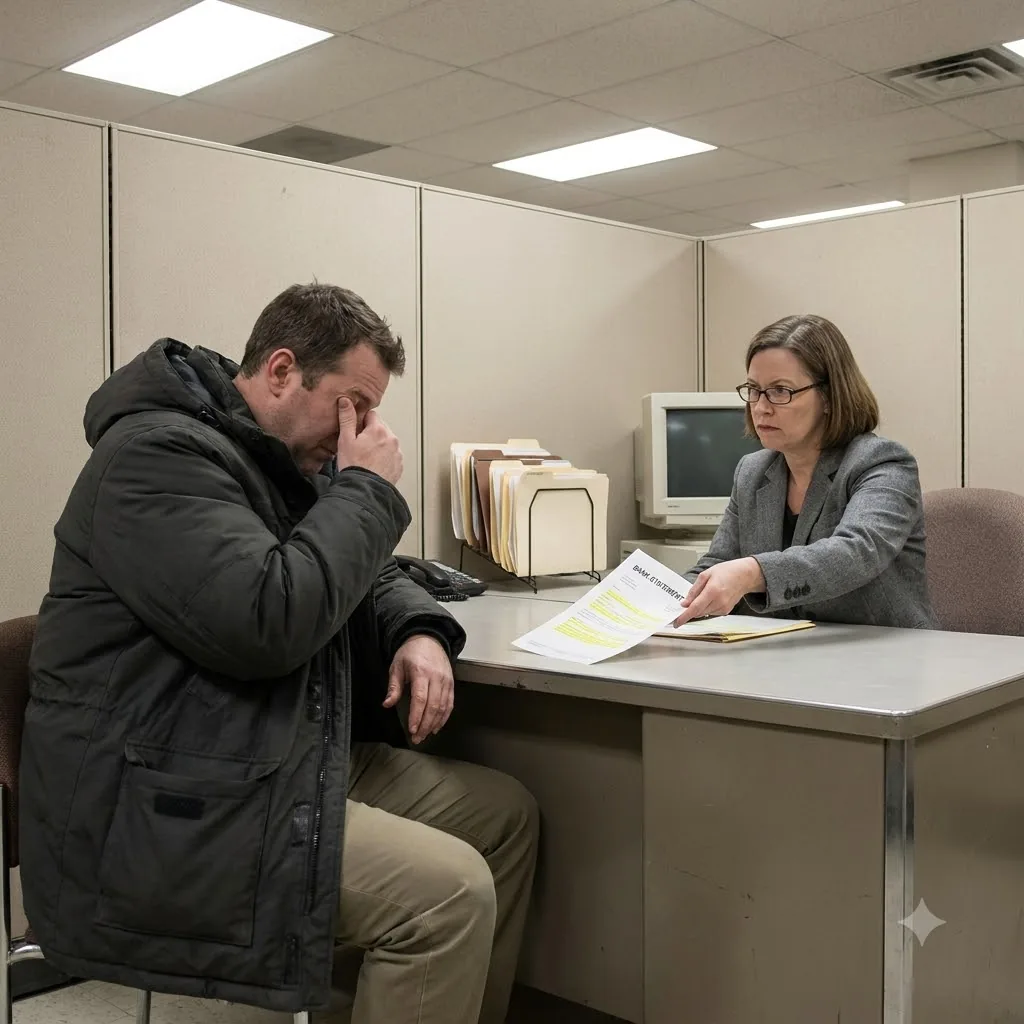
“What exactly are you hiding in that coat, Elias?” Gless’s voice sliced through the mechanical, low-frequency hum of the annex. The auditor did not blink. His narrow eyes remained anchored to the heavy, dark blue fleece of Elias’s parka, tracking the erratic vibrations shaking the fabric.
Elias’s throat tightened, feeling as though he had swallowed a handful of dry sand. He pushed his elbow harder against his ribs, desperately trying to suppress the violent tremors racking his left arm, but the fatigue was setting in. The more he fought the shaking, the more it mutated into jerky, irregular spasms. “Nothing,” Elias managed to croak, his voice thin and unconvincing. “It’s just my coat. I run cold.”
Gless leaned back slowly, the faux leather of his desk chair groaning under the shift in weight. He picked up the silver pen again and pointed the ballpoint directly at Elias’s pocket. “The Department of Housing and Urban Development takes a highly binary view of concealed assets during a financial compliance review. You withdrew eight hundred and forty dollars in cash nine days ago. That pocket is currently stretched by an object roughly the size and rigidity of a banded stack of currency. If you are holding those diverted funds on your person, you are in direct violation of federal law.”
“It’s not cash,” Elias said, a bead of hot sweat carving a path down his temple.
Gless raised a single, skeptical eyebrow. “Then you won’t mind placing it on the desk.”
Elias’s fingers cramped painfully around the thick, folded wad of documents deep inside the fleece lining. The sharp corners of the heavy paper dug into his sweaty palm. Gless was wrong about the cash, but the reality was infinitely worse. The rigid shape his fingers were clamped around was the physical proof of his impending ruin. Folded tightly together into a stiff square were two documents: an aggressive, final-notice collection letter from a private neurology clinic, and a brightly colored municipal court eviction summons he had found taped to his apartment door just five days ago.
The agonizing weight of his situation pressed down on his chest, making it difficult to draw a full breath. Nine days ago, he had made an impossible, desperate choice. He had drained his checking account-sacrificing his mandated rent co-pay-to pay off a predatory medical debt. He was terrified that the private clinic would cut off the experimental, off-label medication that was the only thing keeping his severe nerve tremors from entirely paralyzing him. He had mailed the money order, praying he could scrape together the rent before the end of the month. But his property manager had shown zero leniency. The eviction notice had followed almost immediately.
If Gless saw the municipal court summons, he would terminate the housing voucher on the spot. The HUD-VASH program strictly forbade subsidized tenants from falling into active eviction proceedings. But if Elias refused to show the papers, Gless would terminate the voucher for suspected fraud, assuming Elias was hoarding undeclared income.
“I need a moment,” Elias gasped, the stifling heat of the cast-iron radiator baking him alive inside the thick, insulated parka.
“You have no moments left,” Gless replied with chilling, practiced calm. “Compliance reviews are not negotiations. Under Title 24 of the Code of Federal Regulations, failure to disclose assets upon direct request is grounds for immediate discharge from the voucher program.”
Gless pulled the red termination form to the exact center of his laminate desk mat. He uncapped his silver pen with a sharp click. Elias watched in absolute horror as the auditor’s precise handwriting etched his last name, his Social Security number, and his case file digit by digit into the glaring red boxes.
“Wait,” Elias pleaded, his chest heaving as he shifted his weight in the rigid plastic chair. “It was a medical expense. The money from the bank. I had to pay a medical debt.”
Gless paused, the silver tip of his pen hovering dangerously over the checkbox labeled ‘Unexplained Asset Diversion’. He looked up, his expression hardening into a mask of bureaucratic disdain. “Your Veterans Health Administration coverage handles all approved medical expenses. You do not have co-pays for authorized treatment.”
“It was outside the VA system,” Elias stammered, his heart hammering a frantic rhythm against his sternum. “A private specialist. Out of network. For the nerve damage.” He nodded weakly toward his shaking, coat-covered arm.
Gless stared at him for a long, agonizing second, the silence in the cubicle thick enough to choke on. “Section 8 protocols allow for emergency medical diversions, provided they are rigorously documented. Produce the billing statement and the paid invoice. If the dates match the bank withdrawal, I will suspend this termination and file a hardship waiver. Put the invoice on the desk. Now.”
Elias’s breath hitched. It was a lifeline. But the lifeline was wrapped in barbed wire.
The medical invoice was right there in his hand. But he had frantically shoved it into his pocket the very day he was served the eviction summons, folding them together in a blind panic when a neighbor had walked by in the hallway. Over the last five days, his sweaty, trembling grip had practically fused the different pages into a single, crumpled block of paper.
Elias tried to loosen his fist inside the dark, humid cavern of his pocket. He needed to gently pinch the glossy paper of the medical bill and slide it away from the heavy, brightly colored cardstock of the eviction notice. He concentrated all his remaining willpower on his thumb and index finger, willing them to perform the delicate surgical maneuver.
His nervous system violently rebelled.
The moment he relaxed his tight fist, his left arm convulsed. The tremor roared to life, wildly thrashing his hand against the inside of the coat. The thick fabric visibly battered outward, striking the armrest of his chair with dull thuds.
Elias saw Gless’s eyes widen in alarm. The auditor clearly misinterpreted the severe, uncontrollable spasms as deliberate resistance, or worse, a sign that Elias was struggling to ready a concealed weapon. Gless forcefully pushed his rolling chair back, the plastic wheels screeching against the linoleum as he put distance between himself and the desk.
“Keep your hand exactly where it is!” Gless commanded sharply. He reached toward the heavy black telephone sitting on the edge of the desk, lifting the receiver and pressing his thumb over the glowing speaker button.
“Don’t call security,” Elias begged, the panic rising in his throat like battery acid. “Please. I’m just trying to get the receipt.”
“You are exhibiting hostile, erratic behavior during an active federal audit,” Gless stated loudly, pressing the first digit for the security desk. “I am contacting the VA police detail on the ground floor. They will escort you out, and they will search you.”
Elias envisioned the armed guards flanking him, dragging him out of the cubicle, and emptying his pockets on the crowded lobby desk. The bright pink eviction summons would be laid bare for everyone, including Gless, to see. He would lose his apartment, his voucher, and his freedom in one sweeping, humiliating motion.
“No, look!” Elias cried out. Ignoring the burning fatigue in his muscles, he yanked his shaking hand upward, desperately intending to drag only the white medical bill out into the open.
But his spasming fingers failed him. The entire crumpled mass of documents caught on the heavy brass zipper teeth of the winter parka. Elias pulled harder in a blind panic. The fabric tore with a loud, violent ripping sound, and his hand flew free of the pocket, dragging the entire thick, rigid bundle of hidden papers out into the harsh fluorescent light.