Story code: ST-000829
Part 2: The Sterile Uniform
The heavy, metallic click of the cruiser’s door unlatching echoed like a gunshot in the suffocating quiet of the cul-de-sac. Marcus stood frozen on the slate walkway, his heart hammering against his ribs as the blinding red and blue strobes painted the pristine facades of the surrounding homes. The harsh flashes caught the sweat dripping from his chin, turning the afternoon heat into a disorienting, rhythmic nightmare.
Against his wrist, the delivery scanner delivered its final verdict. A long, sustained vibration dug into his skin, followed by a sharp, high-pitched electronic tone that cut through the silence. Marcus didn’t need to look at the screen to know what it meant. The timer had hit zero. The algorithm had officially flagged him for a critical route delay. A red banner reading *ROUTE DEVIATION – DISPATCH NOTIFIED* would be burning into the display, locking him out of his next sequence of stops until he cleared the error. His perfect metrics, the only thing keeping him on this premium suburban route and away from the grueling, high-crime warehouse district drops, were actively evaporating with every passing second.
A heavy black boot touched the sun-baked asphalt. The officer emerged from behind the shielded door of the cruiser. He was a broad, imposing figure, clad in a perfectly pressed dark uniform that seemed entirely too heavy for the ninety-degree heat. Mirrored aviator sunglasses completely obscured his eyes, reflecting the frantic, strobing lights of the lightbar.
Marcus swallowed hard, his throat dry from the dust of the route. He instinctively raised his empty hand, while his other hand kept a tight, nervous grip on the bulky plastic delivery scanner. “Officer,” Marcus called out, his voice cracking slightly. He tried to muster the polite, de-escalating tone he used with angry customers complaining about late packages. “I’m just making a delivery. Stop one-forty-two. My truck is legally parked against the curb. I wasn’t blocking the turnaround.”
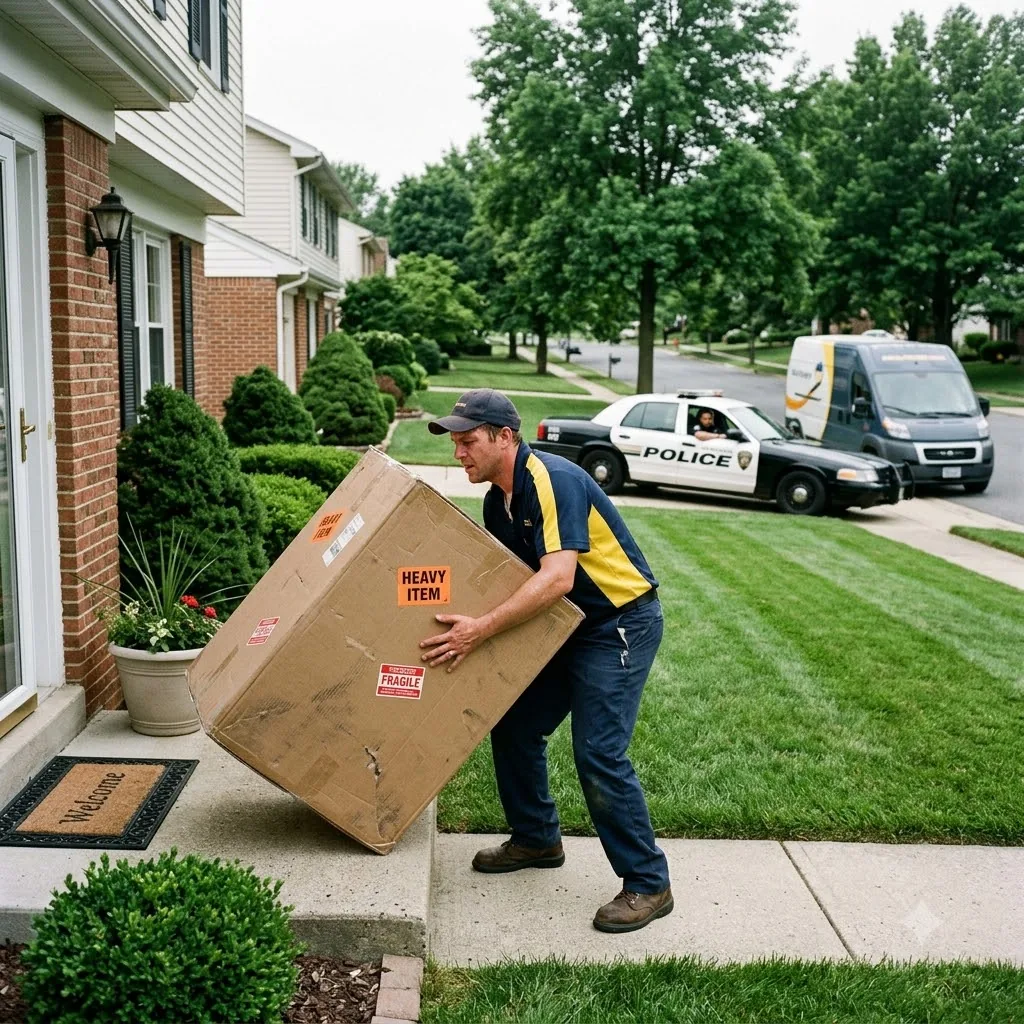
The officer did not look at the sprawling colonial house. He did not look at the heavy flat-pack box resting squarely on the woven welcome mat. He simply stared straight at Marcus, his face completely devoid of expression. The silence stretched, heavy and unnatural, broken only by the low, rhythmic hum of the cruiser’s idling engine.
“Driver,” the officer finally spoke. His voice was flat, synthetic in its lack of inflection, carrying easily across the manicured lawn. “Step down to the curb. Keep your hands visible.”
“I’m coming down,” Marcus said quickly, taking the remaining steps with careful, exaggerated slowness. “Look, I’m just a courier. You can see my uniform. I have eighty more stops today, and my dispatcher is going to start calling my cab if I don’t get this rig moving.”
“Halt,” the officer commanded as Marcus reached the edge of the grass. The officer’s right hand rested casually, yet deliberately, on the textured grip of his holstered sidearm. “Do not approach the patrol vehicle. Place the electronic device on the ground.”
Marcus glanced down at the scanner strapped to his hand. “This? It’s just my manifest scanner. It tracks my packages. I need it to unlock the ignition sequence on the van.”
“Place the device on the ground. Kick it forward,” the officer repeated, the exact same flat cadence, ignoring Marcus’s explanation entirely.
Panic began to tight-rope across Marcus’s chest. This wasn’t a standard traffic stop. Usually, cops in these high-income gated communities were bored, occasionally harassing delivery drivers over parking angles or neighborhood speed limits. They wanted to see a license, run a plate, and issue a warning. They didn’t stand behind armored doors with their hands on their guns.
Marcus knelt slowly, the joints in his knees popping from the strain of his shift, and laid the expensive scanner on the grass. He gave it a gentle nudge with his scuffed work boot, sliding it onto the asphalt.
As he stood back up, Marcus cast a desperate glance at the massive homes surrounding them. The flashing emergency lights were throwing aggressive shadows across the pristine bay windows and manicured hedges. Someone had to be watching. A disruption this loud, this visually violent, should have drawn every curtain-peeker and nosy neighbor on Magnolia Court. Yet, the towering facades remained dark and indifferent. No front doors opened. No one stepped out onto their sprawling porches with a smartphone to record the encounter. The isolation was absolute, pressing down on him as heavily as the humid air.
Suddenly, a hidden sprinkler system roared to life on the adjacent lawn, the mechanical *tst-tst-tst* of the rotating heads making Marcus flinch. The water sprayed in perfect, automated arcs, oblivious to the tense standoff.
The officer stepped out from the protective cover of his heavy door. As he moved into the full glare of the sun, Marcus noticed a chilling detail. There was no gold nameplate pinned over the officer’s right breast pocket. There was no metallic badge gleaming on the left. The uniform was completely sterile, devoid of any identifying department patches on the shoulders.
Instead of approaching Marcus to pat him down or demand identification, the officer walked in a wide arc, bypassing the delivery driver entirely. He moved with a stiff, deliberate purpose toward the rear of the brown step-van.
Marcus watched in mounting confusion as the officer stopped at the back bumper. The cop reached out and grabbed the heavy, solid-brass padlock securing the rear roll-up cargo door. He pulled it sharply, testing the hardened steel shackle.
“Hey,” Marcus said, taking a reflexive step forward before catching himself. “What are you doing? There’s nothing back there but cardboard boxes and packing tape.”
The officer turned his mirrored sunglasses toward Marcus. “Toss your keys onto the pavement.”
“I can’t do that,” Marcus said, his pulse pounding in his ears. The algorithmic timer was forgotten; genuine fear was taking its place. “Company policy strictly prohibits unsealed access to the cargo bay. I have high-value electronics and medical supplies back there. If I open it without a warrant or a supervisor present, I lose my job on the spot.”
The officer didn’t argue. He didn’t cite probable cause, didn’t mention a reported theft, and didn’t ask for consent. Instead, he unclasped the heavy retention strap on his duty holster. The metallic snap cut cleanly through the sound of the hissing sprinklers. He drew his sidearm in one fluid, practiced motion, pointing the dark muzzle squarely at the center of Marcus’s chest.
“Pick up your keys,” the officer ordered, his voice echoing over the quiet street. “Unlock the cargo door. Now.”