Story code: ST-001351
Part 4: The Data Harvest
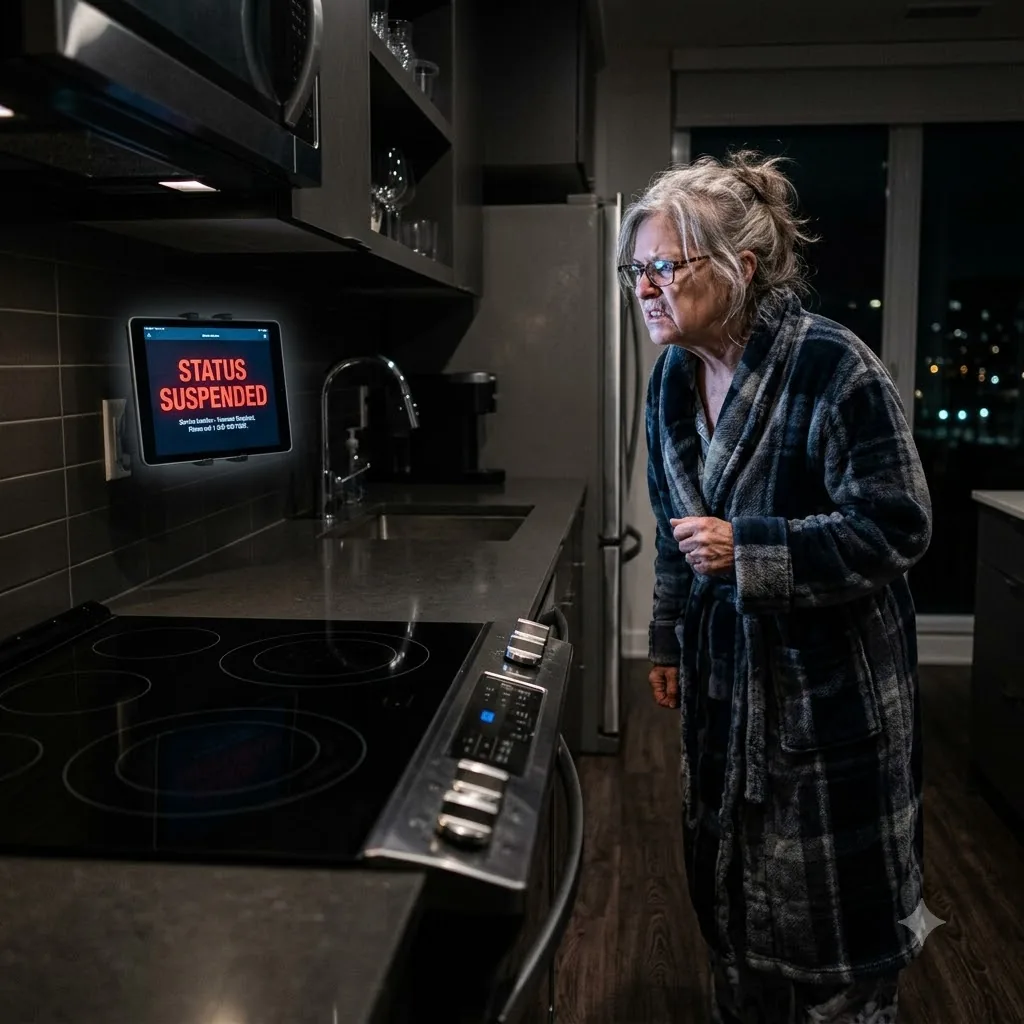
The central wall tablet ticked down in perfect, silent intervals. *03:35:59. 03:35:58.*
Sarah lowered her phone, her thumb hovering over the dead screen. Beside her, Martha stared at the countdown, the fight entirely drained from her posture. The silence of the apartment was suffocating, thick with the unsaid realization that the corporate bureaucracy had built a cage entirely out of fine print.
A sudden, cold chime pierced the quiet. It was a sterile, double-note tone, distinctly different from the blaring alarms of the lockdown.
The tablet’s screen flashed from red to a stark white.
*”Legal parameters updated,”* the smooth, disembodied female voice announced from the ceiling speakers. *”Continuous detention of designated proxy constitutes false imprisonment under municipal fire code section 8. Corporate liability threshold exceeded. Egress for Sarah Miller authorized.”*
The heavy magnetic deadbolt disengaged with a loud, final thud. The front door swung open exactly one inch, stopping with a mechanical whir. A thin draft of stale, beige air from the hallway drifted in.
Sarah looked at the crack of freedom, then back at her mother. Martha hadn’t moved. A thick red laser line illuminated across the floor threshold, painting a digital border across the hardwood.
*”Resident egress remains strictly prohibited pending state extraction at 14:00 hours,”* the AI added calmly.
Martha crossed her arms, retreating into her bulky quilted sweater. She lifted her chin, reconstructing the haughty armor she had worn for the last three years. “Go. You shouldn’t be here when they arrive. I don’t want you watching me pack my life into cardboard boxes.”
Sarah hesitated, her boots planted firmly on the floor. She looked at the woman who had insulted her career, driven her away, and lied to her face just ten minutes ago. “Martha…”
“Just go, Sarah,” Martha said, refusing to make eye contact. “We have nothing left to say. You did your legal duty. The machine won.”
Sarah stepped over the red line and out into the hallway. The moment her boots touched the carpet, the motorized door slammed shut behind her. The heavy deadbolts engaged instantly. The digital nameplate beside the frame shifted back to its rhythmic, pulsing red.
Twenty minutes later, Sarah sat behind the steering wheel of her car in the SilverPines visitor parking lot. The engine was off. The winter cold seeped through the windshield, chilling her fingers as she gripped the steering wheel. She stared up at the pristine, glass-fronted facade of the fifth floor. She had spent her entire adult life fighting for progressive policies, organizing voter drives, trying to build safety nets for vulnerable people. But here, in a private corporate fiefdom, her ideals were entirely useless against an algorithm protecting a real estate portfolio.
She plugged her phone into the dashboard charger and dialed Martha’s number.
Martha answered on the first ring. The line was full of sharp, frantic rustling-zippers pulling, paper tearing.
“I told you to go home,” Martha said, her breath slightly ragged.
“I’m going to,” Sarah replied, keeping her voice flat, devoid of the emotional warmth neither of them was ready to offer. “I’m driving back to my apartment. I’m moving my campaign materials out of the guest room. When the state transport arrives at two o’clock, I am using my proxy status to legally redirect your custody transfer to my address.”
The rustling on the other end stopped. “I am not moving in with you, Sarah. I don’t need your charity. I’d rather go to the state facility.”
“No, you wouldn’t,” Sarah said. “And it’s not charity. It’s a custody transfer. If you go into a state ward, SilverPines gets to liquidate your assets to cover the breach of lease. If I take you in, they only get the apartment. I’m not doing it because I forgive you. I’m doing it because I refuse to let David and his algorithm win.”
Neither of them offered an apology. The bitter screaming match from three years ago still hovered between them, a toxic ghost that remained entirely untouched. Their political divide hadn’t shrunk a single inch. But the landscape around them had violently shifted, rendering their old war suddenly irrelevant.
“It’s listening right now, isn’t it?” Martha whispered, her voice dropping into a tight, fearful register Sarah had never heard before.
Sarah looked at the dark dashboard of her car. “Yes. The ambient microphones don’t have an off switch. They never did. They’re wired into the building’s central telemetry.”
“I paid them,” Martha said, her voice cracking with the terrible weight of her new reality. “I paid them four thousand dollars a month for the illusion of independence. And they were just recording me. Categorizing every sigh, every time I talked to myself, every time I yelled at the television. They were just harvesting it all, waiting for me to slip up so they could flip the rent-controlled lease.”
“They didn’t care about your politics, Mom,” Sarah said quietly. “They just monetized your loneliness.”
Martha didn’t argue. She didn’t snap back. The silence stretched over the cellular network, thick with a shared, chilling terror of the invisible machinery that had quietly surrounded them.
Martha was losing the sanctuary she had fiercely guarded to prove she didn’t need her daughter. Sarah was losing her hard-won separation, forced to become a legal warden to the mother she couldn’t stand. The algorithm had successfully reallocated its risks, indifferent to the human wreckage it left behind.
“They’re going to take the copper kettle,” Martha murmured into the phone, the sound of packing tape echoing sharply. “It’s wired into the smart-kitchen network. I can’t take it with me.”
“Leave it,” Sarah said, starting the car’s engine.
She didn’t hang up. Neither did Martha. They remained on the open line, listening to the static, deeply uneasy and entirely alone together.