Story code: ST-001070
Part 2: The Phase Imbalance
The heat from the trash basin radiated against Vargas’s shins, carrying the acrid, chemical stench of burning toner and lighter fluid. The contractor’s smile didn’t waver. His fingers gripped the edges of the heavily redacted document, hovering just inches above the dancing orange flames.
“Put it down,” Vargas ordered, her voice carefully measured despite the erratic pounding in her chest. She took a half-step forward, her sensible heels scraping against the concrete. “I am City Councilwoman Elena Vargas. You are destroying municipal property and evidence of a district-wide financial audit.”
The contractor chuckled, a low, rasping sound that barely cut through the roar of the fire. “Audit,” he repeated, shaking his head. “You think this is about balancing a ledger, Councilwoman?”
He tapped the glass of his bulky diver’s watch again with a soot-stained finger. “We don’t have time for a civics lesson. Sixty-eight seconds.”
“Sixty-eight seconds until what?” Vargas demanded. Her eyes darted to the uncashed paychecks still banded together in his left hand. It was hundreds of thousands of dollars in district funds, just waiting to be incinerated.
“Until the random federal enforcement patrol breaches the front, rear, and loading dock entrances of this school,” he said, his tone as casual as if he were reading a morning weather report.
Vargas froze. “Federal sweeps are highly classified. The scheduling is strictly randomized. Not even the Mayor’s office gets a courtesy call before they cross the county line.”
“They’re randomized to the Mayor,” the contractor said, his eyes flicking to the high, grated window near the ceiling of the mechanical room. Outside, the sky was still a pale, quiet morning gray. “They aren’t randomized to me.”
Vargas stared at the stitched *Apex HVAC Solutions* patch on his shoulder, struggling to bridge the vast gap between a blue-collar maintenance contract and classified federal intelligence. “How could you possibly know their exact schedule?”
The contractor shifted his weight, lowering the redacted manifest a fraction of an inch closer to the heat. The bottom edge began to curl and brown. “The regional federal processing center is twelve miles up the interstate. They run on an archaic, localized power grid, but their massive commercial climate control systems are wired into the same municipal substations as my schools. Whenever the feds prepare for a multi-sector sweep, they have to power up the block heaters on their armored transport buses and drastically drop the ambient temperature in the holding facility to prep for a high-density influx of bodies.”
He checked his watch again, his eyes narrowing. “Forty seconds. When they do that, it pulls a massive electrical load. The substation registers a distinct voltage sag. My remote thermostat panels read it as a phase imbalance in the cooling grid. It happens exactly fifty-two minutes before their boots hit the ground. Every single time. I’m the only person in this city watching the district’s HVAC diagnostic logs, which makes me the only person who knows exactly when the ‘random’ patrols are leaving their depot.”
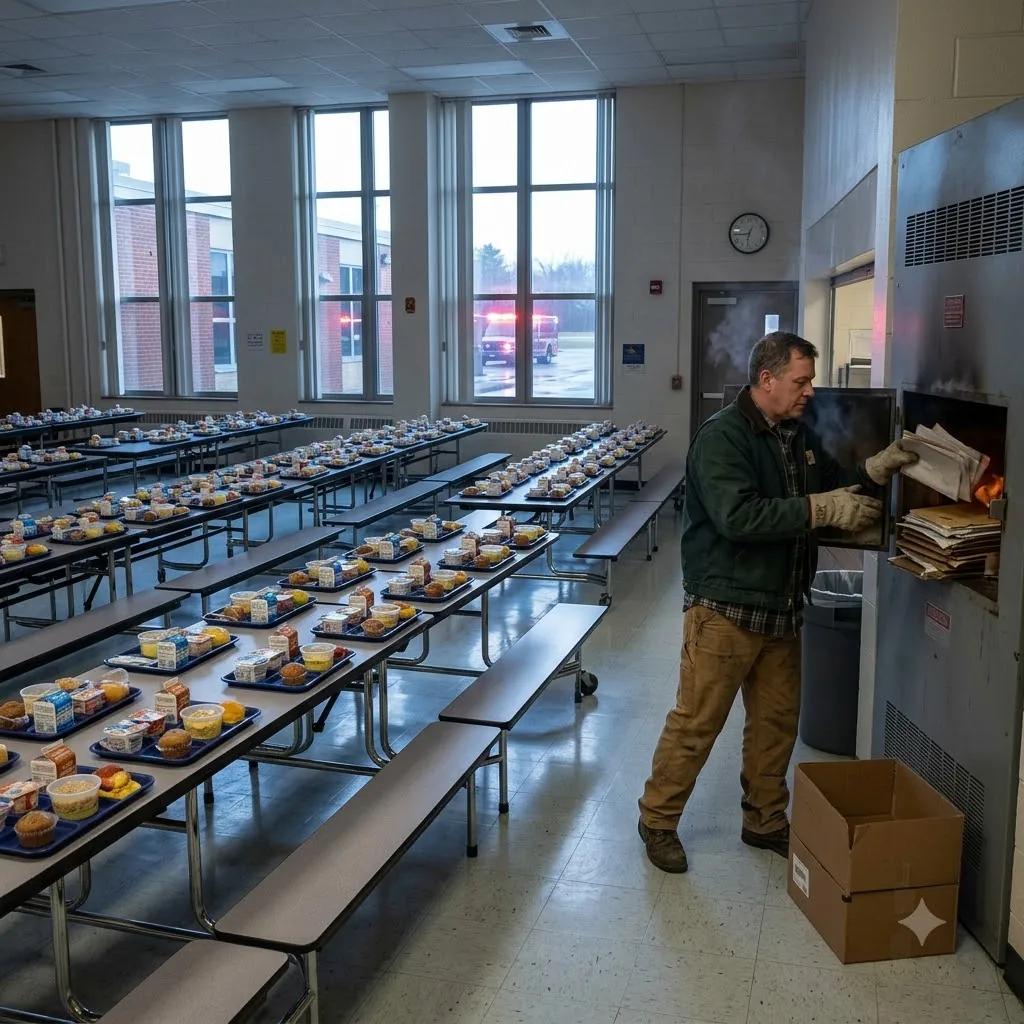
Vargas’s mind raced, the pieces of the morning’s surreal puzzle violently snapping together. The silence of the drop-off lane. The four hundred untouched breakfast trays in the cafeteria sweating under the lights. The locked classrooms.
“You evacuated the building,” Vargas whispered, the realization chilling her despite the sweltering heat of the mechanical room.
“I gave the undocumented custodial staff, the cafeteria workers, and the at-risk families exactly forty-five minutes of a head start,” he corrected, keeping his eyes on his watch. “They went out the service tunnels beneath the gymnasium. But if the feds breach this building and find the administrative files, the timecards, and the payroll ledger… they’ll have every name, every home address, and every emergency contact. A perfect, pre-packaged targeting list.”
He held up the thick stack of uncashed checks. “That’s why these have to burn. No paper trail, no targets.”
“You’re committing a massive felony,” Vargas said, her bureaucratic instincts warring with a sudden, suffocating panic. “You’re destroying over a million dollars of accounted public funds.”
“I’m buying time,” he countered. “Twenty seconds.”
“I can’t let you burn that manifest,” Vargas said, taking another step. “I need to know how deep this goes. Who authorized you to monitor this?”
The contractor finally stopped smiling. His expression hardened into a mask of grim calculation. “Nobody authorized me. I just pay attention.”
He opened his fingers.
The redacted manifest fluttered downward toward the inferno.
Vargas lunged. She thrust her hand directly into the column of heat, her fingers closing around the thick paper just as the bottom edge caught fire. She yanked it back, gasping as the flames singed the cuff of her silk blouse and blistered the skin of her knuckles. She slapped the burning edge violently against her thigh, smothering the spark, clutching the half-charred document tightly against her chest.
Before she could catch her breath, a bone-rattling mechanical groan vibrated through the cinderblock walls.
Through the high grated window, the pale morning light was suddenly, violently fractured by a strobe of blinding red and blue lights. The heavy, unmistakable screech of armored tires skidding onto the loading dock ramp echoed outside. Heavy vehicle doors slammed in rapid succession. Shouts in crisp, authoritative tones drifted through the ventilation shafts.
The contractor didn’t flinch. He tossed the remaining stack of uncashed checks directly into the trash bin, where they instantly erupted into a fresh, roaring pillar of fire.
He stepped backward, kicking away a heavy rubber floor mat to reveal a rusted iron grate set into the concrete floor. He hauled the grate open with one hand, exposing a dark, narrow shaft leading down into the municipal steam tunnels.
The sound of a steel battering ram striking the school’s reinforced rear doors echoed down the hallway behind them.
“They’re locking down the perimeter,” the contractor said, pulling a heavy tactical flashlight from his tool belt. He looked at Vargas, his eyes dropping to the singed, highly classified manifest clutched in her hands, then to the illegal fire raging in the bin between them. “You’re an elected city official standing in a restricted mechanical room, holding half-burned federal evidence next to an active fire. You have about ten seconds to decide if you’re coming down this hole with me, or if you’re staying here to explain this to the feds.”