Story code: ST-001314
Part 4: The Harvest
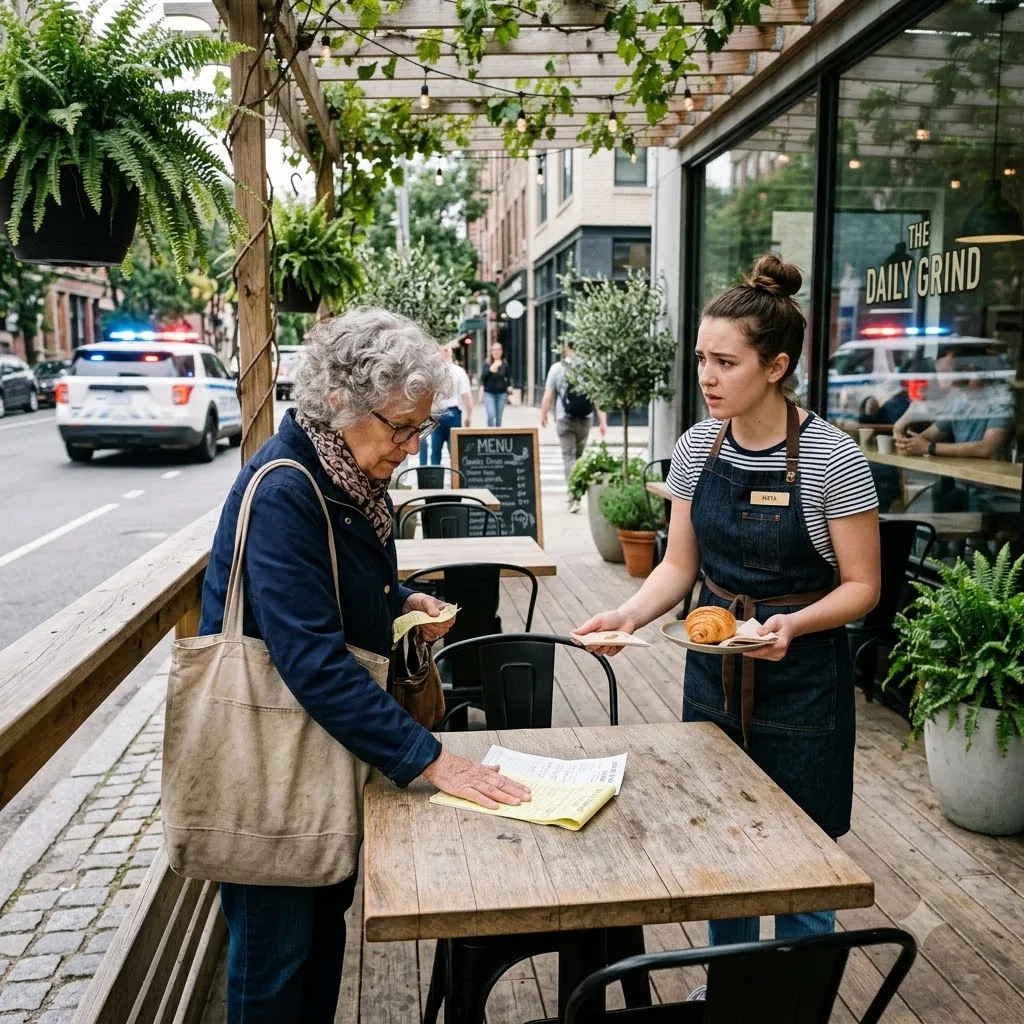
Julian stared at the pen. The plastic cylinder felt heavier than the cast-iron table it rested upon. He looked at Officer Miller’s expectant smile, then down at Ms. Harriet, whose expression remained an unreadable, stony calm. The neon lights of The Daily Grind buzzed above them, casting long, harsh shadows across the concrete.
“I’m not doing it,” Julian whispered, taking a step back.
Miller’s smile didn’t vanish, but it tightened at the corners. “Julian, the charter has already been executed. Your signature just authorizes the final transfer to Veritas. If you don’t sign, we hold the property in administrative limbo, and the daily probation interest continues to accrue against her grandson. You’d actually be costing her more.”
The trap was absolute. Julian looked at the pink slip, at the slogan he had typed while sipping a single-origin pour-over. *Fostering accountability through community-funded stabilization.*
Panic, hot and suffocating, flared in Julian’s chest. The sheer, engineered cruelty of it-and his own starring role in its creation-shattered his carefully curated composure.
“No!” Julian shouted, his voice cracking violently. “No, this is wrong! I just wanted a clean patio!”
He lunged forward, intending to push the horrifying document back toward Miller. Instead, his trembling hand caught the edge of the neat grid of yellow and pink carbon copies Ms. Harriet had laid out. With a frantic, sweeping motion, Julian swatted the entire stack of receipts.
The heavy autumn wind caught the thin paper immediately. Dozens of brightly colored invoices fluttered into the air like morbid confetti, scattering across the patio, sticking to the damp concrete, and blowing against the legs of his expensive, imported wrought-iron chairs.
“Hey! What the hell is your problem, man?”
Julian snapped his head toward the voice. Standing near the entrance of the cafe was a young man in a beanie-one of Julian’s regular evening customers, a graphic designer who usually spent hours nursing a single matcha latte. The young man had stepped out onto the sidewalk, his smartphone raised high, the camera lens pointed directly at Julian. The recording light was a tiny, piercing red dot in the twilight.
Julian froze, his hand still suspended in the air from where he had swept the table. He instantly understood the optics playing out on that small digital screen. He wasn’t the horrified neighbor uncovering a systemic injustice. To the camera, to the internet, he was a wealthy, gentrifying business owner who had just violently swatted a stack of papers out of the hands of an elderly, soon-to-be-evicted woman.
“Wait, no,” Julian stammered, taking a panicked step toward the customer. “You don’t understand what this is. I didn’t mean to-”
“I got it all on video, dude,” the customer said, his face twisted in disgust. He backed away, keeping the phone trained on Julian as he retreated rapidly down the block. “You’re sick.”
Julian turned back to the table, desperate to explain, to fix it. But Ms. Harriet was not looking at him. She was already on her knees.
With slow, deliberate movements, she began to gather the scattered pieces of her ruined life. She reached under a patio chair to retrieve a yellow slip detailing her grandson’s electronic monitoring fee. She peeled a pink nuisance surcharge from the damp pavement. She did not weep. She did not curse Julian. She moved with a quiet, devastating dignity that made Julian’s chest physically ache.
“Ms. Harriet, please,” Julian begged, his voice dropping to a pathetic whisper. He dropped to his knees to help her, reaching for a receipt blowing toward the gutter.
She placed her calloused hand over his, stopping him. Her grip was surprisingly strong. She gently pulled the paper from his fingers.
“Don’t,” she said softly. It was the only word she offered.
She stood up, brushing the dirt from the knees of her faded wool coat. She neatly stacked the recovered invoices, though they were now crumpled and stained with street grime. She slipped them back into her heavy canvas tote, the savings of her entire lifetime reduced to a handful of dirty paper. Finally, she picked up the cheap plastic pen from the iron table and dropped it into the bag.
Miller adjusted his utility belt. “We’ll process it as a hostile refusal to sign, Harriet. The transfer will go through a magistrate tomorrow. You have until noon to vacate the premises.”
Ms. Harriet didn’t acknowledge the officer. She turned her back on The Daily Grind and began the slow walk down the street toward her dark, heavily mortgaged house.
Miller sighed, shaking his head as if dealing with a stubborn child. “Don’t sweat the video, Julian. By next month, the whole block will be stabilized. New demographic, new customers. They’ll love the patio.” He gave Julian a brief, two-finger salute and strolled back to his idling cruiser.
Julian remained on his knees on the concrete for a long time. The street grew quiet, the flashing red and blue lights fading as the cruiser finally pulled away. The wind died down, leaving nothing but the hum of his neon Open sign.
Slowly, Julian pushed himself up and walked back inside the cafe. The bell chimed merrily above the door. The interior was pristine. The chrome of the espresso machine gleamed under the warm, Edison-bulb lighting. The pastry case was perfectly arranged. It was a beautiful, safe, orderly sanctuary.
He stood alone behind the counter, staring out through the spotless glass window at the empty patio. The street was finally clean, just as he had wanted. And in the suffocating silence of his empty shop, Julian finally understood the true cost of his peace, forced to live with the knowledge that his perfect life was entirely funded by harvesting the bones of his neighbors.