Story code: ST-001558
Part 2: The Cost of Doing Business
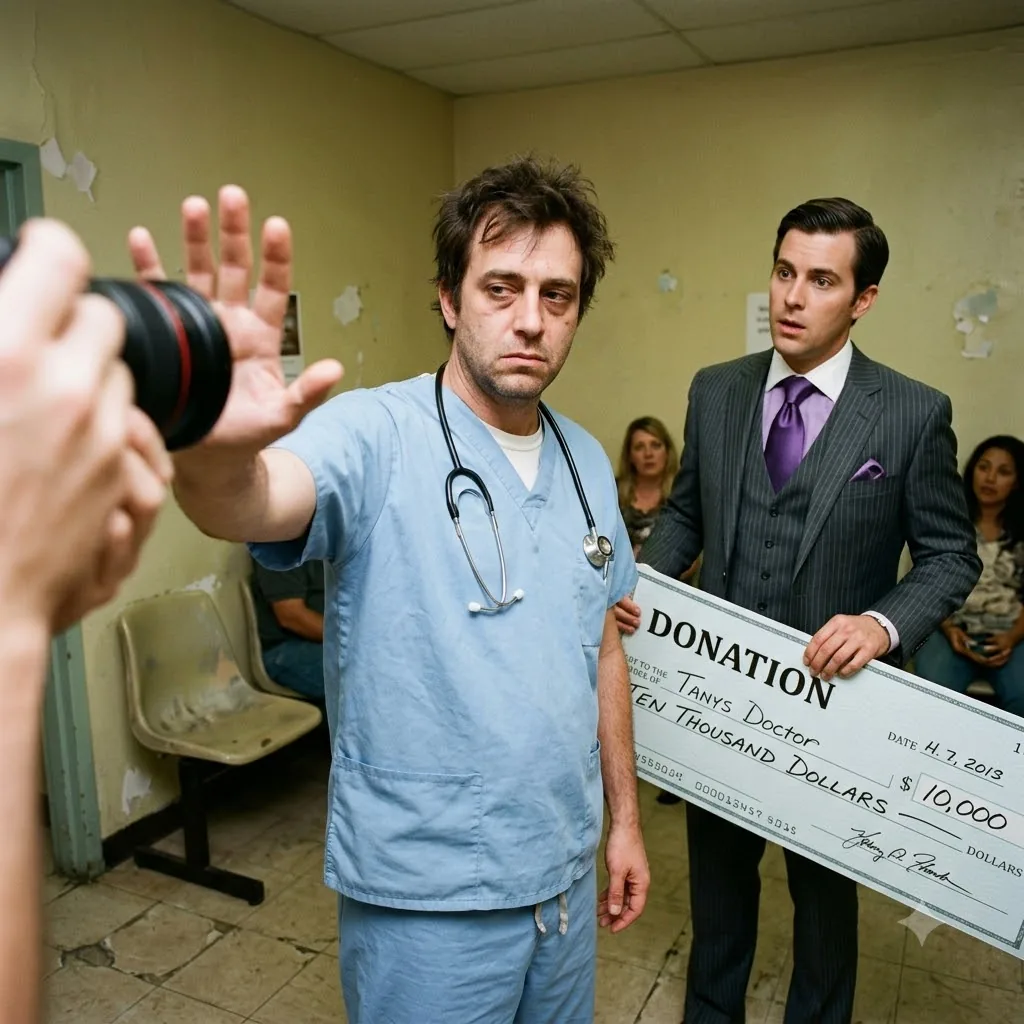
The impact of my palm against the heavy glass of the camera lens sent a sharp, stinging vibration all the way up to my elbow. The sound was flat and ugly in the quiet of the waiting room. The cameraman cursed, a sudden, sharp intake of breath as he staggered backward, instinctively clutching his expensive shoulder rig to protect it from my assault. He stumbled over a stack of faded health magazines, kicking a dog-eared copy of *Highlights* across the scuffed linoleum.
For a span of three heartbeats, nobody breathed. The suffocating weight of the room pressed down on us. The mother, still huddled by the water cooler with her dead son’s blue windbreaker pressed to her mouth, stared up at me with wide, uncomprehending eyes.
Julian did not flinch. He remained kneeling on the dirty floor for a moment, his perfect posture completely undisturbed by the sudden violence. Slowly, he withdrew his manicured hand from the space where the mother had been shrinking away. He stood up, smoothing a microscopic wrinkle from the thigh of his charcoal trousers. When he looked at me, the manufactured, award-winning empathy had vanished from his face, replaced by something flat, metallic, and infinitely more dangerous.
“Cut the feed,” Julian said, his voice dropping its booming, theatrical resonance. It was quiet now, terrifyingly calm.
“I’m still rolling audio, boss,” the sound technician muttered from the periphery, his boom mic hovering uncertainly near the acoustic ceiling tiles.
“I said cut it,” Julian snapped, not breaking eye contact with me.
The red light on the camera blinked off. The sudden absence of it felt like a spotlight had been killed, leaving us in the grim reality of the flickering fluorescent tubes. I kept my body firmly planted between Julian and the grieving woman. My chest heaved. The sour smell of adrenaline mixed with the lingering scent of bleach and failure.
“Arthur,” Julian said, sighing as if dealing with a petulant toddler. He took a half-step forward, invading my personal space just as he had invaded hers. He smelled of expensive sandalwood and mint, a jarring contrast to the metallic tang of the blood and vomit we had just scrubbed from the floorboards. “Do you have any idea how much that Zeiss lens costs? If you scratched it, I’ll have it deducted from your personal salary. Not the clinic’s operating budget. Yours.”
“Get them out of here, Julian,” I said, my voice shaking in a way that betrayed my anger. “This isn’t a film set. A boy just died here. His mother is in shock.”
Julian smiled, a thin, bloodless stretching of his lips. He leaned in, lowering his voice so only I could hear the venom. “Why do you think I’m here, Arthur? You think I like spending my Tuesday afternoons smelling stale urine and despair? You think the board of directors gives a damn about a junk-sick kid in a ZIP code they wouldn’t drive through with locked doors?”
He pointed a stiff finger at my chest, tapping hard against my sternum. Each tap was a physical reminder of the compromise I had lived with for two years.
“I am the reason you have doors to lock,” Julian hissed. “I am the reason you have electricity. I am the reason you had that naloxone in your hand twenty minutes ago. You know the cost of doing business, Arthur. You’ve been playing the good, compliant soldier for twenty-four months because you know that without our grant, you are nothing. You close in a week. Your staff goes on unemployment. And the next kid who overdoses on this block dies in the gutter instead of your waiting room.”
The truth of his words hit me like a physical blow. It was the exact calculation I made every single morning when I put on my badge with their corporate logo stamped next to my name. I had swallowed my pride, nodded at their quarterly reviews, and let them use my clinic as a tax write-off and a PR shield because it bought us the supplies we desperately needed. I had traded my autonomy for sterile gauze, antibiotics, and a fighting chance for this neighborhood. That was the math. I had played along because I had to.
But this was a bridge too far. The price had suddenly become the dignity of a woman who hadn’t even processed that she was arranging a funeral.
Behind me, I heard the rustle of nylon. The mother was trying to use the distraction to slip away. She scrambled to her feet, clutching the jacket, her eyes darting toward the glass double doors.
“Chloe,” Julian barked, not looking away from me.
His assistant, the young woman with the tablet, moved with terrifying efficiency. She intercepted the mother before she could reach the exit, stepping smoothly into her path. Chloe held out a digital stylus and the glowing screen of the tablet.
“Ma’am, I am so deeply sorry for your loss,” Chloe said, her voice dripping with the same synthetic syrup Julian used. “We just need a quick digital signature on this release form for the footage we already captured. It ensures we can set up a memorial fund in your son’s name.”
“Leave her alone!” I yelled, turning to shove past Julian.
Julian caught my arm. His grip was surprisingly strong, his fingers digging into the muscle just above my elbow. He yanked me back, forcing me to face him again.
“Don’t be stupid, Arthur,” Julian warned, his voice rising, shedding the last of its polite veneer. “The board is looking for any excuse to cut the urban health initiative. They want to pivot the funds to suburban wellness centers-yoga studios and mindfulness retreats. If I don’t bring them this raw, gritty reality to prove our community impact, they pull your grant tomorrow. I am trying to save your clinic, and you are getting in my way over sentimentality.”
I looked over my shoulder. Chloe was pressing the tablet closer to the weeping woman, whose hands were shaking too hard to even hold the stylus. The mother looked cornered, trapped between the glass doors and the corporate machinery grinding her down.
Julian signaled the cameraman with a flick of his wrist. The man hoisted the heavy rig back onto his shoulder. The red recording light blinked to life, a small, glowing eye in the gloom.
Julian took a step back, gesturing grandly toward the cornered mother, then toward me. “So, Doctor,” Julian said, his voice returning to its booming, camera-ready pitch. “Are you going to be the localized hero who helps us tell this vital story of community resilience? Or are you going to stand in the way of progress and shut this clinic down for good? Step aside. Let us finish what we started.”