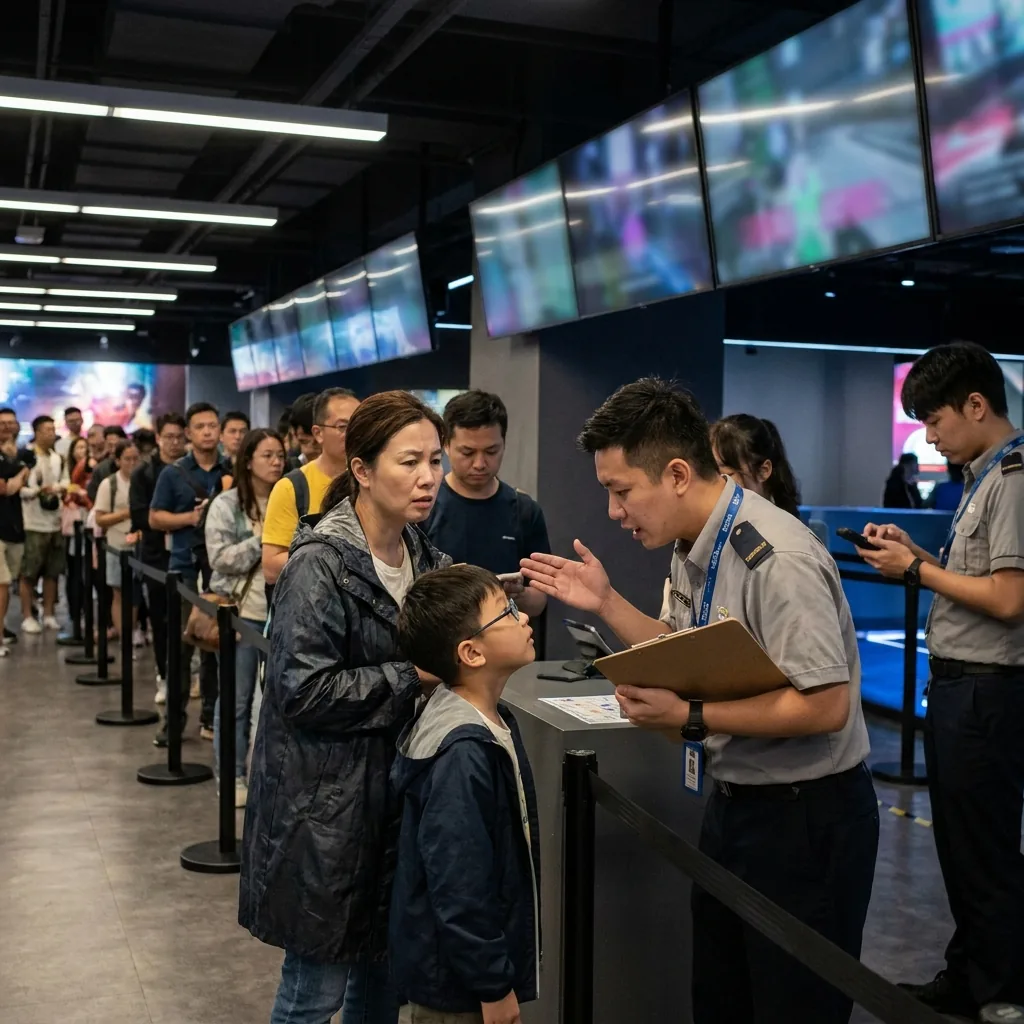
Story code: ST-000657
Part 4: The Wristband Finally Activated
What happened next was cold enough to settle everything.
Marcus Chen did not raise his voice. He did not ask anyone how they felt about fairness or customer service. He stood at the filter control counter with Nina Vale’s tablet between them and waited for the same thing the whole room had been asking for in different words: if the rule was real, let it survive the system.
Nina took the tablet back and opened the denial workflow. Rachel Mercer could not see every line from where she stood, but the screen was angled enough now for the people nearest the counter to catch the shape of it: player name, lane, device note, reason code. Marcus named the fields as Nina moved through them.
“Reservation holder.”
She selected Evan Mercer.
“Lane.”
“Forest,” she said.
“Reason code.”
That was where the process finally squeezed the bluff flat. Nina paused over the list and scrolled once. The visible options were ordinary, plaza-built categories: unreadable wristband, late check-in, height mismatch for climbing zone, battery failure on plaza loaners, damaged strap, tinted lens interference for arena. Nothing on the screen matched the phrases she had used for the last twenty minutes. No external layer competition. No current visual filter compliance standard. No broad glasses block for the forest lane.
Marcus said, “Choose the code that supports your denial.”
Nina tapped one, stopped, backed out, and tapped another. Marcus looked at the screen and said, “That code is for arena tint conflict. His booking is not arena.”
She tried to move to the free-text field.
Marcus said, “Not without a matching code. If you need a custom restriction, it triggers supervisor review before denial.”
That was not dramatic either. It was worse for her than drama. It was a process wall.
Tori Alvarez, still holding her station in a half-stop across the aisle, asked the question everybody else had arrived at by then. “So are we blocking any forest kids in outside glasses or not?”
Marcus answered without looking away from the tablet. “Not on an unsupported denial. Resume standard check-in. Arena tint screening stays in place.”
The lane started breathing again. Tori lifted her scanner and repeated the revised instruction to the waiting families: arena tint only, standard check-in otherwise. One father nodded once and put his son’s glasses back in his hands. A few wristbands began chirping alive again at the adjacent station.
At Rachel’s counter, the consequence landed in the same flat administrative rhythm.
Marcus took the tablet from Nina, opened a supervisor note, and entered a restriction under her staff ID. Rachel could not read every word, but she heard him say them as he typed, because he was saying each step out loud for the station log and for Tori to follow.
“Effective immediately: Nina Vale is removed from live device-eligibility denials pending compatibility review. All non-coded exceptions route to supervisor approval. Existing queue resumes under posted lane criteria only.”
He set the tablet down on the counter, screen facing Nina for acknowledgment. “Confirm receipt.”
Nina read it, pressed her thumb to the staff acknowledgment field, and let her hand drop.
There was no apology speech and no crowd verdict. The plaza simply absorbed the correction and moved on. That was the final difference between a bluff and a rule. One could stop a child for twenty minutes. The other had to fit inside the machine everyone else used.
Marcus turned to Rachel. “Forest lane permits outside glasses unless they meet an active coded block. His pair does not.”
Rachel asked the practical question first. “So he can go in now?”
“Yes,” Marcus said. Then he added the new restriction that made the ending feel earned instead of easy. “Under manual station monitoring for this session only. If visual drift appears in-zone, the glasses come off and he switches to plaza loaners if available. That note will ride on the wristband.”
Rachel looked at Evan. Evan looked at the glasses in his own hands, then at the active play gate. “That’s fine,” he said.
Marcus activated the wristband himself. The band gave a sharp green flash and a short chirp that had been missing from the counter all this time. He attached it to Evan’s wrist, then entered the session note and printed a small add-on tag for the monitor check. It was not a gift. It was not compensation. It was control restored with a cost in convenience and scrutiny.
Rachel took the glasses case while Evan put the frames on. Tori’s station was moving again. The birthday group near the gate had mostly turned back to their own game. Nina stayed at the counter with the restricted tablet and the supervisor note still on screen.
When Rachel and Evan reached the active play gate, the gate host scanned the wristband, saw the monitor tag, and waved for a floor runner to shadow the first minute of his session. Evan stepped through anyway, shoulders square, glasses lit blue under the plaza lights.
Rachel stood just outside the gate long enough to watch his overlay sync with the forest lane markers. No alarm sounded. No staffer rushed in. The system accepted what one person at the counter had tried to keep out.
Then Rachel folded the empty glasses case under her arm and stepped back from the lane, with that specific kind of relief you earn after making the room use its own rules.