Story code: ST-000837
Part 2: Felony Concealment
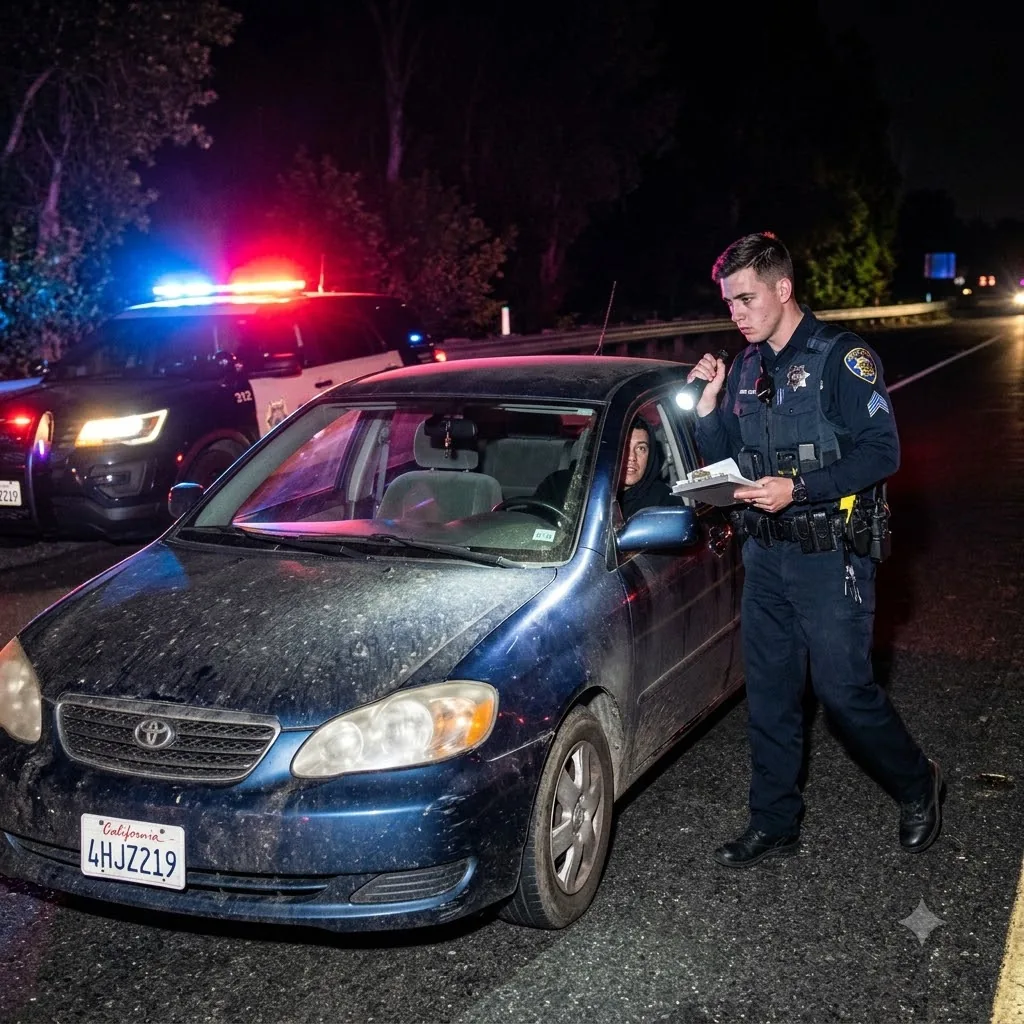
Marcus flinched. The abrupt movement in the passenger footwell shattered the frozen tableau of the traffic stop. His thumb slipped off the radio’s transmission button as his right hand dropped instinctively to his hip. The leather retention strap of his holster was already unsnapped. He drew his Glock 19 in one fluid, practiced motion, keeping the muzzle angled slightly downward but ready, leveling it just below the window frame.
“Show me your hands!” Marcus barked, his voice echoing sharply off the brick facades of the empty apartment buildings. The command tore through the heavy, humid air. “Both of you! Hands where I can see them right now!”
The driver screamed, a raw, guttural sound, and threw her hands up, pressing her palms flat against the interior roof of the rusted Honda. “Don’t shoot! Please, God, don’t shoot! It’s my sister!”
Marcus didn’t lower his weapon. His heart hammered against his ribs, adrenaline flooding his system. He sidestepped slightly to improve his angle, shining the blinding beam of his Maglite directly into the dark void beneath the dashboard.
The pale hand that had grabbed the driver’s wrist belonged to a girl who looked no older than sixteen. She was crumpled in the cramped footwell, her knees tucked tightly against her chest. She squinted against the harsh light, her face entirely drained of color, her skin shining with a cold, clammy sweat. Her left hand was clamped desperately over her right bicep. The dark liquid soaking the pharmacy bag wasn’t just pooling; it was actively flowing from her arm in a steady, rhythmic pulse that screamed of a severed artery.
Marcus’s eyes darted from the bleeding teenager to the crumpled white bag on the center console. In the glare of his flashlight, a red circular logo was partially visible through the saturated paper. A pharmacy chain.
The pieces snapped together in Marcus’s mind with sickening clarity. Twenty minutes before he left the precinct for his patrol, the shift sergeant had read out a fresh BOLO. A commercial burglary at a pharmacy on 12th and Elm. The suspect had thrown a cinderblock through the reinforced glass door, but the frame hadn’t completely given way. They had squeezed through the jagged opening, bled heavily onto the linoleum, and fled with an armful of trauma supplies and antibiotics.
This wasn’t a victimless equipment violation. This was the pharmacy burglar.
A felony arrest.
The realization hit Marcus like a physical blow. Captain Miller’s spreadsheet loomed in his mind. A felony burglary collar would instantly pull Marcus from the bottom of the precinct rankings. It would secure his probation, guarantee his placement on a safe day shift, and satisfy Miller’s relentless demand for proactive policing. All he had to do was make the call.
Marcus holstered his weapon, keeping his hand resting cautiously on the grip, and reached for his shoulder mic. “Dispatch, unit zero-four. I have a priority medical emergency at my location, requesting an expedited bus and a supervisor-”
“No!” The driver lunged across the center console, completely ignoring the danger of Marcus’s sidearm. She slammed her hand against the window glass. “You can’t call it in! If you call an ambulance, it’s a mandatory police report for the glass cuts. They’ll run her name. They’ll see what we did!”
“Step back from the window,” Marcus ordered, his voice hard. “Your sister is bleeding to death. I am getting an ambulance.”
“She won’t make it to a hospital!” the driver pleaded, her voice cracking into a desperate sob. “If you arrest her, she becomes a prisoner. You know the protocol! They won’t take her straight to a civilian ER. They have to clear her at central booking’s medical unit first. It takes hours to process a felony suspect! She’ll bleed out in a holding cage waiting for a precinct doctor!”
Marcus froze. His thumb rested heavily on the transmit button of his radio.
He wanted to tell the driver she was wrong, but the lie wouldn’t form in his throat. He had seen the grim reality of the booking process. The understaffed medical cages were a bureaucratic nightmare. Suspects routinely sat for six to eight hours before seeing a nurse. If Marcus made this arrest, the teenager would be handcuffed to a metal bench, trapped in the system’s lethal apathy. With an arterial bleed, she wouldn’t last forty-five minutes.
The radio on his shoulder crackled, the harsh static slicing through the quiet night.
“Unit zero-four, dispatch,” the operator’s bored, nasal voice echoed in the stillness. “Status check. Captain Miller is standing at the desk. He’s asking if you’ve got a collar on that traffic stop, or if you’re coming back empty for the shift. Advise.”
Marcus stared at the teenager. Her eyes were fluttering, rolling back slightly as her head lolled against the edge of the passenger seat. Her lips were taking on a terrifying blue tint. The makeshift tourniquet-a thin leather belt wrapped above her elbow-was slipping.
“Please,” the driver whispered, tears carving clean lines through the grime on her cheeks. “I know a private clinic two miles from here. They won’t ask questions. Just let us go. If you take her in, you are killing her.”
The pressure in Marcus’s chest was suffocating. His career, his badge, and his financial survival were waiting on the other end of the radio. A simple “10-4, suspect in custody” would solve every professional problem he had. It was the correct legal decision. It was the safe decision.
But as he watched the teenager’s chest hitch in a shallow, rattling breath, he knew he couldn’t pass a death sentence on a terrified kid who had stolen bandages to survive.
Marcus pressed the transmission button.
“Dispatch, unit zero-four,” Marcus said, his voice remarkably steady despite the chaotic hammering of his pulse. “Negative on the collar. Tell the Captain it’s just a busted taillight. Writing a written warning now. No backup required.”
“Copy that, zero-four. Clear.”
Marcus released the button. He had just formally lied to dispatch. He was officially concealing a felony, aiding a fugitive, and risking years in a federal penitentiary if he was ever caught.
“Thank you,” the driver gasped, frantically throwing the car into drive. “Thank you, God. We’re leaving. We’ll go to the clinic.”
“Put it in park!” Marcus snapped, reaching through the open window and slamming his hand onto the steering wheel. He shined his flashlight into the footwell again. The pool of blood was spreading rapidly across the floor mats, dripping steadily from the slipping belt.
The teenager let out a weak, agonizing groan and went entirely limp.
“She isn’t going to make it two miles,” Marcus said, the grim reality settling over him like a suffocating blanket. He had crossed a massive legal line to protect her from his department, but his lie hadn’t stopped the bleeding. “Her tourniquet is failing. If you drive away right now, she dies in your passenger seat in ten minutes.”
Marcus looked down the empty, dark street, realizing how incredibly isolated he had just made himself. He couldn’t call his fellow officers for help anymore. He couldn’t call an ambulance. He was completely alone.