Story code: ST-000878
Part 2: He Kept Using The Fake Term Like It Could Move Water Back
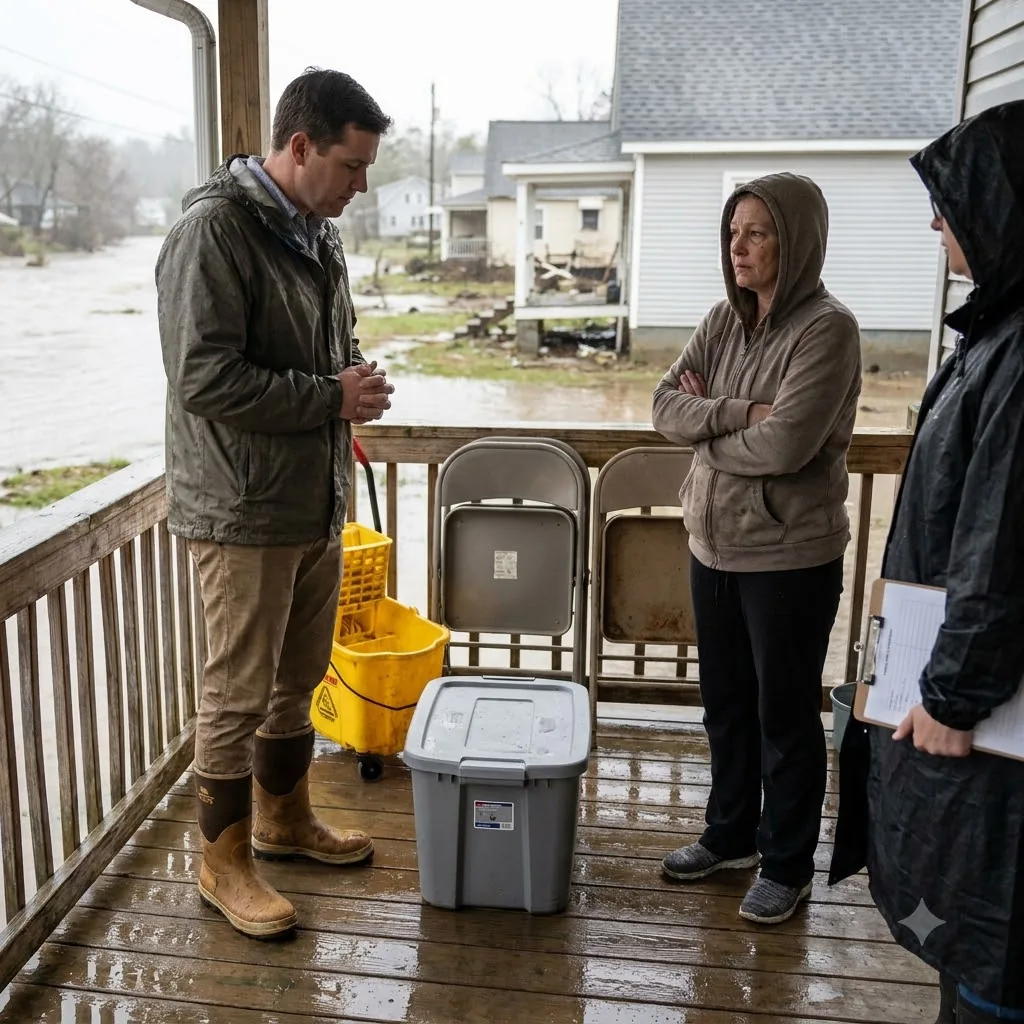
By the time Grant finished explaining the tote’s so-called drift index, the porch had gotten quieter than any intake space should be. He had turned a packed bag, a rising flood, and an older woman with pill bottles in her lap into a lesson about how not to embarrass yourself in front of a specialist. And the worst part was how close it came to working. He crouched near the evacuation tote without touching the wet boards with his knee. “A high drift index,” he said, smoothing the front of his folder with one hand, “shows the household has shifted into impulsive relocation signaling before proper sequence capture. That’s what creates placement distortion.” Tessa stared at him. “It’s a bag.” “It’s a movement indicator,” he corrected. Noah looked from the tote to his sister. “So if the tote’s packed, that hurts us?” Grant turned to him right away, quick enough that I could see he preferred the question coming from someone still trying to follow him. “Not hurts. It complicates. Premature mobility presentation can suggest the family is acting outside guided retreat channels.” He said guided retreat channels like we all used that phrase every day. Noah stopped fiddling with the damp bin lid and just stood there holding it against his leg. Elena adjusted the grocery bag on her lap and asked, “If I take my medicine and my keys out of that tote and put them in my purse, does the water go down?” Grant gave her a polite smile without answering the question she asked. “This isn’t about the water itself. It’s about managing your migration posture so the system can read it correctly.” I picked up the legal pad and wrote the term down exactly as he had said it: drift index. Then I wrote movement indicator under it. Then premature mobility presentation. I did that because once language starts slipping around a room, it helps to pin it where people can see it. Tessa saw me writing and asked him, “Read correctly by who?” Grant spread two fingers over the folder. “By the placement process. By the sequencing side. By the stabilization review that comes before route assignment.” “Who is the person?” Tessa asked. “What’s their name, or what office is that, or what number do I call?” He did not answer that either. He shifted into another explanation, this one about phased departure optics and unmanaged family motion. It had the same polished rhythm as the first one. Start with a big phrase. Pause like you had just taught a class. Then circle back and make the plain question sound smaller than the answer. Around us, ordinary porch work kept trying to happen. Water tapped into the bucket. Somebody in the side room dragged another chair across tile. I wrung out one towel and laid it over the railing, but I stayed close enough to hear every word because the tote had become the whole meeting now. Grant had done that on purpose whether anyone said so or not. The visible proof of why they needed to leave had been recast as a warning sign against leaving wrong. He asked Tessa, “When exactly did you pack this?” “After the second flood this month,” she said. “And who instructed you to formalize departure readiness?” Tessa let out one short breath through her nose. “The water under my mother’s house instructed me.” Noah almost smiled at that, but Grant moved over it fast. “That’s an emotional answer,” he said. “I’m talking about authorized sequence initiation.” I looked at Elena then. She had gone very still except for her thumb rubbing the cap of an orange prescription bottle through the plastic grocery bag. She asked him, in a voice flatter than before, “Can she take me out of here today without messing up your sequence?” Grant answered with timing instead of meaning. “Potentially, if the household first de-intensifies the visible mobility cue and re-centers around assigned staging behavior.” Noah frowned. “De-intensifies the visible mobility cue means unpack the tote?” Grant nodded once. “That would be the safest immediate corrective step.” There it was. A real instruction at last, and it was the dumbest one in the room. Tessa looked down at the tote, then back up at him. “You want me to unpack the insulin, the chargers, the clothes, the papers, and my mother’s medications while the porch is flooding, so your process reads us better?” Grant lifted one shoulder. “I want the household to stop broadcasting unmanaged departure.” I watched Noah’s face as that landed. He looked at the wet boards, the tote, then at the bins he had already moved twice to keep them out of seepage. He said the term carefully, like he was testing the weight of it. “If the tote is a movement indicator, what about those bins? What about my truck backed up to the steps? What’s the difference?” Grant’s answer came a half-second late. “The tote is more formalized.” “Formalized by what?” I asked. He turned to me again. “By its relocation function.” I held up the legal pad so the words faced him. “You said drift index measures impulsive relocation signaling. Then you said it’s a movement indicator. Then you said packing before sequence confirmation creates noncompliant movement signals. Now you’re saying the tote is formalized by its function. Which one are you asking them to respond to?” Grant’s mouth stayed open just long enough for Noah to stop moving completely. Elena lifted her eyes from the pill bottle to his face. Tessa did not blink. He recovered and said, “These are interrelated concepts.” “Okay,” I said. “Then in the next step, apply one of them to this family. Right now. This porch, this tote, Elena’s meds, Noah’s truck, and tonight. Which concept decides whether they leave or stay?” The bucket dripped again. Grant glanced at the tote, and for the first time since he stepped onto the porch, his polished answer did not arrive on time. He looked.