Story code: ST-000208
Part 2: The Red Folder
Elias looked down at the photograph. The glossy paper caught the harsh, artificial light of the office, but the image beneath the glare was dominated by the deep, chaotic orange of a crown fire. It was a shot from the Ridge Fire, taken two years ago. In the center of the frame, Elias stood on a steep, rocky grade. He was holding a drip torch, a line of fresh, low-burning fire trailing from the spout. Fifty yards behind him, silhouetted against a terrifying wall of flames, a lime-green state forestry Type-3 brush engine was completely engulfed.
Elias remembered the moment perfectly. The oppressive, lung-searing heat. The roar of the wind shifting violently, a sound like a freight train tearing through the timber. He remembered the taste of ash and the desperate screaming over the radio. Looking at the photograph now, sitting in the freezing, sterile quiet of the regional director’s office, Elias felt the tight collar of his borrowed dress shirt digging into his throat.
“Two hundred and fifty thousand dollars,” Hayes said, his voice smooth, devoid of the theatrical warmth he had used in the lobby. “That is the replacement cost of a Type-3 engine, fully equipped. Not counting the hazard pay and the political fallout of losing a rig on a high-profile suppression line.”
Elias kept his hands perfectly still on his knees. He met Hayes’s flat stare. “The engine was dead,” Elias said, his voice low and even. “It vapor-locked on a thirty-degree slope. The wind shifted forty-five degrees in three minutes. If I hadn’t burned out that ridge to rob the main fire of fuel, the crew would have been overrun. The engine was already lost. The men weren’t.”
Hayes did not blink. He slowly turned his gaze back to the red folder, using his manicured index finger to trace the edge of the heavy black redaction marker on the top page.
“That is an interesting tactical assessment,” Hayes murmured. “Unfortunately, it is not the official one. The Incident Commander’s report paints a very different picture of that afternoon. It describes a temporary contractor who broke protocol. A squad boss who ignored direct radio commands from the division supervisor, bypassed the chain of command, and initiated an unauthorized, rogue backfire that trapped a state vehicle.”
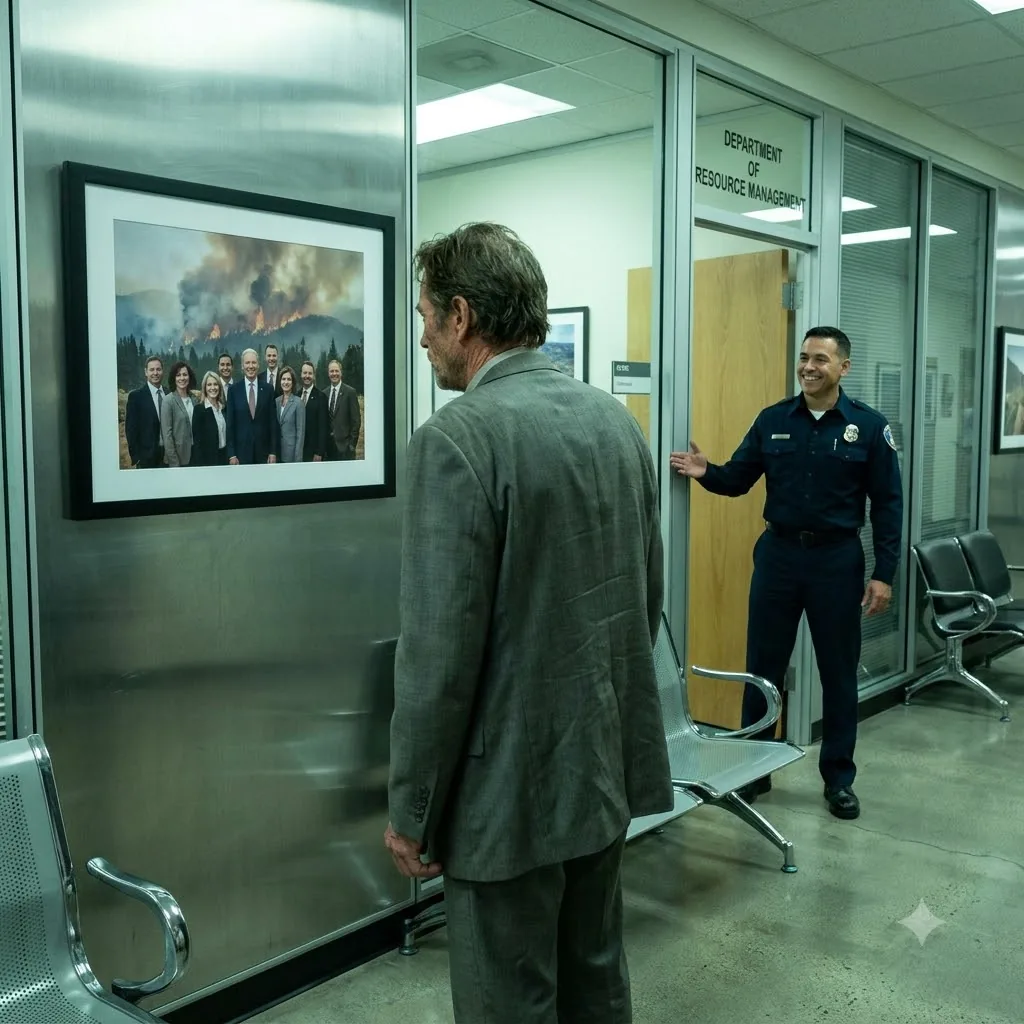
Elias’s jaw tightened. The Incident Commander for the Ridge Fire had been the man smiling in the lobby photograph-the regional director who had spent the critical hours of the blowup at a staging area ten miles away. “The radio net was jammed,” Elias said, forcing the words out evenly, refusing to let the anger crack his composure. “And division command gave us a bad safety zone coordinate. I made the call on the ground.”
“You made a reckless call,” Hayes corrected sharply. He leaned forward, the leather chair groaning in the quiet room. “You took state property and state lives into your own hands. And you know what the committee sees when they look at this file, Elias? They don’t see a hero saving a crew. They see a liability.”
Hayes tapped the brass military service coin he had placed next to the folder. The metallic clink sounded unnaturally loud.
“We love our veterans,” Hayes said softly, weaponizing the very service he had just praised in front of the receptionist. “But the sad reality is, sometimes they bring the war back with them. They get hyper-aroused in high-stress environments. They suffer from combat fatigue. They see enemies in the smoke, and they react with extreme, unilateral aggression. They cannot follow a civilian chain of command.”
The trap snapped shut around Elias with suffocating clarity. The loud, effusive display in the lobby hadn’t been a welcome; it had been a calculated performance. Hayes had made sure every employee in the administrative wing saw him treating the combat veteran with the utmost respect. If Elias was turned away for the crew boss job, no one would blame the forestry department. They would whisper that the poor veteran just wasn’t mentally fit for duty.
Elias thought of the past three months. The dwindling savings account. The stack of unopened utility bills on his kitchen counter. The quiet, pitying look his brother-in-law had given him when handing over this cheap, ill-fitting polyester suit. He needed this job desperately. Hayes knew it. The state ran comprehensive background checks; they knew exactly how much Elias had earned as a seasonal contractor, and they knew he had been out of work since November.
Hayes reached into the back of the red folder and slid a single, crisp sheet of white paper across the mahogany desk. It came to rest perfectly parallel to the photograph of the burning engine.
“I am a pragmatic man,” Hayes said, leaning back and resting his elbows on the armrests. “I don’t want to see a decorated soldier out on the street. The department is willing to offer you a position today. Community Outreach and Safety Liaison. GS-7 pay grade. Full medical benefits. A comfortable desk, right here in the administrative wing.”
Elias stared at the white paper. It was a formal addendum to his application. He read the top paragraph, his eyes catching on the legal phrasing. *…acknowledging a lapse in judgment due to service-related stress factors during the Ridge Fire incident…*
“You want me to be a mascot,” Elias said, the realization settling heavily in his chest. “You want to put me in a polo shirt to secure federal veteran-hiring grants, but you want me kept off the fireline.”
“I want to protect the state,” Hayes countered smoothly. “You withdraw your application for Crew Boss. You sign that document accepting the desk job and acknowledging your missteps on the Ridge incident. We close the red folder forever. You get a steady paycheck, and everyone goes home happy.”
Elias looked at the glossy photo of the burning engine, then at the typed confession that would permanently rewrite his own history, legally branding him as unstable and incompetent in the field. If he signed it, he would never hold a drip torch or lead a wildland crew again. He would be buying a paycheck with his professional soul.
Hayes reached into his breast pocket, withdrew a heavy silver pen, and clicked the top with his thumb. He set the pen down directly in the center of the typed confession.
“And if I decline?” Elias asked, his voice barely above a whisper.
Hayes’s smile finally returned, cold and entirely devoid of humor. “Then you walk out of here with nothing. And I am legally obligated to forward this Tier-One red folder, complete with the Incident Commander’s unredacted assessment of your mental instability, to the federal wildland database. You won’t be able to get a job clearing brush for the highway department, let alone command a fire crew anywhere in this country.”
The freezing air of the office seemed to press down on Elias’s shoulders, the silence stretching out, broken only by the faint hum of the overhead lights and the metallic gleam of the silver pen waiting on the desk.