Story code: ST-001166
Part 2: The Safety Governor
The shrieking alarm of the AI camera bored into Elias’s skull, a relentless digital scream marking his financial ruin. But the money no longer mattered. In the convex glass of the side mirror, the blinding yellow light shifted, casting deep, erratic shadows across a towering, jagged silhouette. It wasn’t a standard truck. It wasn’t a highway cruiser. It was a massive wedge of rusted, asymmetrical metal, completely lacking the smooth aerodynamics of any street-legal vehicle. Heavy, armor-like plates overlapped along its chassis, throwing off violent showers of orange sparks where something dragged against the asphalt. It rode mere inches from his DOT bumper, perfectly matching his seventy-mile-per-hour speed with terrifying ease.
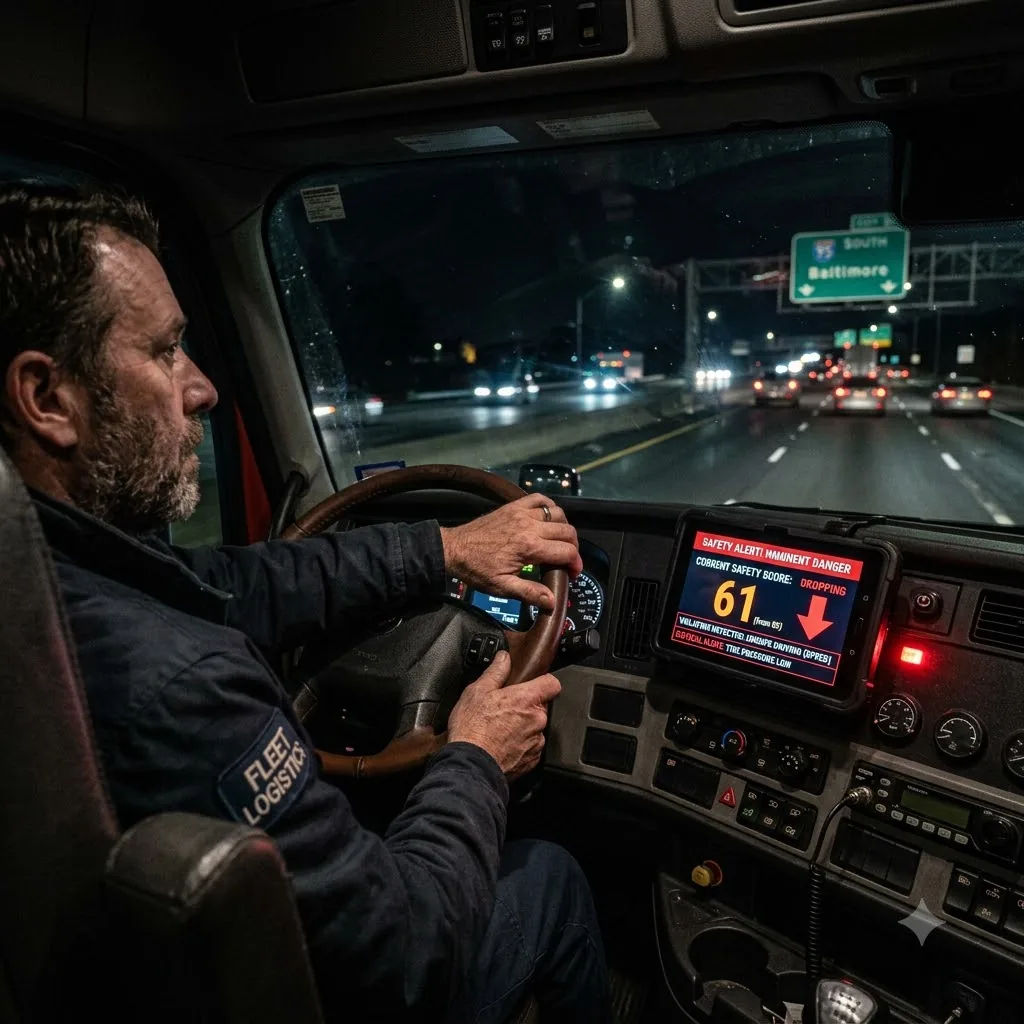
The tablet on the dash flashed from red warning text to a solid, pulsing black screen. A sterile, automated voice overrode the stereo speakers, cutting through the heavy thrum of the diesel engine. “Account locked. Critical safety violation. Remote vehicle immobilization initiated.”
Elias felt the heavy accelerator pedal go completely soft beneath his boot. The resistance vanished entirely. He pumped it twice, desperately trying to force fuel into the engine, but the electronic throttle control had already been severed by the corporate safety algorithms. The tachometer needle stuttered and began a slow, inevitable descent. The massive Cummins engine, his only lifeline in the desolate Nevada night, was spinning down. The rig began to lose speed, coasting entirely under its own eighty-thousand-pound momentum.
“No, no, no, not out here,” Elias muttered, his voice raspy in the dry cab. He reached across the dashboard, his calloused fingers frantically punching the manual override sequence into the tablet. He hammered his fist against the screen, but the biometric lock held firm. The company’s safety protocols were absolute. If a driver proved completely unresponsive or dangerously erratic-like staring backward into a mirror while at highway speeds-the truck was programmed to gently bring itself to a halt on the shoulder.
Out here, coming to a halt meant death. A violent, shuddering impact slammed into the rear of the flatbed. The entire cab pitched forward, throwing Elias hard against his shoulder belt. The steering wheel jerked in his grip, nearly snapping his wrists as the front tires momentarily lost traction. The jagged shape behind him wasn’t just tailgating anymore; it was actively ramming the heavy steel undercarriage of his trailer.
He looked back into the mirror. The yellow light was blinding, but he could see the thick canvas tarp covering his flatbed load violently tearing away. Whatever was behind him had extended a heavy, articulated arm or ramp, scraping a terrible groove down the rear doors of the trailer. The smell of burning rubber and oxidized metal began to seep through the vents, choking the sterile, air-conditioned oxygen of the cab.
The automated voice chimed again, perfectly calm, entirely detached from the nightmare unfolding. “Speed reduced to fifty-five miles per hour. Please prepare for an automated lane departure to the right shoulder.”
Elias gripped the wheel with his left hand, fighting the automated steering column that was now trying to gently pull the rig toward the dark, gravel edge of Interstate 80. With his right hand, he reached under the dashboard, his fingers digging blindly into the tangled nest of wiring behind the electronic logging device. He didn’t have time to be surgical. He found a thick bundle of braided wires connected to the AI camera system and yanked with all his strength.
A sharp spark burned his knuckles. The red and green LEDs on the camera flickered, but the blaring alarm didn’t stop. The system was hardwired into the engine control module on a separate, reinforced circuit. The company had engineered it so a panicked driver couldn’t simply unplug the watchful eye to hide an accident. The truck continued its forced deceleration, the speedometer needle dipping steadily below fifty.
Another ramming impact. This one hit harder, slightly off-center. The rear trailer wheels locked up for a fraction of a second, sending a terrifying lateral sway through the connection point. Elias wrestled the wheel, steering aggressively into the skid to keep the rig upright. If the trailer flipped at this speed, it would crush the cab flat and drag him along the asphalt in a shower of sparks.
In the side mirror, the jagged shape began to slide out from directly behind the flatbed, moving into the left passing lane. As it pulled parallel to the rear axles of his trailer, Elias finally got a better look at it. It was a rolling fortress, devoid of any visible windows, windshield, or driver compartment. The exterior was a chaotic patchwork of heavy steel plating and industrial grating. Massive, oversized tires chewed up the painted dashed lines. From the center of its armored chassis, a thick, mechanized spear-like structure was pivoting, aiming directly toward the side of Elias’s trailer.
His flatbed was carrying massive wooden spools of industrial copper wire-a high-value load that made him a prime target for hijackers. But this wasn’t a standard highway robbery. They weren’t trying to force him off the road to steal the rig intact. They were tearing the trailer apart piece by piece while it was still moving.
The tablet pinged with a new message, an incoming text from his remote dispatcher, utterly oblivious to the mechanical monster pacing the truck. “Elias. Your safety feed is dark. Telematics show emergency braking. Do not exit the cab. Police dispatch has been notified. Estimated response time: 47 minutes.”
Forty-seven minutes. He didn’t have forty-seven seconds. The automated braking system clamped down harder on the air brakes. The truck shuddered violently, dropping to forty miles per hour. The heavy steering wheel pulled sharply to the right as the AI forced the rig onto the gravel shoulder. Rocks pinged loudly against the undercarriage. The mechanized spear on the armored vehicle extended with a pneumatic hiss that Elias could hear over the roaring engine, punching straight through the side of his flatbed trailer.
A heavy shower of copper wire and shredded canvas exploded into the night air. The impact acted as a violent anchor, tethering the two massive vehicles together. Elias’s rig lurched hard to the left, physically fighting the AI’s automated pull to the right. The tires screamed against the pavement. The cab filled with the deafening sound of tearing metal and structural failure.
“Speed reduced to twenty miles per hour. Engaging parking brakes in ten seconds,” the automated voice announced brightly.
Elias looked down at the heavy steel tire iron resting on the passenger side floorboard. The truck was blindly parking itself, deliberately locking him inside a stationary cage while the towering, faceless machine attached to his trailer prepared to finish the job.