Story code: ST-001773
Part 2: Hard Migration
The brass knocker slammed against the door again, the heavy impacts vibrating through the hardwood floorboards of the hallway. Sarah froze, her fingers hovering inches above the mechanical keyboard. The glowing green text of her shadow terminal reflected in her glasses, waiting for the final execution command. She glanced at her secondary monitor, where her smart home hub had managed to recover from the brute-force attack just long enough to display the front porch camera feed.
Two police officers stood on her welcome mat. One had his hand resting casually but purposefully on his holstered sidearm.
Swatting. The digital mob had escalated to weaponizing local law enforcement within minutes.
Sarah shoved away from her desk, her heart hammering violently against her ribs. She took a deep, shuddering breath, forcing her face into a mask of sleepy, irritated confusion, and walked to the front entryway. She pulled the heavy wooden door open just as the lead officer raised his fist to knock a third time.
“Sarah Jenkins?” the officer asked, his eyes darting past her shoulder to scan the dimly lit interior of her house.
“Yes, officer. Is something wrong?”
“We received a priority emergency call,” the second officer said, stepping slightly to the side to widen his field of view, checking the shadows of her living room. “An anonymous tip claiming an active hostage situation and a rigged explosive device at this address. You need to step outside, ma’am. Keep your hands where we can see them.”
The crisp night air hit her as she complied, standing barefoot on the cold concrete of her porch. The flashing red and blue lights of their cruiser painted her quiet suburban street in a chaotic strobe. “I’m a software engineer,” she said, keeping her voice remarkably steady despite the adrenaline flooding her system. “My company suffered a massive data breach today. The CEO publicly blamed me on social media about an hour ago. My personal information, including this address, was leaked online. This is a fake call. It’s called swatting.”
The officers exchanged a long, skeptical look. They asked her a dozen pointed questions, demanded to run her physical ID, and performed a tense, methodical sweep of the immediate entryway and living room. It cost her fifteen excruciating minutes. Fifteen minutes where Julian’s expensive, outsourced crisis management team was undoubtedly tearing through her backend systems unchecked.
“We’ll log it as a false report,” the first officer finally said, handing back her driver’s license with a frown. “But with your information out there, this might not be the last call we get tonight. Lock your doors. Turn off your lights. Consider staying somewhere else until this blows over.”
“I can’t,” Sarah muttered as they turned back to their cruiser. “I have to work.”
She locked the deadbolt, threw the brass chain, and sprinted back to her office. Her phone, abandoned on the floor, was vibrating so intensely it was slowly spinning in circles on the wood. She ignored it and dropped back into her chair.
Her terminal was still active. The shadow infrastructure-the true, hidden backbone of Zenith Logistics that she had quietly built to keep Julian’s bloated, poorly optimized code from crashing the servers on a daily basis-was waiting. Zenith didn’t just move digital data; they moved physical freight. Thousands of trucks, coordinating real-time perishable deliveries across the coast. Julian thought he had locked her out of the routing dashboard, but the dashboard was just a pretty user interface sitting on top of her proprietary event-driven architecture.
She typed a rapid sequence to pull the current server telemetry. The output scrolled down the screen in a blur of white text, and Sarah’s stomach tightened into a painful knot.
They weren’t just locking her out. They were executing a hard migration.
Julian’s crisis team was blindly copying the core production databases to a brand-new, isolated server cluster, intending to sever the old environment completely. It was a scorched-earth tactic to ensure the “rogue engineer” couldn’t touch anything ever again. But they were moving so recklessly fast, they were completely ignoring the legacy dependencies.
Sarah pulled up the migration logs through her shadow access. “You absolute idiots,” she whispered to the empty room.
They didn’t realize that the fleet’s GPS routing API was hardcoded to the old database schema. If they completed the migration and killed the legacy servers, every single Zenith truck currently on the highway would instantly lose their routing manifests. The entire supply chain would halt in its tracks. Millions of dollars of perishable goods would rot in transit.
And Julian would have the perfect, undeniable narrative: *The rogue engineer planted a logic bomb on her way out to destroy the company.*
More dangerously for Sarah, the old server held the raw access logs. It held the irrefutable digital footprint of Julian forcefully overriding her deployment blocks yesterday, which directly caused the massive customer data leak he was currently blaming on her. If that server was wiped, her only proof of innocence vanished into the digital ether forever.
She had to intercept the migration. She had to download the access logs before the transfer completed, but the network bandwidth on the shadow relay was brutally throttled to avoid triggering automated security alarms.
Her fingers flew across the keyboard, writing a quick, dirty bash script to prioritize the log extraction. `Executing packet tunnel…`
Suddenly, the overhead lights in her office flickered and died. The low hum of her refrigerator in the kitchen cut out. Her primary monitors went completely black, plunging the room into absolute darkness.
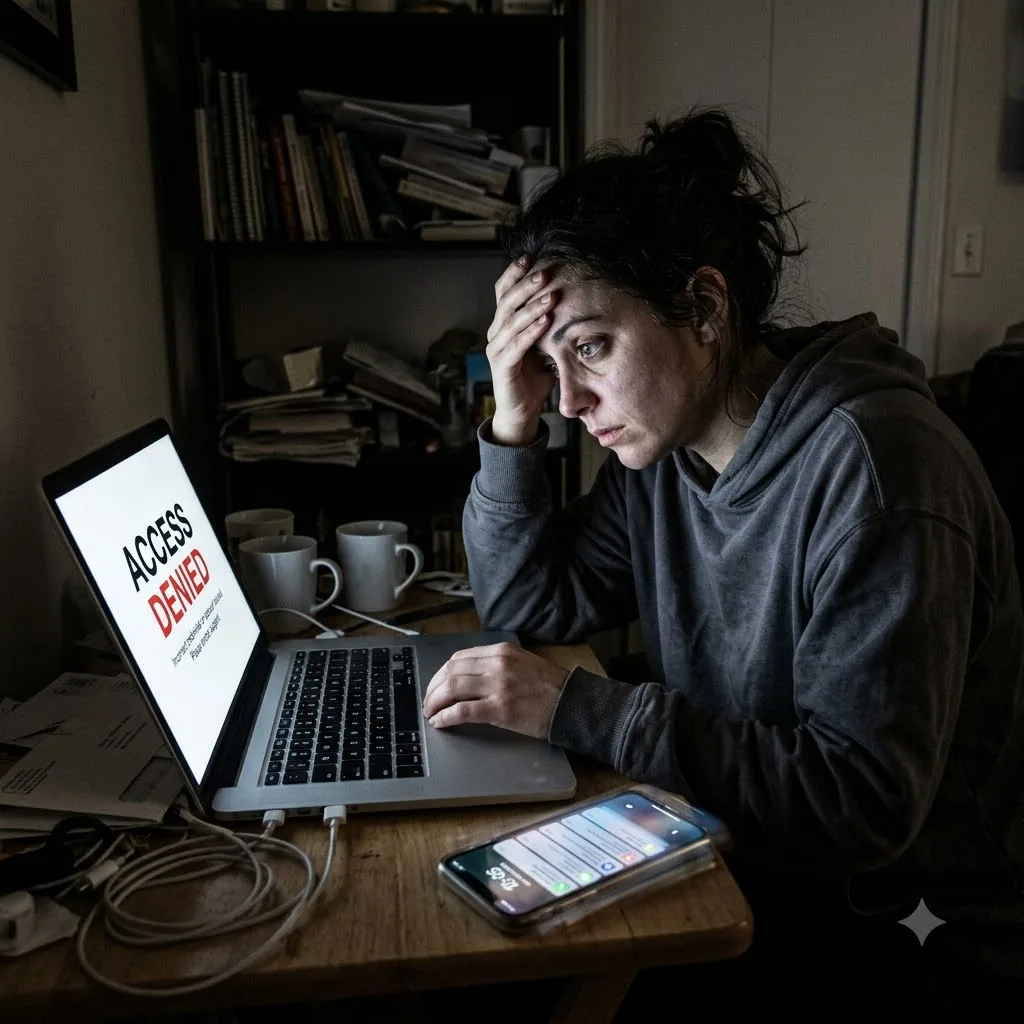
Sarah froze. The only light remaining was the harsh, white glare of her laptop screen, now running on its internal battery. Her home network icon in the corner of the screen switched from a solid Wi-Fi fan to a disconnected globe.
The mob hadn’t just swatted her. They had targeted her utility accounts. Someone had successfully impersonated her and ordered an immediate, emergency shutoff of her local power and internet.
Total isolation crashed down on her. She was sitting in the dark, her physical life being systematically dismantled piece by piece.
She scrambled to turn on her phone’s cellular hotspot, tethering her laptop to the weak 4G signal. The connection icon spun, struggled, and finally clicked over. She quickly re-established the secure tunnel to the shadow relay, praying the connection would hold.
The terminal refreshed. The database migration was at 88 percent.
She initiated the download of Julian’s override logs. The progress bar crawled. *12%… 15%…* The cellular connection was agonizingly slow. If she didn’t get the entire file, it wouldn’t stand up in any legal proceeding.
Then, the terminal chimed-a sharp, jarring sound in the quiet house. A new process had just been spawned on the Zenith server side. It wasn’t an automated script. Someone on the crisis team had detected her shadow tunnel.
A raw, unencrypted text string appeared directly in her command line interface, forcefully bypassing every stealth protocol she had active.
`SYS_ADMIN: We see the backdoor, Sarah. Canceling your download. The police are already on their way back to your house, and this time they have a warrant for corporate sabotage.`
The download progress bar froze at 41 percent, and the entire terminal flashed red.