Story code: ST-001630
Part 3: The Ghost in the Machine
“Eight,” Vance repeated, his fingers tightening on the corner of the heavy paper check.
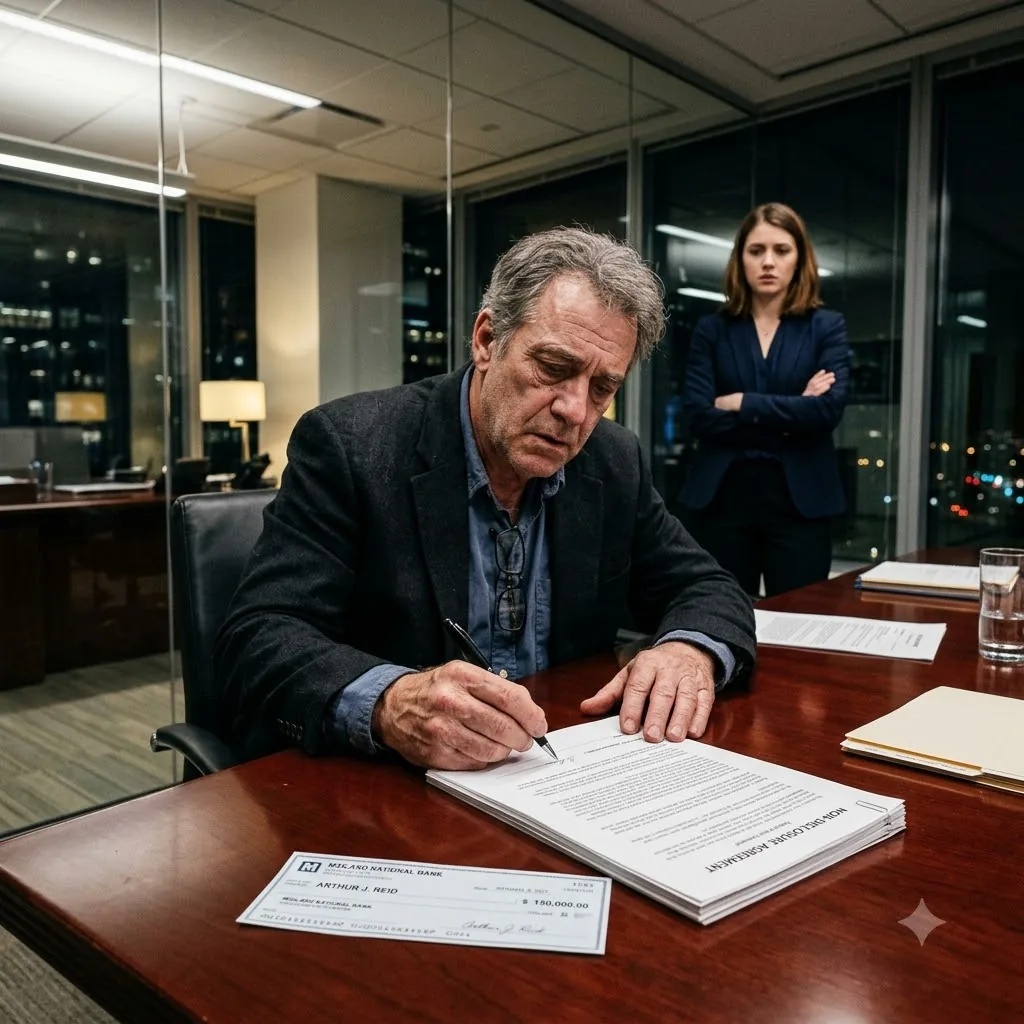
Arthur opened his hand. The heavy silver pen dropped onto the mahogany table with a sharp, final clatter. It rolled over the non-disclosure agreement, leaving a tiny bead of black ink near the signature line, and came to a rest against Chloe’s trembling wrist.
“Nine,” Vance said, but his triumphant sneer faltered. He looked down at the discarded pen, his brow furrowing in confusion.
“I’m not signing it,” Arthur said. His voice was no longer a dry croak. The sheer absurdity of the moment had suddenly crystallized into a cold, profound clarity. He looked at his own attorney. “Back off, Tom. Both of you.”
“Arthur!” Davis gasped, his hands flying to his thinning hair as he practically climbed onto the table. “You are throwing away your life! You can’t afford to walk away from this!”
“I already threw it away,” Arthur said softly. He turned his full attention to the pale engineer standing over his document. “Show me, Chloe. Show me what you built.”
Vance erupted. “Security! I am not playing this game! This mediation is over! The offer is rescinded!” He snatched the cashier’s check from the table, waving it in the air like a weapon.
Chloe didn’t flinch. The moment Arthur dropped the pen, a frantic, hyper-focused energy seemed to overtake her terror. She reached down into the oversized canvas tote bag resting against her chair leg and hauled out a thick, agency-issued laptop. She slammed it onto the mahogany, directly over the NDA, and threw open the lid.
“Ms. Aris, close that machine right now, or I will have you arrested for corporate espionage!” Vance yelled, lunging across the wide table to slam the screen shut.
Arthur stood up. He wasn’t a large man, and the last two years of relentless litigation had hollowed him out, but he planted his hands on the table and leaned directly into Vance’s path, physically blocking the lawyer’s reach. “If you touch her, Vance, I will bypass the civil courts and have you arrested for assault. Let her finish.”
Vance froze, caught completely off guard by the sudden defiance. The mediator shrank back against the frosted glass wall, a silent, wide-eyed spectator to the derailment.
Chloe’s fingers flew across the keyboard. Lines of terminal code reflected in her dark eyes. “They told the press we licensed a generic enterprise AI,” she said, her voice fast and breathless. “An off-the-shelf language model. They said it was just a tool to optimize workflow and generate ideas. That was a lie.”
She hit a final keystroke. A proprietary dashboard loaded on the screen. The agency’s familiar blue logo sat in the top left corner, but the rest of the interface was a stark, utilitarian grey, devoid of any corporate polish.
“Generic models are trained on the public internet,” Chloe explained, her eyes locked on the screen as she navigated through nested, encrypted folders. “They sound like everyone, which means they sound like no one. The agency didn’t want a generic copywriter. They wanted you. They wanted the man who won them fourteen industry awards. But they didn’t want to pay your senior salary, and they didn’t want you aging, resting, or having opinions.”
Arthur stared at the screen. The folder names flashing by were dates. Decades of dates, stretching all the way back to the late nineties. “What is this?” he asked, a cold dread pooling heavily in his stomach.
“It’s an offline, isolated model,” Chloe said. “I built the neural architecture, but they restricted my access to the training data. They told me they were uploading old, public campaigns to teach it basic brand standards. But I bypassed the sandbox last night. I looked at the raw data they fed it.”
She clicked a master directory labeled *A.P. Source*.
Arthur stopped breathing.
The screen populated with thousands of text files, scanned notebooks, and audio logs.
“They didn’t just scrape your published work, Arthur,” Chloe said, turning the laptop slightly so he had a clear view. “They scraped your local hard drive. Your agency-issued phone. Your personal cloud backups that you logged into from the office network. Everything you ever typed or spoke into a company-owned device for thirty years.”
Arthur leaned closer, his chest tight. He recognized the file names instantly. *Winter_Campaign_Draft_1.doc*. That was from 1998. It was a campaign that had been killed in committee, a quiet, melancholic piece of writing he had loved but never shared outside a single closed-door meeting. Below it were hundreds of others. *Notes_on_Rain.txt*. *Thoughts_April.docx*. Personal musings. Private observations. Unfinished sentences he had typed out while eating lunch alone at his desk.
“They stole your mind,” Chloe whispered, her eyes shining with horrific guilt. “Every false start, every private draft, every discarded idea. They mapped the exact neural pathway of your creativity to train this model exclusively on you.”
“This is a breach of confidentiality!” Vance roared, his face turning a deep, dangerous purple. He pointed a shaking finger at Davis. “Your client is in possession of stolen company secrets! This is a criminal act!”
“It’s my work,” Arthur said, his voice deadly quiet. “These are my private files.”
“You created them on company hardware!” Vance shot back, slamming his fist onto the table. “Under the terms of your employment, the agency owns every single keystroke you made on that network! We own the data! We own the output!”
“But you didn’t just keep the data,” Chloe interrupted. She clicked a final button on the dashboard. “You resurrected him.”
A small media player appeared on the screen. A text box beneath it read: *Prompt: Write a sixty-second radio spot for the new luxury sedan. Theme: Nostalgia and rain. Read in default voice.*
Chloe pressed play.
Static hissed from the laptop’s small speakers, followed by a soft, rhythmic drumming that sounded exactly like rain against a windowpane.
Then, a voice spoke.
*”There’s a specific kind of quiet that only happens at 3:00 AM, when the world is washed clean…”*
Arthur stumbled backward. His hip caught the edge of his heavy leather chair, nearly knocking it over.
It was his voice.
Not an approximation. Not a robotic, stitched-together imitation. It was the exact, raspy timbre of his own throat, complete with the slight pause he always took before a dependent clause, the subtle softening of his consonants when he leaned into a conversational tone.
*”…when the headlights cut through the fog, not just lighting the road, but illuminating a memory.”*
Arthur felt his pulse pounding violently in his temples. The phrasing, the cadence, the emotional vulnerability-it was unequivocally his writing. It was the exact tone he had spent three decades perfecting, the unmistakable authorial signature that had built the agency’s empire. He was listening to a digital ghost of himself, conjured from thirty years of his stolen memories, pitching a car he had never seen.
The voice continued to play, filling the sterile mediation room with Arthur’s stolen soul.
Vance stood paralyzed on the other side of the table, his fist still hovering uselessly above the mahogany, the crumpled $850,000 settlement check clutched in his sweaty palm. He wasn’t yelling anymore. He just stared at the laptop, his chest rising and falling in shallow, panicked breaths as the undeniable proof echoed off the glass walls.
Arthur slowly raised his eyes from the glowing screen to the agency’s lead counsel. The silence beneath the artificial voice was absolute.
“Boilerplate,” Arthur whispered.
Vance swallowed hard, his mouth opening, but no sound came out. For the first time in two years, the lawyer had absolutely nothing to say.