Story code: ST-000580
Part 4: The Cost of Humanity
Zero seconds.
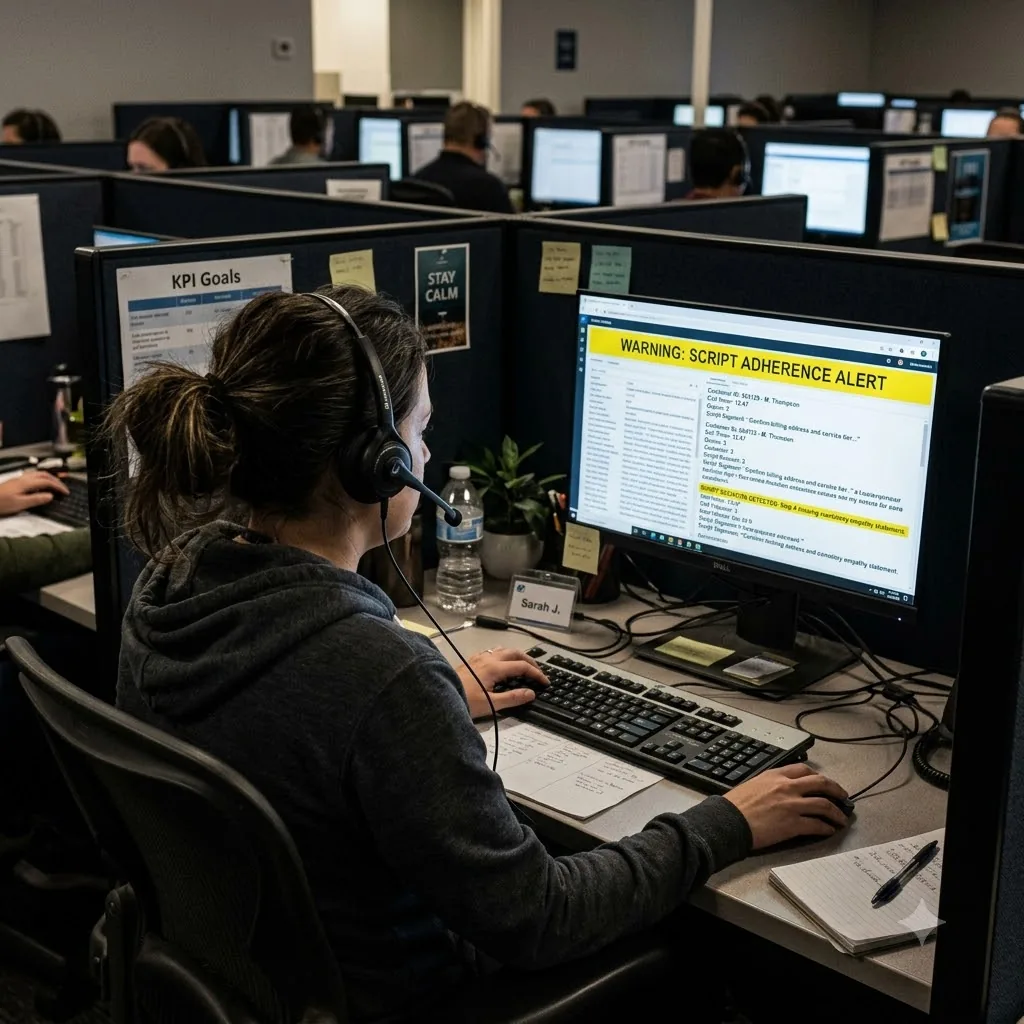
The guard’s thick fingers closed around the braided power cable at the back of the terminal. With a violent, upward jerk, he tore the cord from its socket. The monitor died instantly. A hard, flat black swallowed the blinding corporate amber of the termination script. The ambient hum of the localized cooling fans whined down to a pathetic halt.
In Marcus’s headset, the audio feed severed. The desperate, echoing sobs of the widow vanished. The synthetic baritone of Quality Assurance Unit 7 was abruptly cut off. There was no static, no dial tone. There was only the heavy, muffled acoustics of the cubicle floor pressing in through the noise-canceling foam, a thick and unnatural silence.
Marcus exhaled. His hands, which had been flying across the keyboard with frantic precision moments ago, now rested loosely on his thighs. He reached up, his fingers brushing the cheap plastic housing of the headset, and pulled it off his ears. He unplugged the audio jack from the dead console. The mechanical *snick* of the metal pin leaving the port sounded like a vault door locking shut.
The security guard was breathing heavily, towering over the desk. One hand rested on the tactical baton at his utility belt; the other still clutched the frayed end of the severed power cable. But the guard wasn’t the one who broke the silence.
“Stand up, Marcus.”
Marcus turned his head. It was the floor supervisor, Reynolds. Reynolds was a ghost on the processing floor, a man who only manifested when an employee’s adherence metrics fell below the eighty percent threshold for three consecutive shifts. Now, he stood squarely in the aisle, flanked by two additional security personnel. The tablet in his hand was already glowing with Marcus’s employee file, a giant, pulsing red *TERMINATED* watermark bleeding through his personnel data.
Marcus looked down at the floor. The plastic asthma inhaler lay on the thin industrial carpet, right next to the polished tip of Reynolds’s dress shoe. Marcus leaned over, moving slowly enough that the guard didn’t draw his weapon, and picked it up. He wiped a speck of dust from the mouthpiece.
He thought about the medical portal on his screen turning gray. *COVERAGE DENIED*. The reality of it hit him now, a cold, suffocating weight settling into the bottom of his stomach. Tomorrow at 0800 hours, the pharmacy network would reject his daughter’s refill. He would have to empty his checking account, drain what little savings he had left, and maybe sell his car just to buy a single month’s supply at the uninsured retail markup. After that, he didn’t know. The merciless math of his own ruin was just as stark as the casualty matrix he had just leaked. He had traded his daughter’s oxygen for a dead man’s dignity.
“You realize what you’ve done,” Reynolds said, his voice completely devoid of anger. It was clinical, detached-the voice of a man who had internalized the QA algorithm so deeply he no longer needed a script. “You breached a Level 4 firewall, violated your non-disclosure agreement, and triggered a localized security lockdown. You threw your life away for a nine-digit claim number that Legal will bury in arbitration by tomorrow morning.”
Marcus slid the inhaler into his pocket. His fingers wrapped tightly around the plastic casing. It grounded him, reminding him of what was real.
“The audio log is immutable,” Marcus said. His voice was quiet, but steady. He barely recognized his own tone. It lacked the hollow, subservient cadence of a Tier 1 processor. “You can’t delete a direct claimant recording. It’s hardcoded into the compliance mandate to protect the company. Now, it’s going to destroy it.”
Reynolds narrowed his eyes, his expression tightening into a mask of corporate irritation. “Grab your personal items. You have sixty seconds to vacate the premises before I authorize a physical extraction.”
Marcus looked back at his desk. There were no pictures of his daughter. Personal items on the workstation were flagged as visual distractions by the productivity AI. There was only a company-issued pen and a half-empty bottle of water. He had nothing to take. He had entered this building with nothing, and he was leaving with nothing.
“His name was David,” Marcus said.
Reynolds frowned, genuinely confused by the statement. The name didn’t compute against the metrics on his tablet. “Move.”
Marcus stepped out of the cubicle. The entire row of processors was silent. Dozens of faces, pale in the artificial glow of their monitors, were turned toward him. The automated prompts on their screens were undoubtedly flashing red, warning them of unauthorized eye movement, penalizing their adherence scores by the second. But nobody looked away. They had all heard him. Over the low hum of the servers, they had all heard him read the math.
The guards fell in around him, boxing him in, guiding him toward the heavy double doors at the end of the aisle. Marcus walked with his head up. The crushing dread of his financial reality walked right alongside him, a shadow that would swallow him whole the moment he stepped out into the smog-choked daylight. He would have to go home and explain this to his daughter. He would have to figure out how to survive in a world that meticulously calculated the exact cost of human life.
But as the magnetic locks disengaged and the heavy doors swung open to escort him out of the sterile corporate hive, Marcus realized the knot of tension that had lived at the base of his neck for three years was gone. The suffocating weight of being a machine had finally lifted. He kept his hand in his pocket, holding the inhaler, stepping out into the uncertain air-terrifyingly vulnerable, and entirely human.