Story code: ST-000894
Part 3: The Analog Proof
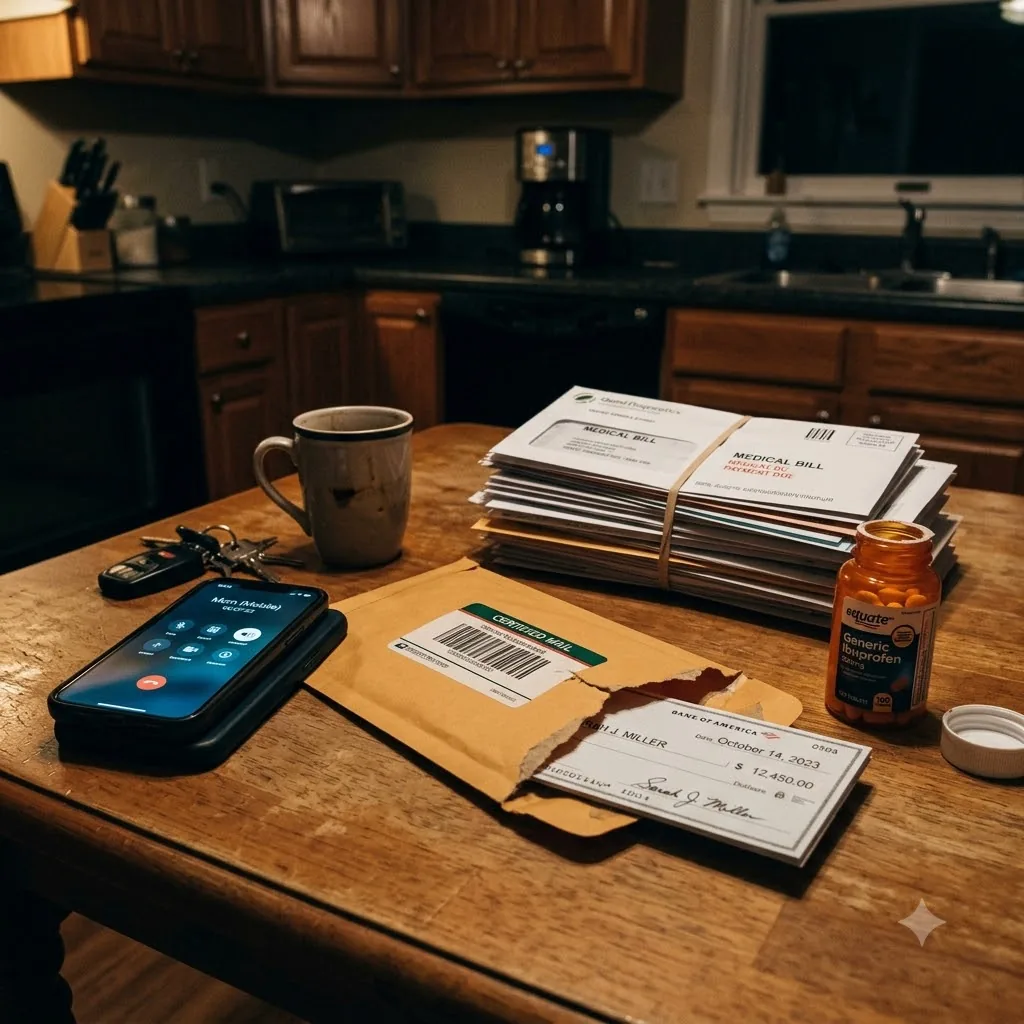
He dug his left elbow into the sticky linoleum, hauling his dead weight forward. One foot. The heavy security paper of the settlement check crinkled in his fist, soaked in his own cold sweat. The agony radiating from his shattered right hip was a white-hot frequency, drowning out the low hum of the refrigerator. He had thirteen feet left to the deadbolt. To keep from blacking out, to force his broken body down the narrow hallway, Marcus anchored his mind to the only thing that mattered: the moment he had broken them.
He closed his eyes against a wave of nausea and let his mind drop back into the grid of nine glowing rectangles on his lawyer’s laptop. It had been three weeks since the final Zoom mediation.
Elena Rostova had occupied the center-top square. She was the Lead Product Manager of Logistics Optimization at the fulfillment corporation, logging in from a sunlit, glass-walled office in San Francisco. She wore a cream cashmere sweater and spent the first two hours of the call occasionally sipping from a frosted glass bottle of mineral water. Her defense had been a masterclass in Silicon Valley detachment.
“The Aegis routing engine is a passive optimization suite,” Elena had told the mediator, her voice calm and entirely devoid of empathy. “It analyzes historical flow and suggests pathways. It does not dictate human biology. If Mr. Vance suffered acute renal failure, and subsequent avascular necrosis from his aisle incident, that is a tragic consequence of his own failure to manage his hydration and report his injury through proper protocols. The code is neutral. It cannot be held responsible for an individual’s poor time management.”
Marcus opened his eyes in the present, gasping as he dragged his right hip over a raised floorboard. The bone ground together like pulverized glass. He spit a mouthful of metallic saliva onto the floor and pulled himself forward another foot.
In his memory, the lead corporate counsel was moving to wrap up the mediation. They were offering eighty thousand dollars-a nuisance payout, provided Marcus signed a non-disparagement clause admitting he was at fault for his own organ failure. David Hirsch, his lawyer, had been frantically typing a private message to Marcus, urging him to consider it.
Instead, Marcus had leaned forward, his face filling his webcam. He ignored David’s protests. He reached into his jacket pocket and pulled out a battered, black resin Casio stopwatch.
“Ms. Rostova,” Marcus had said, his voice cutting sharply through the digital static. “Do you know what this is?”
On the screen, Elena blinked. Her expensive minimalist headset caught the glare of the California sun. “A timer?”
“It’s an analog stopwatch. Because your warehouse banned all personal cell phones on the floor, and the wall clocks were removed last year to ‘reduce visual clutter.'” Marcus held the scratched face of the Casio up to the camera lens. “I bought this at a pharmacy for eleven dollars. And I used the lap-memory function every single shift for three years.”
Elena’s expression hadn’t changed, but she had stopped sipping her water.
Marcus opened a small, grease-stained spiral notebook on the table in front of him. “The lie you’re telling today is that your algorithm is passive. But I kept analog records of your digital footprints. October 12th. You pushed a server-side update called ‘Dynamic Queueing.’ I know the exact date because at 10:14 AM, the scanners restarted. Before 10:14, the walk from Aisle Fourteen to the nearest restroom was allocated at four minutes. After 10:14, the scanner dropped the allowance to two minutes and forty seconds.”
One of the corporate lawyers had unmuted to object, but the mediator silenced him. Marcus didn’t wait.
“November 3rd,” Marcus continued, reading from his cramped handwriting. “Version 4.2. In your beta documentation, you called it ‘Gamified Hydration Rewards.’ What it actually did was interface with the physical building security. If a worker’s pick-rate dropped below ninety-nine percent, the algorithm disabled their RFID badge at the breakroom turnstiles.”
Elena’s posture shifted. The effortless, detached lean backward vanished as she sat up straight, her eyes darting off-screen to a second monitor.
“November 18th,” Marcus said, his voice dropping to a dead, hollow flat. “The day my right hip was crushed by a misaligned pallet at 6:00 AM. I was bleeding internally. I was terrified of being fired, so I tried to keep working. But I was limping. My efficiency rating dropped to eighty-four percent. At 9:15 AM, I tried to access the water station to swallow an ibuprofen. My badge flashed red. The turnstile was electronically locked.”
Marcus held the Casio closer to the screen, his knuckles white.
“I stood there for three minutes and forty-two seconds. I have the lap time right here. By 2:00 PM, I was in acute renal failure. Rhabdomyolysis. My kidneys were shutting down from muscle breakdown and severe dehydration. The lack of blood flow killed the bone in my leg.”
He stared directly into the camera, bypassing the lawyers, bypassing his own counsel, looking straight into the center-top square.
“You didn’t write an optimization suite, Elena. You wrote a physical cage. I didn’t choose to destroy my organs. You wrote a line of code that locked the door to the drinking water while I was bleeding to death. And I have the exact millisecond you did it.”
On the screen, the silence was absolute. Elena Rostova’s hand hovered midway to her mouth, frozen in place. The bored, corporate confidence had completely drained from her face, leaving behind a pale, wide-eyed terror. She stared through the webcam at the cheap plastic stopwatch, realizing with absolute certainty that she had left a trail of physical destruction, and he had perfectly, undeniably documented every single keystroke.
The corporate counsel began shouting over each other, desperately trying to mute her feed, but Elena just stared, her mouth slightly open, entirely out of words.