Story code: ST-000796
Part 4: The Shattered Partition
The silence stretched, agonizing and heavy. David stared at Arthur, his chest heaving beneath the oversized green canvas jacket, waiting for a defense, an apology, a denial. When nothing came, the last tether of the old man’s composure simply snapped.
With a raw, tearing sound in his throat, David hurled the amber pill bottle. It struck Arthur squarely in the chest, the heavy plastic cracking hard against his blue pharmacy nametag before dropping back into the puddle of infant formula.
But David didn’t stop there. The crushing grief suddenly metabolized into blind, kinetic fury. He spun around, slamming his fists into the metal shelving unit of aisle four. Boxes of specialized baby cereal and glass jars of pureed carrots rained down, shattering against the linoleum in a chaotic explosion of shrapnel and paste.
“You knew!” David roared, kicking the spilled jars, sending glass flying across the white tiles. “You knew what it was doing to her!”
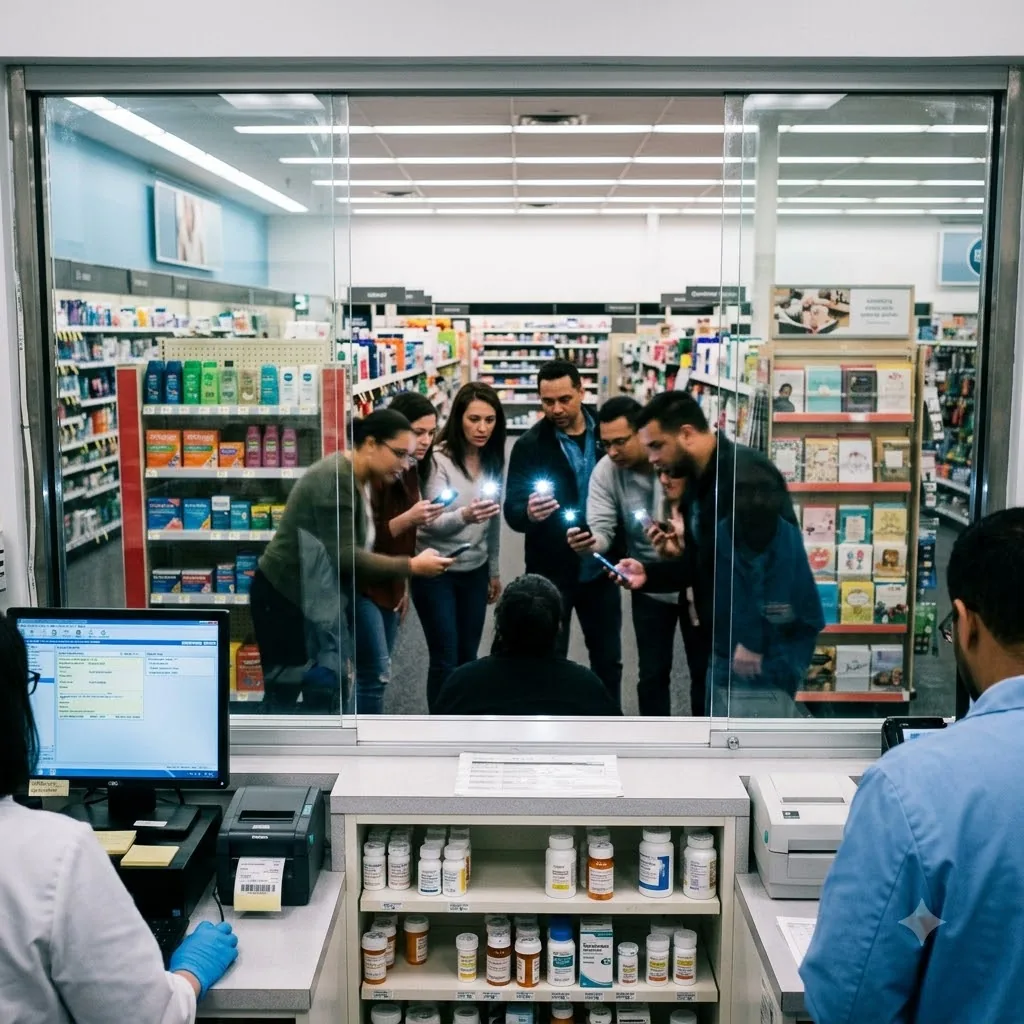
The sudden, violent outburst shattered the crowd’s voyeuristic trance. The teenager in the backwards cap flinched, instinctively taking a large step backward, his phone dipping toward the floor. The businesswoman in the sharp suit gasped, her eyes widening in genuine alarm as a stray chunk of glass skittered over the toe of her leather pump. The clinical detachment of their glowing screens was instantly destroyed. This was no longer a neatly framed spectacle to be consumed on a feed; it was the unpredictable, dangerous reality of a man tearing himself apart.
The spell was broken. The teenagers turned and hurried down the adjacent aisle. The businesswoman slipped her phone into her purse and walked briskly toward the front registers, her head down. Within seconds, the tight ring of onlookers evaporated, scattering into the far corners of the store, desperate to distance themselves from the ugly, uncontainable grief they had just been so eager to document.
“Carl, get back,” Gary said, his voice stripped of its previous authority, replaced by a nervous urgency. The manager grabbed Arthur’s elbow, yanking him backward. “Arthur, step away from him. Let him wear himself out. The police are three minutes away.”
But Arthur didn’t move. He stood anchored in the spilled formula, the pristine hem of his white coat soaking up the sour milk.
David’s violence burned out as quickly as it had erupted. He slumped against the dented metal shelving, his breath coming in ragged, wet gasps. He slid down to the floor, landing heavily in the ruined baby food. He didn’t look at Arthur anymore. The pharmacist had ceased to be a person; he was just another fixture of the store, another cold mechanism in the system that had swallowed his daughter.
David reached out, his trembling hands gathering the three hysterical toddlers. He pulled them against the dark green canvas of Maya’s jacket, burying his face in the oldest boy’s hair. The red dental-floss stitching on the shoulder pressed against the child’s cheek.
“I’ve got you,” David sobbed into the boy’s shoulder, rocking the children amidst the broken glass. “I’ve got you. Grandpa’s here.”
Arthur took a tentative step forward, his hand rising instinctively. “Mr. Vance…”
David didn’t flinch. He just held the children tighter, completely shutting Arthur out. The absolute rejection was more devastating than the screaming had been.
Sirens wailed in the distance, a faint, rising howl bleeding through the store’s automatic sliding doors. Hearing them, David slowly pushed himself up. He didn’t try to run, and he didn’t try to argue. He just looked incredibly frail. He hoisted the youngest girl onto his hip, gripped the oldest boy’s hand, and ushered the middle child forward. Without a backward glance, the old man limped toward the front of the store, leaving a trail of bloody, milk-stained footprints on the tiles. Gary and the teenage security guard simply stepped aside, letting him go.
Arthur was left completely alone in the wreckage of aisle four.
The bright, cheerful pop music continued to play from the overhead speakers, a grotesque contrast to the disaster at his feet. Arthur looked down. The amber prescription bottle floated in the puddle of infant formula, the heavy black marker of his own handwriting staring back at him.
He turned his head, looking down the empty aisle where the crowd had stood. He remembered the disgust he had felt watching them. He had hated them for holding up their screens, for viewing the old man’s agony through a layer of glass, for documenting a tragedy without ever intervening.
Arthur looked down at his ruined coat, and then he looked past the empty aisles, all the way to the back of the store.
The pharmacy counter sat elevated and secure. The thick plexiglass partition gleamed under the harsh fluorescent lights. The computer monitors glowed with patient databases, a perfectly ordered grid of rules and measurements.
A hollow, nauseating cold settled in Arthur’s stomach as the truth finally clicked into place. He was no different from the bystanders with their smartphones. He had done the exact same thing to Maya.
For two years, he had watched her drown. He had stood behind his elevated glass barrier, a passive observer to her destruction. He had noted her paling skin, her trembling hands, and her hollowed-out eyes. He had meticulously logged her escalating dosages into his system, documenting her descent into addiction with clinical precision. And he had done absolutely nothing to stop it. He had hidden behind the legal validity of the doctor’s signature and the boundaries of his white coat, telling himself it wasn’t his place to intervene.
His professional detachment was a lie. His sterile, legal passivity had been just as predatory, just as voyeuristic, as the crowd filming the breakdown. The only difference was that they had just watched the aftermath. Arthur had handed her the bottle.