Story code: ST-001753
Part 4: The Extraction
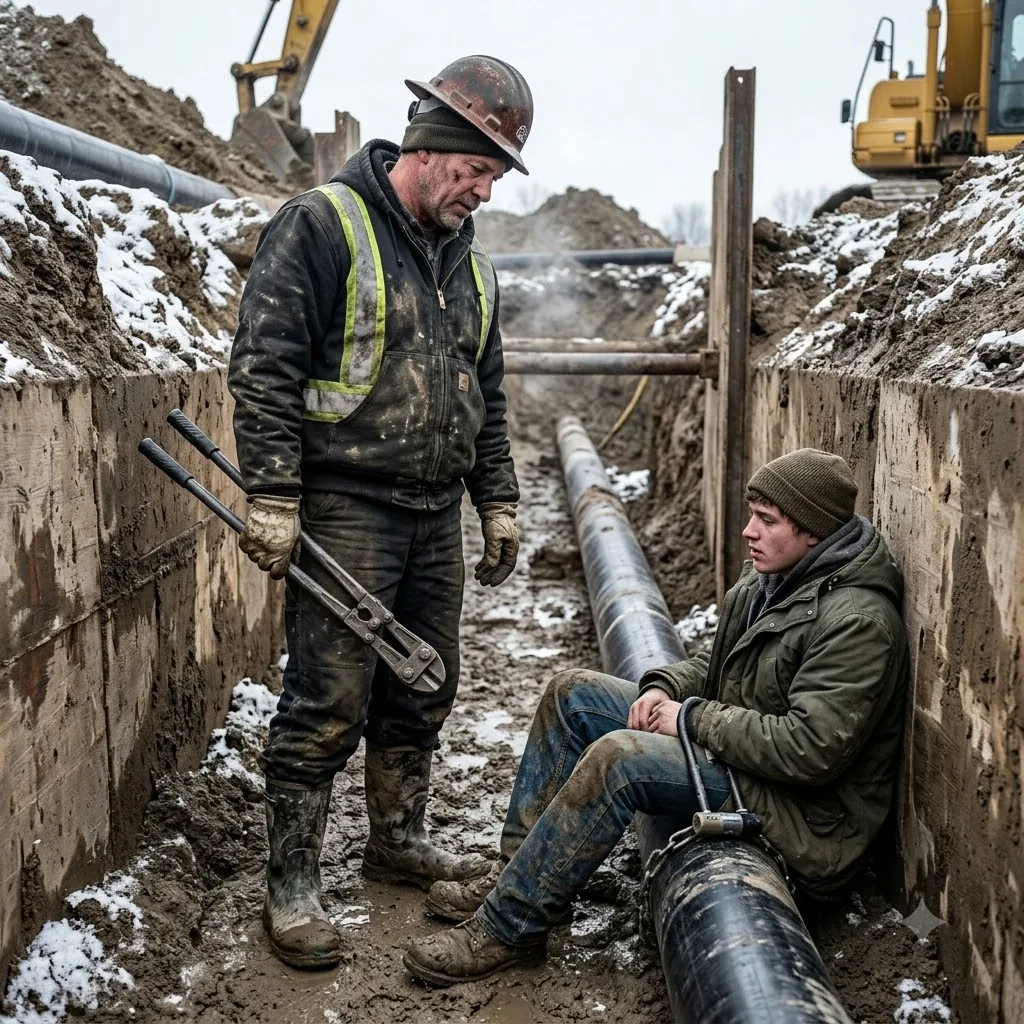
The high-pitched hiss of the fractured flange dominated the trench, spraying a relentless mist of toxic gray drilling fluid into the freezing air. Arthur sat slumped in the ankle-deep mud, his body completely spent. He didn’t have the strength to lift his arms, let alone swing the heavy cast-iron wrench a second time. Opposite him, the kid was crying now, a quiet, panicked whimpering as he futilely clawed at the frozen brass keyhole of the titanium lock. They were both soaked to the bone, shivering violently as the gray slurry coated them in a thick, noxious film.
It took twenty minutes for the county fire department’s heavy rescue team to swarm the excavation site. When they finally descended into the pit, Arthur didn’t fight them. Two broad-shouldered firefighters in heavy yellow turnout gear hooked him under the armpits and unceremoniously hauled him up the slick clay embankment. His legs dragged uselessly behind him. He was entirely numb, his hands locked into stiff, aching claws.
Arthur knelt in the wet gravel at the edge of the trench, his breath pluming in the freezing air, and watched them extract the boy. The fire crew didn’t bother trying to thaw the frozen padlock mechanism. A firefighter hauled a massive hydraulic spreader down into the mud. The heavy jaws whined with immense, unstoppable pressure, gripping the thick titanium U-lock and snapping it like a dry twig. The kid-Leo, Arthur heard one of the EMTs call him-collapsed backward into the slurry, his bright neon waterproof jacket ruined and heavy with gray mud.
“Get up.”
Arthur slowly raised his head. Miller stood over him, the foreman’s face a tight, furious mask of pure corporate liability.
“You are off this site, Arthur,” Miller said. His voice was dropped to a harsh, flat whisper so the approaching state troopers wouldn’t overhear. He didn’t ask if Arthur was hurt. He didn’t look at the bloody scratch on Arthur’s cheek. “I don’t care what your excuse is, and I don’t care about your sob story. You intentionally breached a live, high-pressure hazardous material line. You’re fired. As of right now.”
Arthur tried to speak, to beg, to remind the foreman about Monday morning, about the county bank and his wife’s empty bedroom. But his throat was raw, burning from the toxic mist, and the words died against his teeth.
“The company is keeping your final paycheck to cover the preliminary hazmat cleanup,” Miller continued, his eyes cold and dead. “And if you ever set foot on a pipeline easement again, corporate will bury you in so many civil suits your grandchildren will be paying them off. Turn in your hardhat and get off my site.”
Miller turned his back and walked away, already shouting orders to the arriving hazmat containment crew. Arthur was just a broken gear that had jammed the machine. The gear had been removed. The machine would keep running.
A paramedic grabbed Arthur by the elbow, pulling him to his feet and guiding him toward the back of a waiting ambulance. The EMT wrapped a crinkling silver mylar emergency blanket around Arthur’s shivering shoulders and sat him down on the cold diamond-plate bumper. Arthur let his muddy boots rest on the wet asphalt of the access road. The flashing red and blue lights of the police cruisers painted the heavy morning mist in harsh, rhythmic strobes.
A minute later, a second EMT guided the kid over. Leo was shaking uncontrollably, his teeth chattering so hard they clicked. His lips were tinged a dangerous, pale shade of blue. The paramedic draped an identical silver mylar emergency blanket over the boy’s shoulders and sat him on the bumper, less than two feet away from Arthur.
Arthur stared down at the wet pavement between his boots. The double-time was gone. The hazard pay was gone. The house his grandfather built was gone. He had nothing left to give his wife but absolute failure. Come Monday morning, the bank would take the keys, and they would be completely out of options.
Beside him, Leo pulled the thin foil blanket tighter around his neck. The kid was staring out toward the highway, where the state troopers were aggressively waving away a small group of young people holding protest signs. Leo’s “support team.” They weren’t looking down the access road. They were already arguing with the police, holding up their own phones, filming the officers, moving on to the next piece of content. Nobody came over to check on the boy who had chained his neck to the iron. To the livestream audience, the broadcast was over. To the movement, Leo was just a prop that had outlived its usefulness.
Arthur slowly turned his head and looked at the kid. After a moment, the kid turned and looked back.
There was no anger left in Arthur’s chest, and no smug, rehearsed defiance left in the boy’s eyes. They were just two freezing, terrified men wrapped in cheap foil, sitting in the mud. Arthur pulled his own silver blanket closer, the metallic material crinkling loudly in the damp air. Behind them, the massive diesel engine of the trencher roared back to life, vibrating through the soles of their boots, entirely indifferent to them both.