Story code: ST-001882
Part 3: The Algorithm’s Errand
The iron rung turned in Arthur’s bleeding hands, grinding against flakes of seventy-year-old rust before giving way with a sickening snap. For a split second, weightlessness seized his stomach. He lunged upward with his right hand, his fingers hooking blindly over the solid steel lip of the maintenance gantry just as the rung detached completely.
He dangled seventy feet above the concrete floor, his expensive dress shoes kicking empty air. Below him, the heavy iron pipe plummeted into the dark, clanging violently against the grated stairs. A sharp curse echoed up from the man climbing beneath him.
Arthur ignored the burning in his shoulders and hoisted himself over the edge, collapsing onto the meter-wide walkway of the massive overhead crane. Decades of undisturbed black dust coated the yellow girders. He scrambled backward on his hands and knees, dragging his ruined tailored shirt against sharp rivets until his back hit the cold cinderblock of the factory’s outer wall. It was a dead end. The catwalk ended abruptly at a sheer drop into the darkened assembly pit.
The heavy, rhythmic thud of steel-toed boots vibrated through the metal grating. A massive, grease-stained hand clamped onto the edge of the gantry.
The man in the battered industrial respirator hauled his bulk onto the walkway. His breathing sounded like a dying piston-a wet, mechanical wheeze that filled the suffocating space. He stood up, blocking the only ladder down, his heavy boots planted firmly on the groaning steel.
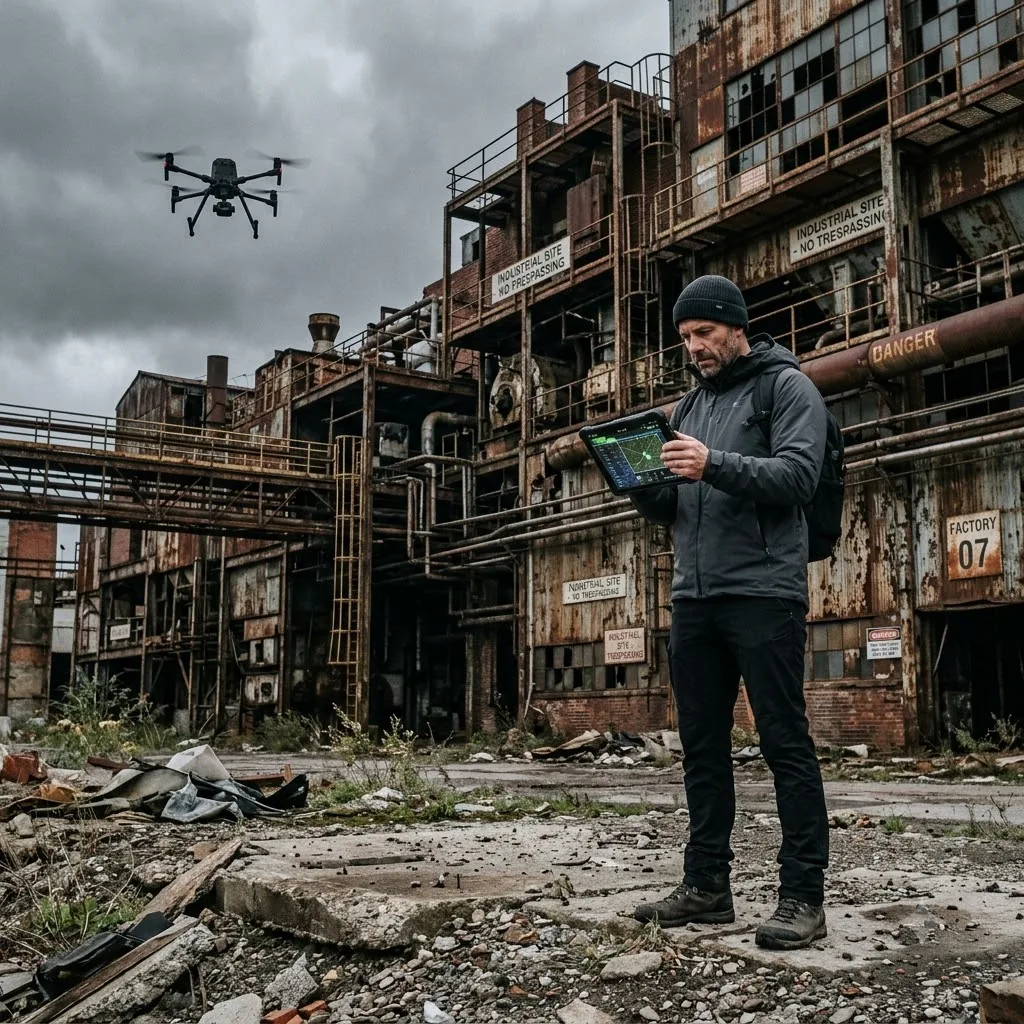
A mechanical whine echoed from the far side of the factory wall. A rusted freight elevator, previously lost in the shadows, ground its way up to the gantry level. The grated doors rattled open, and the second man stepped out onto the catwalk. In his hand, he held Arthur’s shattered iPad.
The screen was severely cracked from where it had been smashed into Arthur’s chest, but the LCD backlight still bled a faint, fractured white light through the spiderweb of glass.
“He didn’t get far,” the second man grunted, walking slowly across the suspended girder to join the man in the respirator. He tossed the damaged tablet to the floor, sliding it across the grating until it hit Arthur’s scuffed Italian leather shoe.
“It’s trying to run a local diagnostic,” the second man said, leveling a heavy, unlit acetylene torch at Arthur’s face like a club. “It wants a biometric login to access the sync cache. Unlock it, suit. Show us if the payload went to your corporate cloud, or I’ll throw you off this edge and we burn the building right now.”
Arthur stared at the shattered glowing screen near his foot. His ribs throbbed violently. His chest heaved as he looked at the two men, their territorial desperation so painfully obvious. They thought they had captured a corporate spy. They thought he was an executive, a wealthy developer plotting to bulldoze their lucrative underworld operation to build luxury condos.
The sheer absurdity of it bubbled up in Arthur’s throat. A harsh, broken laugh escaped him.
The man in the respirator took a threatening step forward, raising his heavy, grease-stained boot as if to stomp on Arthur’s knee. “You think this is funny, suit?”
“I’m not a suit,” Arthur rasped, the corporate confidence entirely stripped from his voice. He reached down and gingerly picked up the cracked tablet, wincing at the pain in his ribs. “Do you honestly think I own this site? Do you think I’m a developer?”
The second man narrowed his eyes. “You’re flying a six-thousand-dollar drone and wearing an Armani shirt.”
“It’s a rental drone. And this is an outlet-mall knockoff,” Arthur said, his voice trembling but gaining a sharp, bitter edge. “It’s my only good interview shirt. I wore it because I thought looking the part might make the acquisition firm actually pay my freelance invoice on time.”
He pressed his thumb against the shattered home button. The screen flashed, accepting the biometric scan. The application unlocked, revealing rows of dense, scrolling code instead of the topographical wireframes from earlier.
Arthur held the tablet out, turning the broken screen toward the two men. “I’m a data analyst. Or I was, until three months ago. The firm that bought this bankrupt holding company laid off my entire department. They replaced us with the exact same proprietary AI mapping software that’s running on this tablet.”
The man in the respirator glanced at the second man, a flicker of confusion breaking his imposing stance. “What the hell are you talking about?”
“I’m talking about why I’m here,” Arthur said, pushing himself up the cinderblock wall until he was standing, albeit unsteadily. He tapped the cracked glass, highlighting a string of automated command logs. “No human being sent me here. No corporate executive looked at a map and targeted your chop shop. The top floor of the development board doesn’t even know this building exists.”
The second man stepped closer, squinting at the glowing green text.
“The AI runs daily sweeps of municipal data,” Arthur explained, his voice echoing in the cavernous rafters. “It looks for anomalies to find undervalued real estate. It noticed a discrepancy in the power grid data for Sector Four. Your military-grade jammer and your diesel generators are creating a massive localized electromagnetic footprint. The algorithm flagged it as a statistical outlier and auto-generated a work order for a physical survey.”
Arthur pointed to his own chest, right over the spreading bruise. “I’m just a desperate, out-of-work contractor who took a two-hundred-dollar gig to bring the drone to the coordinates the machine spit out. The algorithm deployed me like a glorified delivery boy.”
The men stared at the scrolling text, the hostile certainty in their posture beginning to waver. The terminal logs explicitly showed automated queries, completely devoid of any human names or executive oversight.
“We’re fighting over scraps in a dead factory,” Arthur said softly, lowering the tablet. The violet glow of the jammer far below illuminated the exhaustion on his face. “You’re hiding from the cops and the corporations, thinking you outsmarted them. But you were found by a line of code looking at a spreadsheet. We’re both just getting erased by the same math.”
The man in the respirator slowly lowered his arms. The mechanical wheeze of his breathing suddenly sounded less like a threat, and more like the desperate gasping of a drowning man realizing the tide had already taken him. He looked down at the chopped luxury SUVs in the violet light below, then back up to the shattered screen in Arthur’s hand, entirely out of answers.