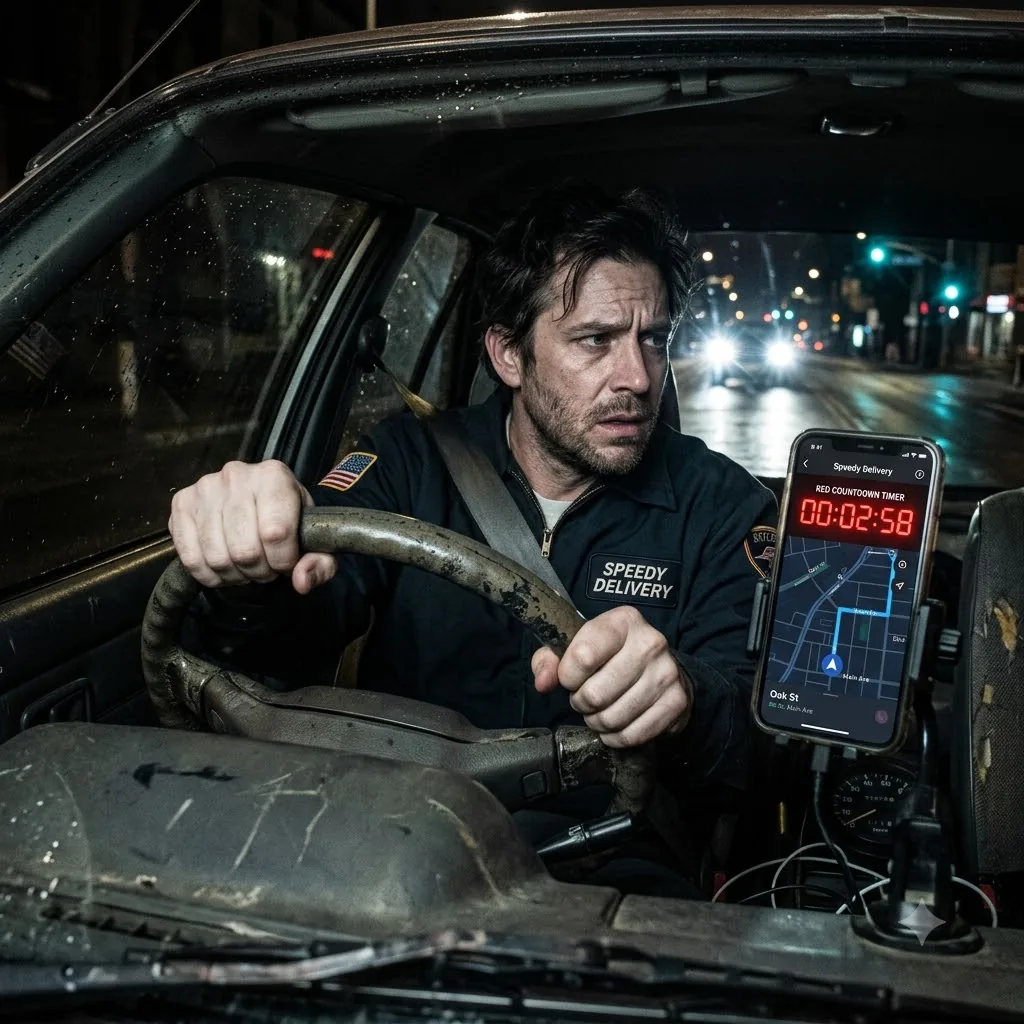
Story code: ST-000815
Part 2: The Beta Tier
The face was unmistakable. Elias had stared at it for three hours straight last month during the mandatory, uncompensated “Driver Excellence” retraining modules. He had seen it on the glossy cover of Tech Innovator magazine while waiting in line at the grocery store, placed right next to the headline: The Man Who Solved the Labor Puzzle. It was Julian Thorne. The founder and CEO of OmniDash. The architect of the very algorithm currently strangling the life out of Elias, dollar by dollar.
Thorne stood relaxed in the doorway, barefoot on the gleaming hardwood, a heavy crystal glass of amber liquid in his left hand. Up close, the tech billionaire looked impossibly rested. His skin possessed a healthy, expensive glow that sharply contrasted with the deep, purple bags beneath Elias’s own eyes. The sprawling foyer behind him was a testament to minimalist wealth, all polished stone and floating staircases.
“Are you going to hand that over, or just bleed truffle oil all over my porch?” Thorne asked. His voice was smooth, carrying the casual authority of a man who hadn’t been told no in a decade.
Elias looked down. The crushed paper bag was weeping a steady, dark drip of soy and oil onto the pristine slate beneath his worn sneakers. The heavy scent of the expensive food, once agonizingly appetizing to his empty stomach, now made him violently nauseous. The practiced, desperate apology he had been rehearsing in the suffocating heat of his car evaporated completely. His jaw worked, but his vocal cords refused to produce sound. The man standing in front of him wasn’t just a customer; he was the reason Elias’s car had no air conditioning. He was the reason Elias had run a yellow light yesterday and nearly caused a pileup, terrified of a sixty-cent time penalty.
“I…” Elias finally managed to scrape a single syllable from his dry throat. He instinctively pulled the ruined bags slightly closer to his chest, uncaring that the grease was soaking into his faded t-shirt. “There was a dog. On Elm Street. It darted out from between two cars. I had to slam on the brakes.”
Thorne sighed, a soft, weary sound of mild inconvenience. He took a sip of his drink and reached into the pocket of his crisp linen trousers, producing a sleek, matte-black smartphone. “Look, man, I get it. Things happen. I’ll just tap it out on the app as a damaged transit. The system will auto-dispatch a replacement from the restaurant. You don’t need to worry about it.”
“No,” Elias blurted, the sheer volume of his own voice startling him. He took a half-step forward, his panic overriding his exhaustion. “Please. No. Don’t do that.”
Thorne paused, his thumb hovering a fraction of an inch above his glowing screen. His eyebrows knit together in mild, patrician confusion. “Excuse me?”
“If you mark it damaged,” Elias said, the words tumbling out in a frantic, disjointed rush, “the system logs it as a critical failure. My rating is at ninety-one percent. If it drops to ninety, I get throttled. I won’t get any shifts for a full week. Rent is due on Tuesday. If I get throttled, I’m out on the street. Please. I’m begging you.”
Thorne offered a practiced, sympathetic smile-the exact same empty smile from the retraining videos. “The algorithm doesn’t punish good drivers, friend. It simply optimizes the fleet. If your score is hovering at the threshold, it means your current routing metrics are already sub-optimal. The platform adjusts for standard variance. A single damaged order only costs you a tenth of a point. It’s perfectly equitable.”
“It’s not a tenth of a point!” Elias’s voice cracked. “Your new update-the one from last week! It changed the penalty structure. A total loss order drops the driver by a full point and a half. It triggers an automatic tier reduction.”
Thorne’s expression shifted. The friendly veneer thinned, his eyes narrowing as he evaluated the sweating, desperate man on his porch. “The dynamic penalty update hasn’t been pushed to the public release yet. How do you know about that?”
“Because I’m in the Beta tier,” Elias said, his chest heaving with shallow, rapid breaths. “Because I’ve been driving for your company for four years. Because I was forced into the testing pool last month. I watched your app dock me five dollars on the way up this very hill because I avoided a traffic jam that wasn’t on your map. If you press that button, you fire me. Literally. You fire me over a dog.”
Thorne stared at him for a long, silent moment. The melodic hum of cicadas in the meticulously landscaped bushes seemed to grow deafening. Thorne glanced down at his phone, the interface of the OmniDash customer portal glowing brightly in the dusk, then back up to Elias. He didn’t put the phone away. Instead, he reached into his front pocket with his other hand and pulled out a silver money clip.
“I appreciate your long-term dedication to the platform,” Thorne said, his tone shifting from casual to purely transactional. He peeled a crisp hundred-dollar bill from the thick stack and held it out. “Here. This covers your rent, or whatever short-term liquidity issue you’re facing. But I still haven’t received my dinner.”
Elias stared at the money. A hundred dollars. It was more than he had made in the last fourteen hours of grueling, continuous driving. It would keep the lights on. It would buy him a few days of survival.
“Take the cash,” Thorne instructed, his voice hardening into a direct command. “Then I need you to open your app and swipe ‘Confirm Handoff’. If you do that, the system thinks I accepted the order intact. Then I can file a post-delivery quality complaint on my end. It routes through customer service instead of the automated transit penalty layer. You keep your rating, I get my refund, and my assistant orders me something else.”
Elias’s hand trembled violently as he reached into his pocket and pulled out his cracked Android. He opened the OmniDash driver portal. The bright green slider waited at the bottom of the screen: Confirm Handoff.
But Elias knew the fine print of the Beta tier. He knew the hidden architecture of the code better than the insulated billionaire who had commanded its creation. If a customer filed a post-delivery quality complaint on a confirmed handoff, the algorithm didn’t just dock points. It flagged the driver for deliberate tampering and fraud. It was a permanent ban. No appeal. No human review. It was the digital death penalty.
“Swipe it,” Thorne said, thrusting the hundred-dollar bill closer, his patience evaporating. “We both win. Come on, I have a conference call in ten minutes.”
Elias looked at the glowing green slider on his screen, then at the hundred-dollar bill, and finally at the shattered plastic containers leaking through the paper bag in his hands. If he refused, Thorne would simply tap the ‘Damaged’ button, throttling Elias’s shifts and starving him out over the next week. If he swiped, he took the hundred dollars but guaranteed his own permanent termination before he even reached his car.
His cracked phone vibrated violently in his palm. A red banner flashed across the top of his screen, accompanied by an aggressive, high-pitched chime. Customer Dispute Pending. 60 Seconds to Confirm Action.