Story code: ST-000936
Part 2: Biological Obstruction
The impact knocked the breath from Marcus’s lungs in a violent, dusty rush. The black rubber of the high-speed transit belt was not a smooth surface; it was a deeply grooved, industrial tread designed to grip heavy, unwieldy freight. The rough material tore instantly through the knees of his denim jeans, scraping the skin beneath down to raw, weeping tissue as his momentum carried him forward.
He slid on his stomach, throwing both arms around the massive, red-taped box just as it tipped over the abyss. The dense weight of it slammed into his chest, cracking something deep in his ribs, but he locked his fingers together. He did not let it fall.
But he was moving. Fast.
The belt carried him away from his sorting station at a relentless fifteen feet per second. The roar of the electric motors was deafening down here, vibrating straight through his sternum and rattling his teeth. Marcus craned his neck, wiping a stinging mixture of sweat and warehouse grime from his eyes.
Fifty yards ahead, the conveyor line entered the primary sorting tunnel. It was a massive, enclosed steel archway packed with high-intensity laser scanners and heavy hydraulic diverter arms that punched packages into different regional chutes with bone-shattering force. The clearance between the moving rubber belt and the roof of the sorting tunnel was barely eighteen inches. It was designed for cardboard, not human bone.
Marcus shoved the heavy red box aside, trying to push himself up on his hands and knees to scramble back over the safety railing. The moment he applied weight to his right leg, the cramped calf muscle seized violently, locking the limb into a rigid, agonizing spasm. A white-hot spike of pain shot from his ankle to his hip. His leg collapsed completely, dead and useless, dropping him flat against the vibrating rubber.
Forty yards. The flashing blue lasers of the sorting tunnel swept across his pale face.
He looked up. Suspended eight feet in the air, running parallel to the conveyor line, was the emergency stop cord-a thick, red steel cable. He was lying entirely flat. He had to stand to reach it.
Thirty yards.
Marcus screamed, biting through his lower lip as he forced his entire body weight onto his left leg. He lunged upward in a desperate, unbalanced arc, throwing his right arm blindly toward the ceiling. His calloused fingers brushed the cold steel cable. He grabbed it, wrapped his fist around the braided metal, and let his full weight drop.
The cable snapped taut with a harsh metallic clank.
Instantly, a massive alarm klaxon shattered the ambient roar of the warehouse. The mechanical braking system of the transit belt engaged with terrifying violence. The sudden, unnatural deceleration threw Marcus forward like a discarded ragdoll. He slammed shoulder-first into the unyielding steel frame of the diverter gate just inches from the gaping mouth of the tunnel. The heavy red box skidded to a halt beside him, completely undamaged.
Then, the impossible happened. The miles of conveyor belts groaned, hissed, and fell utterly silent. The low-frequency vibration that had lived in his bones for eight consecutive months simply vanished. In its place, rotating red emergency strobes painted the cavernous warehouse ceiling in sweeping arcs of crimson light.
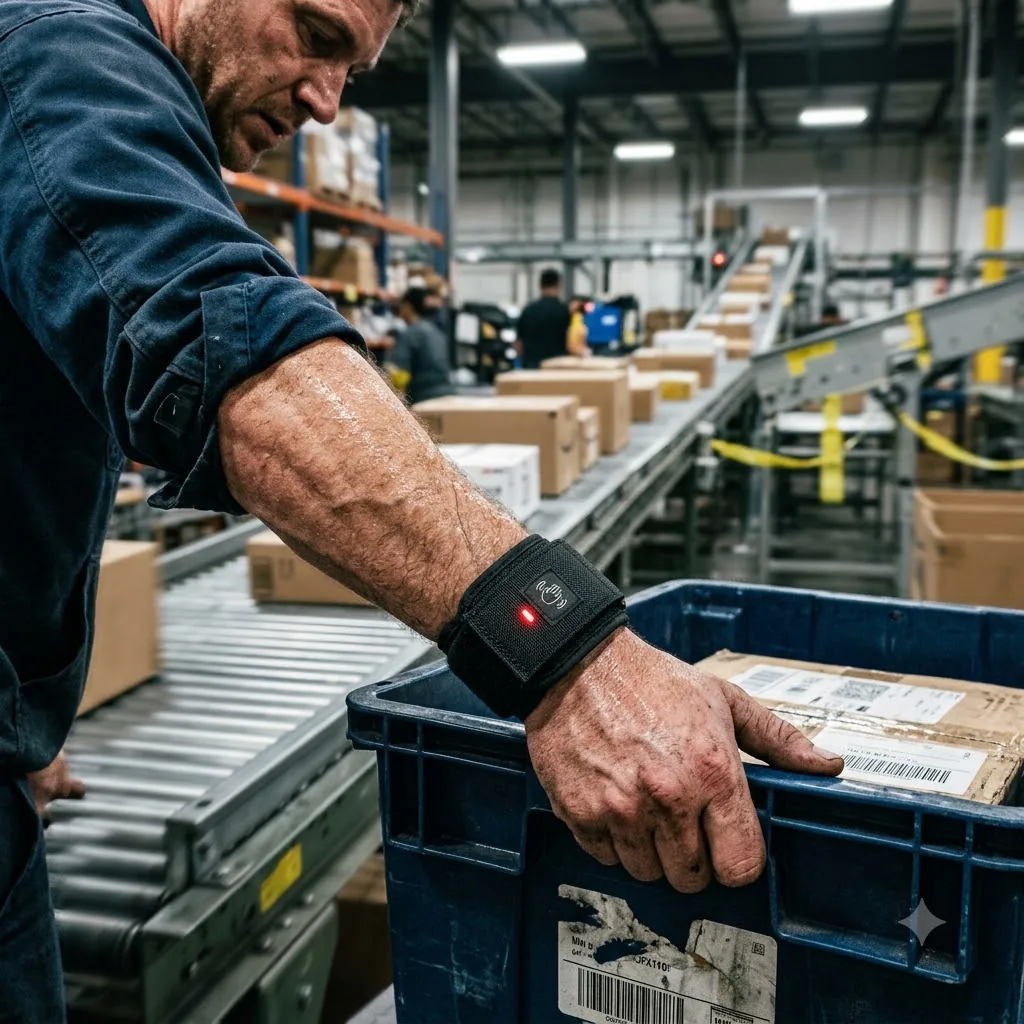
The heavy black band on his left wrist began to vibrate continuously-not the standard pulse of a scan, but a solid, searing hum that burned his skin. He looked at the cracked OLED screen. The ‘Time Off Task’ counter was gone. The screen was flashing a new, undocumented code in blinding white text: SYSTEM FAULT – OBSTRUCTION RECORDED.
Footsteps echoed on the concrete floor below. Marcus peered over the edge of the elevated belt, gasping for air, clutching his throbbing ribs. A floor manager in a pristine, reflective yellow vest was speed-walking down the aisle. He wasn’t looking up at Marcus. He was staring intensely at a glowing tablet in his hands.
“Station Four-Two,” the manager shouted, his voice echoing unnervingly in the vast, sudden quiet. “Who pulled the E-Stop on Line Seven?”
“I caught it,” Marcus choked out, his voice hoarse from the airborne cardboard dust and the adrenaline. He pointed a trembling, bloodied finger at the red-taped box resting safely on the stationary belt. “The main diverter gate jammed. It was going to fall. I caught it before it hit the floor.”
The manager stopped and finally looked up, his expression entirely devoid of relief or human concern. He tapped the screen of his tablet with a stylus. “You crossed the painted yellow safety line. You initiated an unauthorized Level One shutdown.”
“It was going to break,” Marcus repeated, desperately trying to sit up, but his right leg refused to cooperate. “That’s a third write-up. The merchandise would be ruined. I couldn’t let it fall.”
“Do you know what a full mechanical stop on Line Seven costs this facility?” the manager asked, his voice flat, completely ignoring Marcus’s bleeding knees and shallow, ragged breathing. “Every sixty seconds this belt is immobile, the logistics algorithm bleeds four thousand dollars in delayed throughput.”
The manager tapped his tablet again.
The wristband on Marcus’s arm emitted a high-pitched, piercing chirp. The screen changed from SYSTEM FAULT to a live, rapidly increasing dollar amount. The system was calculating the warehouse’s downtime and logging the financial penalty directly against his employee account ledger. It was already past two thousand dollars and climbing fast.
“Corporate security is en route,” the manager said casually, turning his back to examine the jammed steel gate below. “The algorithm has classified your physical presence as a biological obstruction. You have ninety seconds to clear the belt before the automated restart initiates, or the hydraulic diverters inside that tunnel will clear you themselves.”