Story code: ST-000911
Part 4: The Anchor
Thorne looked from the discarded microfiber rag on the granite to Marcus’s face. The silence stretched, brittle and sharp. The underwriter’s pale eyes darted to Greg, who had shrunk against the stainless-steel refrigerator, looking entirely helpless.
“You’re the owner,” Thorne stated. It wasn’t a question. The realization washed over his features, followed quickly by a flush of red that crept up from his stiff collar.
Marcus didn’t move. He stood his ground in the center of his own kitchen. “This is my house. I bought it. I fixed it. I underpinned the foundation you just tried to write off as a structural liability.”
Thorne’s jaw tightened. His professional detachment evaporated, replaced by a defensive, sputtering indignation. “This is misrepresentation. This is mortgage fraud. I am here to evaluate a property under the assumption that the applicant is the primary resident.”
“The applicant is standing right there,” Marcus said, gesturing to Greg. “And you were about to penalize him for a structural failure that doesn’t exist, based on nothing but your coded assumptions about this zip code.”
Thorne grabbed his tablet, his fingers clumsy and rigid against the screen. “The evaluation is over. National Mutual will be notified of this deception.” He shoved the tablet into his leather satchel. His movements, previously so smooth and practiced, were jagged with humiliation. He was a man used to wielding a clipboard like a weapon, suddenly disarmed in a kitchen he had grossly underestimated.
“You can notify whoever you want,” Marcus said, his voice deadly calm. “But if your report mentions anything about friction piles or a compromised foundation, I have the certified engineering blueprints and a lawyer who loves redlining cases. You missed the mark, Thorne. By twenty-two feet to bedrock.”
Thorne didn’t look at him again. He didn’t say goodbye to Greg. He spun on his expensive leather shoes and marched out of the kitchen, his pace bordering on a frantic retreat. The front door opened and slammed shut, vibrating the floorboards.
Seconds later, the heavy luxury engine roared to life in the driveway. Marcus watched through the front window as the silver sedan reversed too quickly, its tires biting into the asphalt before it sped away down the suburban street.
The silence returned to the kitchen, but it no longer felt sterile. It felt heavy with consequence.
Greg let out a long, shaky breath and pushed himself away from the refrigerator. He rubbed his face with both hands. “Well,” Greg said softly. “That’s it, then. The refinance is dead.”
Marcus turned to look at his friend. He saw the genuine regret in Greg’s posture, the shared understanding of the financial blow this meant. The lower interest rate, the cash out for his daughter’s college fund-it was all gone. The algorithm had won the paperwork battle.
“I’m sorry, Greg,” Marcus said. And he meant it. He had dragged his friend into this humiliating theater for nothing.
“Don’t,” Greg shook his head. He looked around the staged kitchen, at the generic props and the pristine, soulless surfaces. “You shouldn’t have had to do this in the first place. None of this. I’ll… I’ll call the broker on Monday. We’ll figure something out. A different lender. A different approach.”
“Yeah,” Marcus said, though he knew the black mark on the file would make it nearly impossible.
Greg nodded slowly, patting Marcus on the shoulder as he walked past him. “I’ll let myself out.”
The front door clicked shut for the second time.
Marcus was alone. The house was quiet, the afternoon sun dipping lower, casting long, golden shadows across the hardwood floors. He walked slowly out of the kitchen and into the main hallway. He stood in front of the stock photograph of the smiling white couple clinking wine glasses. He stared at the empty image for a long time.
The financial cost of his outburst would be steep. The denial letter would arrive in a few days. The system would punish him for stepping out of the invisible bounds it had set for him.
But as Marcus breathed in the familiar scent of his own home, the tight knot that had been strangling his chest all morning finally loosened.
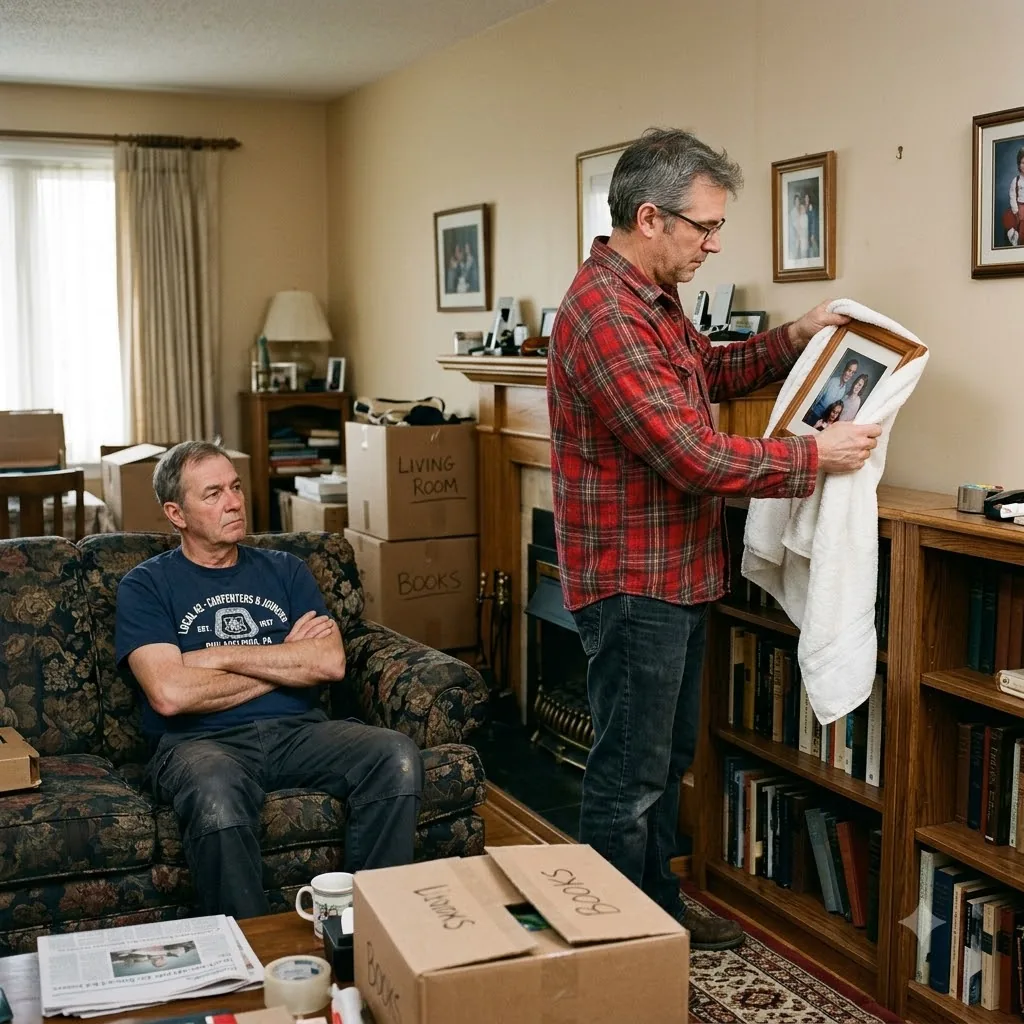
He turned and walked back to the kitchen pantry. He moved the heavy bulk bags of rice aside and hauled the large cardboard box out from the dark corner on the floor. He opened the flaps.
There was his daughter’s smile. There was his wife’s worn copy of Beloved. And right at the bottom, resting heavily against the cardboard, was the thick, ornate frame holding the sepia-toned photograph of his grandfather. A man who had moved North with nothing but a suitcase and calloused hands, who had worked until his back gave out so his children could own land.
Marcus lifted the frame. The glass was cool against his palms. He carried it out to the hallway.
He reached up and pulled the picture of the clinking wine glasses off the wall. He let it drop unceremoniously to the floor. The frame cracked, the wire backing scraping against the wall and leaving a tiny gash in the paint. Marcus didn’t care.
He took a heavy iron nail from his pocket and pressed the point against the freshly painted drywall. He grabbed a hammer from the bottom shelf of the hall closet. With three sharp, echoing strikes, he drove the nail deep into the wall, anchoring it firmly into the wooden stud.
He hung his grandfather’s picture on the nail. He straightened it, feeling the solid weight of the frame settle against the house. The stern, proud eyes of his grandfather looked back at him, watching over the hallway once again. Marcus stood in the quiet house, surrounded by his own strong walls, and finally took a full, deep breath.