Story code: ST-001503
Part 4: Sixty-Eight Degrees
The temperature in Marcus’s penthouse was locked at a flawless sixty-eight degrees. Beyond the floor-to-ceiling windows, the city sprawled in a glittering, silent grid, utterly detached from the freezing rain and churned earth of Sector Four. Inside, the massive living space was a monument to slate, glass, and white leather. There were no photographs on the mantle. There were no books on the floating shelves. The only source of light was the eighty-inch flat screen mounted flush against the far wall, casting a cool, flickering blue glow across the empty room.
Marcus sat rigid on the edge of the sofa, wrapped in a heavy cashmere robe. His feet were bare, resting on the heated hardwood floor. A few feet away, shoved carelessly onto a pristine white rug, lay his ruined Italian oxfords and his mud-caked bespoke trousers. The heavy, abrasive scent of diesel and damp earth still clung to the fabric, a harsh, organic pollutant intruding upon the filtered air of his home.
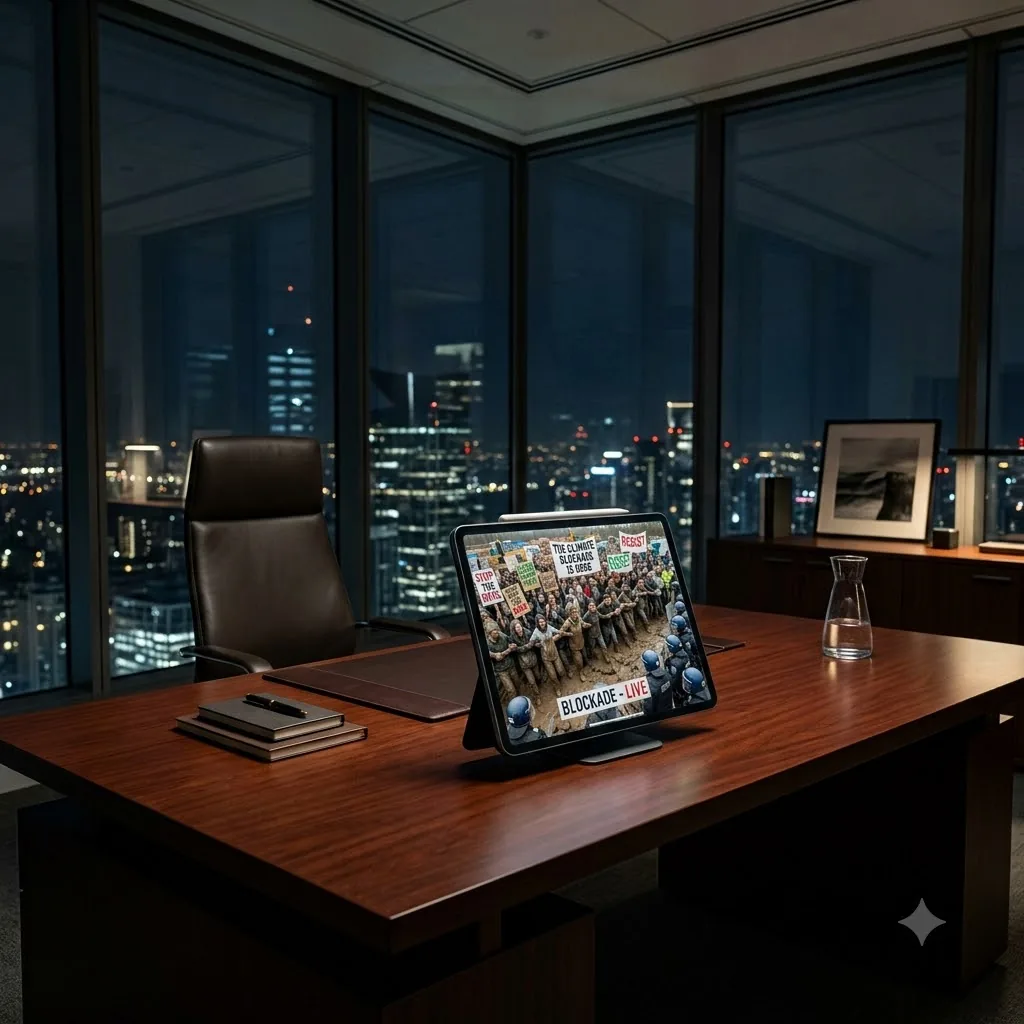
On the television, a polished news anchor spoke silently over a continuous loop of high-definition drone footage. The chyron across the bottom of the screen read in bold red letters: *Uintah Pipeline Cleared: Corporate Restraint Praised Following Extremist Standoff.*
Marcus watched the screen with hollow, unblinking eyes. The media package was a masterpiece, constructed from the very footage he had tried to suppress. The narrative had assembled itself without him. The broadcast showed the black-clad tactical team moving with precise, military efficiency. It showed the violent surge of the vanguard, the flare, the heavy chains. And then, the footage cut to Marcus.
There he was, captured by a long-range telephoto lens. A lone executive in a tailored suit, dropping to his knees in the freezing mud before the lead protestor. The news anchors couldn’t hear the audio. They couldn’t hear him begging. They didn’t know he was frantically trying to drain his own hidden offshore accounts to buy his daughter’s life.
To the world, to the board, and to the market, it looked entirely different. It looked like the ultimate display of corporate empathy. A senior executive risking his own safety in the mud, pleading for a peaceful resolution, only to be ruthlessly rebuffed by radical elements. The broadcast showed Maya turning away from him. It showed the tactical team sweeping in immediately after, their use of force retroactively justified by the failure of the company’s brave, final diplomatic effort.
On the glass coffee table, Marcus’s phone vibrated violently. The screen illuminated, displaying a barrage of incoming notifications.
*E. Sterling – CEO: Absolute genius on the ground, Marcus. The board is thrilled. Market closed up three points. We’re pushing the ‘Hero Exec’ angle globally.*
*D. Vance – Security: Area secured. Targets processed and detained. Nice distraction out there. Kept them focused while we flanked.*
*Corporate Comm: CNN wants an exclusive at 8 AM. They want the suit you wore.*
Marcus stared at the glowing phone. The notifications stacked one on top of the other, a relentless cascade of professional worship. He had intentionally smashed a multi-million-dollar server array. He had hijacked corporate transport. He had attempted to sabotage a critical infrastructure sweep to protect a trespasser. In any other universe, he would be facing immediate termination, crippling lawsuits, and federal charges.
Instead, the corporate machine had simply swallowed his treason, digested it, and spat it out as highly profitable public relations. His rebellion had inadvertently cemented his legacy. His job was safer than it had ever been. His wealth was secure.
Marcus reached out and flipped the phone face down against the glass table. The notifications continued, a muffled, angry buzzing that vibrated through the thick glass, but he ignored it.
He looked back at the television. The local affiliate was running raw footage of the arrests outside a county detention center. A line of protestors in heavy, soaked canvas jackets were being marched from an armored transport vehicle into the concrete building. Marcus leaned forward, his chest tight, his breath catching in his throat.
The camera panned across the faces of the arrested. Maya was the third in line. Her hands were secured behind her back with heavy plastic zip-ties. The dark goggles and the woven scarf were gone, revealing the stark, exhausted lines of her face. The heavy canvas jacket hung open. The vintage silver squash blossom necklace was gone, likely confiscated by intake officers, but the memory of the fractured turquoise stone burned brightly in Marcus’s mind.
As she walked toward the booking doors, Maya looked directly into the news camera. Her dark brown eyes were flat, hard, and entirely devoid of fear. She did not look like a defeated captive. She looked like a woman who had drawn a line in the earth that she would never, ever cross.
*”Go back to your glass box, Kee.”*
The name echoed in the cavernous, silent penthouse. It was a phantom sound, trapped in his own head, but it felt louder than the buzzing phone. Kee. The boy who had learned to set silver on the reservation. The man who had carved a turquoise crescent for his wife, accidentally cracking the stone in his haste. The father who had packed a single bag and walked into the city, convincing himself he was building an empire for them, only to discover he was just building a tomb for himself.
Marcus sat back against the leather sofa. The air conditioning hummed, perfectly regulating the temperature to sixty-eight degrees. The city outside remained distant and untouchable. He was safe. He was rich. He was universally praised. He looked around the multi-million-dollar penthouse, his gaze sweeping over the imported slate, the flawless glass, and the sterile white walls. He had traded his name, his family, and his blood for this room, and as the cold silence pressed in around him, he finally understood that it was entirely, devastatingly empty.