Story code: ST-000760
Part 4: The Price of Freedom
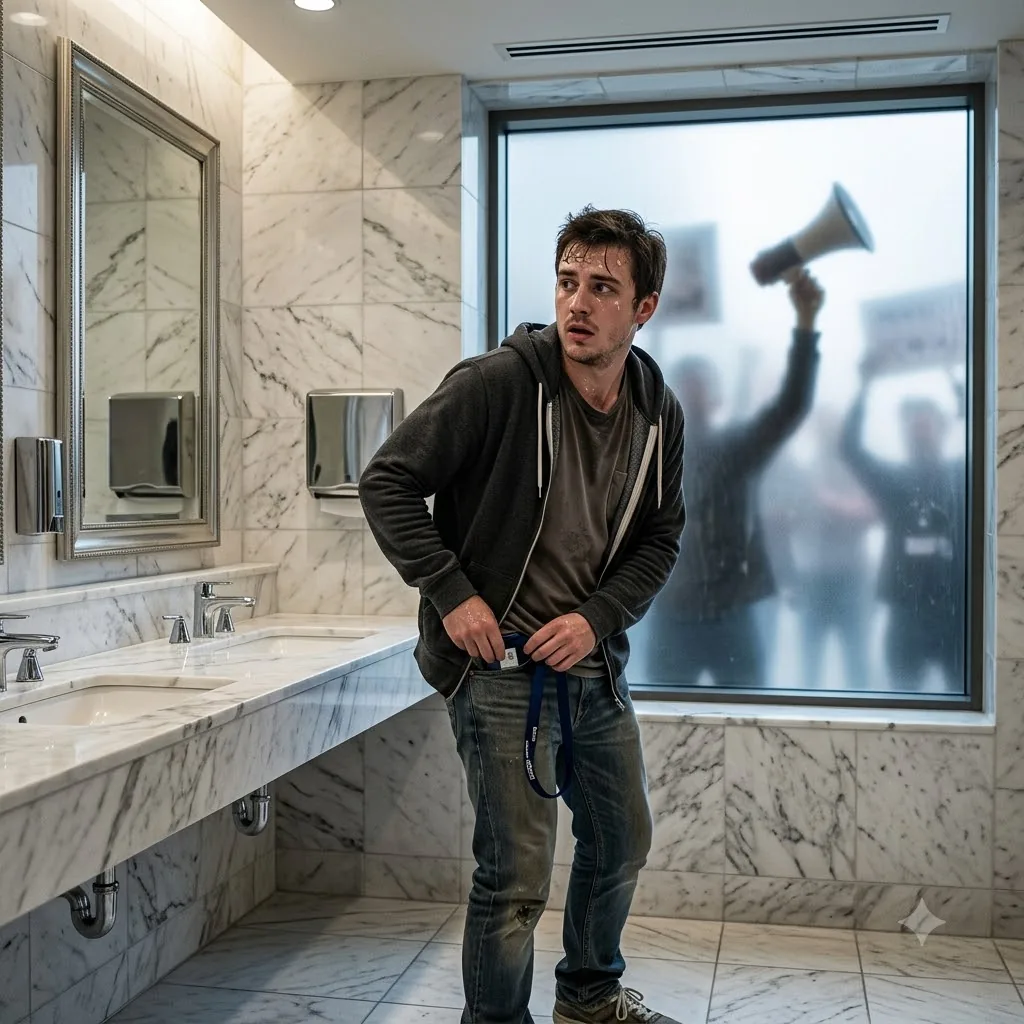
Leo didn’t say a word. The hollowed-out look in Marcus’s eyes pinned his tongue to the roof of his mouth. He tightened his grip on the stolen schematics, lowered his head against the flashing strobe of police lights, and walked away. He stepped past the bleeding man who had taught him everything, his expensive dress shoes splashing through the oily puddles of the alleyway. He didn’t look back. He just kept walking until the roar of the Azure Tower protest faded into the dull hum of city traffic.
Two hours later, Leo sat in the oppressive silence of his cramped basement apartment. The Vanguard-issued windbreaker lay crumpled on the floor like a discarded skin. The heavy leather portfolio rested on his scratched Ikea desk, its contents spilling out. The contrast between the billion-dollar corporate blueprints and his peeling laminate countertops had never looked so grotesque.
He woke his laptop. The banking window was still open.
The spinning wheel was gone. The balance glowed in crisp, undeniable green digits: $15,042.00. The wire transfer had cleared. The money was real.
His hand trembled slightly on the mouse as he navigated away from the checking account and opened his federal student loan portal. A red banner at the top of the screen screamed about past-due notices, looming over a principal balance of $14,800. It was the anchor that had been dragging him under for a decade, the suffocating financial weight that had made Vanguard’s backroom offer impossible to refuse.
Leo typed the payment amount into the custom field. $14,800.00. He clicked ‘Submit.’
The screen refreshed. A green checkmark appeared. *Balance: $0.00.*
He stared at the monitor, waiting for the relief. He waited for the triumphant rush of liberation, the vindication he had promised himself when he first signed Vanguard’s non-disclosure agreement. Instead, a cold, leaden sensation settled at the bottom of his stomach. He was free. He was entirely, legally, financially free. And he felt absolutely nothing.
A notification pinged on his phone, which sat face-up beside the laptop. It was a news alert from a local civic broadcast, carrying a headline that made his breath catch in his throat: *Vanguard Holdings Condemns ‘Violent Extremism’ of Housing Protest Leader.*
Leo picked up the phone and clicked the link. A video began to auto-play.
It wasn’t news footage from the riot outside the Azure Tower. It was a vertical, shaky video, shot from a phone camera. The resolution was grainy, but the subject was unmistakable. It was Marcus, leaning over a battered Formica table, his face red with passion, shouting, “If they try to take these homes, we tear their glass towers down to the studs! We make them bleed capital!”
Leo felt the blood drain from his face, leaving his skin icy and numb.
He knew that video. He had shot it.
It was from a private strategy meeting eight months ago in the basement of the community center. Marcus was venting, speaking in pure hyperbole, desperately trying to rally a room of exhausted volunteers. Leo had recorded it to transcribe meeting minutes. When Vanguard’s security division had asked for “contextual background on the opposition’s leadership” during his initial onboarding, Leo had handed over a hard drive of raw files, assuring himself it was just for internal threat assessment. He had told himself it was standard corporate due diligence.
Now, Vanguard’s PR machine had stripped the clip of all context. They had aggressively color-graded the footage to make the basement look like a militant bunker, slowed down Marcus’s impassioned gestures to look threatening, and splashed the words “DOMESTIC THREAT” across the bottom of the screen in bold, red letters. The view count in the bottom right corner was already ticking past three hundred thousand.
The article beneath the video detailed how Vanguard was leveraging the footage to permanently blacklist Marcus from every municipal planning board in the state, painting the entire community trust as a violent radical group. Marcus wasn’t just going to lose the neighborhood. He was being publicly crucified, his life’s work incinerated by a viral smear campaign built entirely on Leo’s footage.
Leo sat frozen in the glow of the screen. The silence of his apartment pressed inward, heavy and suffocating. The green checkmark on his loan portal still sat quietly in the adjacent tab-the exact price of a good man’s life.
A sharp, violent wave of nausea hit him.
Leo dropped the phone. He kicked his desk chair back, the plastic wheels snagging on the cheap carpet as he scrambled frantically toward his bathroom. He collapsed in front of the toilet, gripping the cheap porcelain rim with white-knuckled fingers. He retched, his body violently rejecting the adrenaline, the crushing guilt, and the horrifying reality of what he had actually done. He gagged until his throat burned, but there was nothing left to empty.
He slumped back against the cold linoleum floor, pulling his knees to his chest. Above him, his laptop chimed with another automated email alert, completely indifferent to the man shivering on the floor. Leo closed his eyes, squeezing them shut in the dark, but the image of Marcus’s bloodied face in the alley wouldn’t fade. He had finally won the game, and he would never, ever be able to wash it off.