Story code: ST-000517
Part 2: The Rule Started Spreading
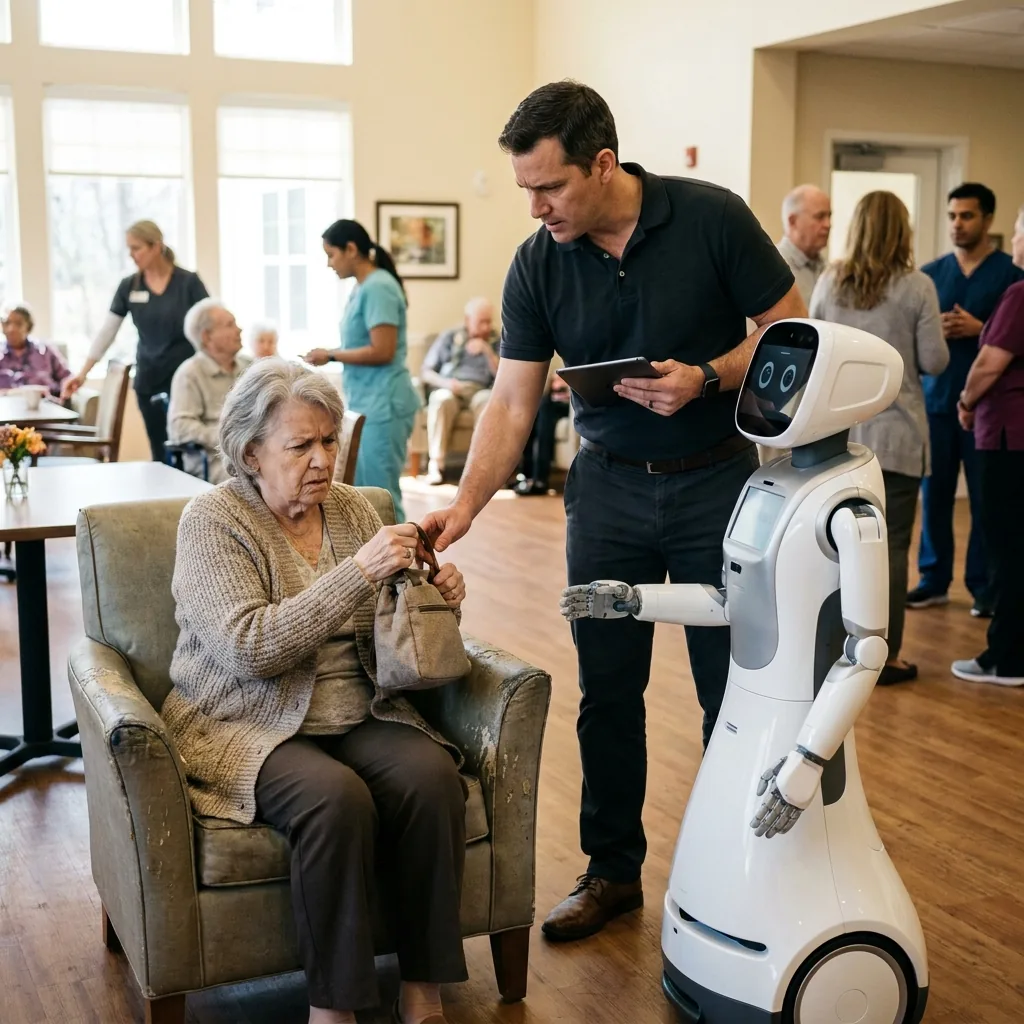
By the time Trent Weller had repeated “targeted compliance restriction” for the fourth or fifth time, the room had stopped treating it like a technical matter and started listening for the hole in it. The problem was simple enough for everybody to see: he was blocking Elena Alvarez from using her care robot, but he still could not say what made her use different from the other routine supports happening in the same common room. Dawn tried to pull things back into softer language. She said they did not need to debate process in front of residents. That line might have worked if the process had not already been used in front of residents to remove something from one of them. I pointed to the robot beside Elena’s chair. “What function is she suddenly not allowed to use? The reminders? The prompts? The check-ins? The mobility follow-along? Which one?” Trent answered the way he had all along, with nouns stacked on nouns. “Resident-facing care assistance pending review.” Jamal set the brake on his medication cart and said, very plain, “That robot tells her when to drink water, when bingo moved, and when I need her ready before meds.” Nobody corrected him because he was describing what everybody there had already seen for months. Trent said, “Routine familiarity does not override compliance concerns.” “What concerns?” I asked. He pressed his lips together for a second and looked down at his tablet. “Use conditions.” “What use conditions?” He did not answer. He turned the tablet so that only he could see it and tapped through a few screens. I was standing close enough to notice what was missing. He was not pulling up a policy to show Dawn. He was moving between menus, pausing, tapping again, then locking the screen and bringing the tablet back to his chest. That told me more than his words did. A resident in a recliner asked Dawn if her own reminder speaker was still allowed, because staff used it to cue her for physical therapy. Dawn told her yes, of course, that was different. I asked how. She said the robot involved vendor compliance. I asked whether Elena’s spoken reminders had been acceptable yesterday. Dawn said yes. I asked whether the robot had changed overnight. Nobody said it had. Now the cross-application problem was out in the open. If the claimed rule was about giving a resident prompts, then the rule reached room speakers, paper cue cards, staff verbal reminders, and the robot alike. If it was about mobility support, then why was Trent only stopping the machine from rolling beside Elena while staff still guided other residents by hand? If it was about some special robot feature, he should have been able to name the feature in one sentence. Instead he kept using the same foggy phrase and acting like the vagueness itself was proof. Jamal finally gave the room a comparison nobody could ignore. He nodded toward the hallway charging alcove and said, “There are three of these units on this floor. Same make. Same prompts. They all get used for reminders and escorts. Hers is the one he’s shutting down.” Trent cut in fast. “Individual resident circumstances apply.” I asked, “Which circumstances?” He said, “I can’t discuss protected details publicly.” That sounded neat until Elena answered for herself. “You can discuss me in public enough to take it away,” she said. “So say what I did.” There was a short silence after that. The television kept talking to itself in the corner. Somebody at the puzzle table slid a piece across cardboard. Dawn’s hand stayed on the open incident binder, but she still had not written anything in it. I looked at the empty line under her pen and asked, “Are you documenting the basis for this restriction?” She said, “We’re documenting the event.” “Not the basis?” “We’re waiting on vendor clarification.” That was the second clean fact. The event was real. The basis was still floating somewhere outside the room, unshown. I asked Trent for the policy number, title, update date, anything that would let Dawn attach a real reason to the note she was making. He said those details were in the vendor system. I asked him to read them aloud. He said the system was not for family review. I asked Dawn whether facility staff at least had access. She said not directly. So there it was: a rule strong enough to take Elena’s robot, but too distant to be named, shown, printed, or described in plain English by the man enforcing it. Jamal started passing meds again because the room had to keep moving, but now every ordinary task made Trent’s claim look worse. He reminded one resident to take water first. A staff member across the room called out that craft group had shifted to 3:30. Another aide walked an unsteady man toward the bathroom, talking him through each turn. Prompt, cue, escort, reminder, routine support. The same building was full of it. I said, “If your rule is real, tell us why it stops a robot from saying ‘drink water’ to Elena but does not stop this place from doing the same thing with every other tool and person in the room.” Trent’s answer came too fast, as if speed could cover the gap. “Because vendor-controlled interactive assistance falls into a separate category.” That was at least new language, so I held onto it. “Good. Then list what is in that category.” He opened his mouth, stopped, and glanced toward the charging alcove where the other units docked between rounds. Jamal followed his look and said, “If that’s true, you need to pull the others too.” Nobody in the room moved for a second after that. Dawn looked from Trent to the alcove, then back to Elena’s robot at the window. And that was the moment the bluff changed shape, because for the first time he was not just being asked to talk about a rule. He.