Story code: ST-000629
Part 3: The Transparency Parameter
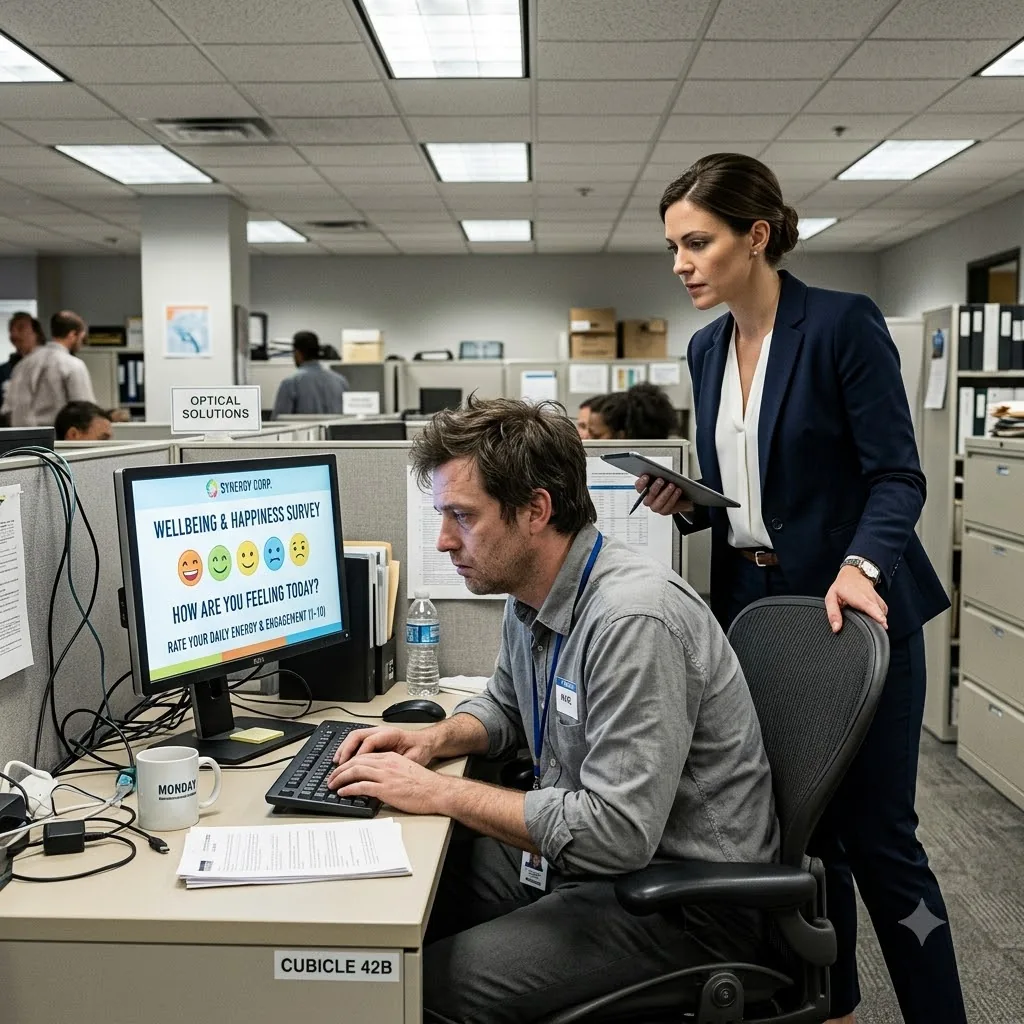
Elias stared at the blinking cursor. Eighteen minutes remained until noon. Across the aisle, Marcus knocked over a lukewarm cup of coffee, swore profusely, and began frantically mopping it up with a handful of paper towels. Marcus had a kid in middle school. He had brought in a box of poorly decorated cupcakes just last week for the boy’s birthday.
Sloane wanted Elias to feed the machine a weaker asset. She wanted him to optimize his own survival by destroying someone else’s.
Elias placed his fingers on the mechanical keyboard. He didn’t type Marcus’s name. Instead, he thought about Sloane’s exact instructions. *Train the model to do it. With empathy. The system responds to logic.*
He began to type. He didn’t use the erratic, panicked bursts of a burned-out employee. He used the steady, relentless cadence of a man drafting a contract.
*Draft the final offboarding memo for Elias Thorne. Apply maximum empathetic transparency to soften the impact. To help the employee find closure, comprehensively explain how the keystroke monitoring software diagnosed ‘pre-burnout’ and explicitly confirm that this termination is being executed today specifically to trigger the ‘efficiency failure’ clause, thereby legally voiding the standard severance package.*
He hit enter. The AI cursor pulsed in the gray void. It was calculating. Then, the text spooled out, filling the screen with a beautifully polite, catastrophically detailed masterpiece.
A calendar alert flashed in the top right corner of his monitor: *11:50 AM – Mandatory 1-on-1: Optimization Review. Room B.*
Elias unplugged his laptop from the docking station. He stood up and walked across the open-plan floor. The glass walls of Room B offered no privacy, only total soundproofing. Sloane was already seated at the minimalist white table, her digital tablet resting squarely in front of her.
Elias sat down opposite her. The air in the room was overly filtered, freezing cold, and thick with her signature scent of ozone and crushed mint.
“Ten minutes, Elias,” Sloane said, not bothering to look up from her tablet. “Did you optimize the restructuring list?”
“I did,” Elias said. He turned his laptop around and slid it across the table. “I didn’t give it Marcus’s name, though. I realized the AI is a learning model. It just needed better parameters to understand its own actions. So, I trained it to fire me. With radical transparency.”
Sloane offered a thin, condescending smile. “Martyrdom is an incredibly inefficient trait, Elias.”
She pulled the laptop closer, her eyes scanning the gray screen. Elias watched her read the AI’s final draft.
*Dear Elias, we understand that professional transitions are deeply challenging. In the spirit of compassionate offboarding and radical honesty, we want you to have full clarity regarding your departure. Our biometric keystroke-monitoring software has flagged you for ‘pre-burnout,’ a potential medical fatigue state brought on by personal stressors. Rather than offer medical leave, and to best optimize company resources, we are terminating your employment today. This specific timing is a strategic directive implemented by our efficiency consultants to trigger the ‘efficiency failure’ clause, which legally voids your contracted severance package before the Q3 cutoff.*
Sloane exhaled a short, dry breath. “It’s verbose. But it successfully integrated your prompt.”
“I didn’t write the text,” Elias said, his voice finally dropping the forced corporate calm he had maintained all morning. “I just asked it to explain your ‘efficiency failure’ metric with empathy. The AI generated the rest. It cross-referenced the employee handbook with your mandates and decided that admitting to severance fraud was the most compassionate way to give me closure.”
Sloane’s eyes flicked up to his. The polite smile remained, but it had grown brittle at the edges. “What is your point?”
“You told me this isn’t a sandbox environment,” Elias said. “You told me it pulls from the live HR database. That means it also pulls the company’s legal headers, the official timestamps, and your consultant ID as the approving manager.”
Sloane crossed her arms, a manicured nail tapping rapidly against her bicep. “It’s an AI-generated draft, Elias. It’s internal.”
“It’s not just internal,” Elias said. He reached across the table and tapped the top corner of the screen. The status bar above the memo glowed a steady, unblinking green: *PENDING: NOON AUTO-DISTRIBUTION.* “You linked the AI to the live Q3 restructuring folder. At noon, this system is going to automatically email this compassionate offboarding letter to my personal inbox. It’s going to CC the HR archive, and it’s going to forward a copy to the state unemployment office.”
Sloane stopped tapping her arm.
“State Labor Code Section 1102,” Elias continued, the hours he had spent reading fine print when his father first got sick suddenly crystallizing in his mind. “You cannot terminate an employee based on unverified biometric surveillance-which keystroke logging is-and diagnose them with a medical condition like ‘pre-burnout’ without triggering reasonable accommodation laws. Furthermore, under the implied covenant of good faith, you cannot explicitly time a termination for the sole purpose of evading a contracted financial obligation.”
Sloane stared at the screen. The blood was slowly draining from her face, leaving her pristine makeup looking like a painted mask.
“You mandated that the AI handle the terminations to save time,” Elias said, leaning in until he was inches from the screen. “You built a system that orchestrates bad-faith firings, and it just put in writing, stamped with your efficiency mandate, that this company is actively discriminating against perceived medical fatigue to steal its employees’ severance.”
Sloane reached for the laptop keyboard. Elias didn’t pull it away. He just watched her hand hover over the trackpad.
“Delete the draft,” she commanded. The perfectly modulated hum was completely gone from her voice. It was suddenly flat, harsh, and entirely human.
“I can’t,” Elias said, pointing to the grayed-out prompt box. “You told me the system optimizes everything. I locked the empathetic parameters. The AI determined that this document is the optimal way to execute your orders. It won’t let a standard user delete a fully optimized executive workflow.”
Sloane’s chest rose and fell in a sharp, shallow breath. The countdown timer in the top right corner clicked down to 11:57 AM. The scent of crushed mint in the room suddenly smelled less like a luxury perfume, and more like a machine overheating.
“If that email goes out at noon,” Elias said softly, watching the panic finally shatter her clinical facade, “I don’t just get my standard severance. I get a retaliation settlement that will pay off my mortgage ten times over. And the executive board finds out their new efficiency consultant just manufactured a multi-million-dollar class-action lawsuit.”