Story code: ST-000804
Part 2: The Black Box
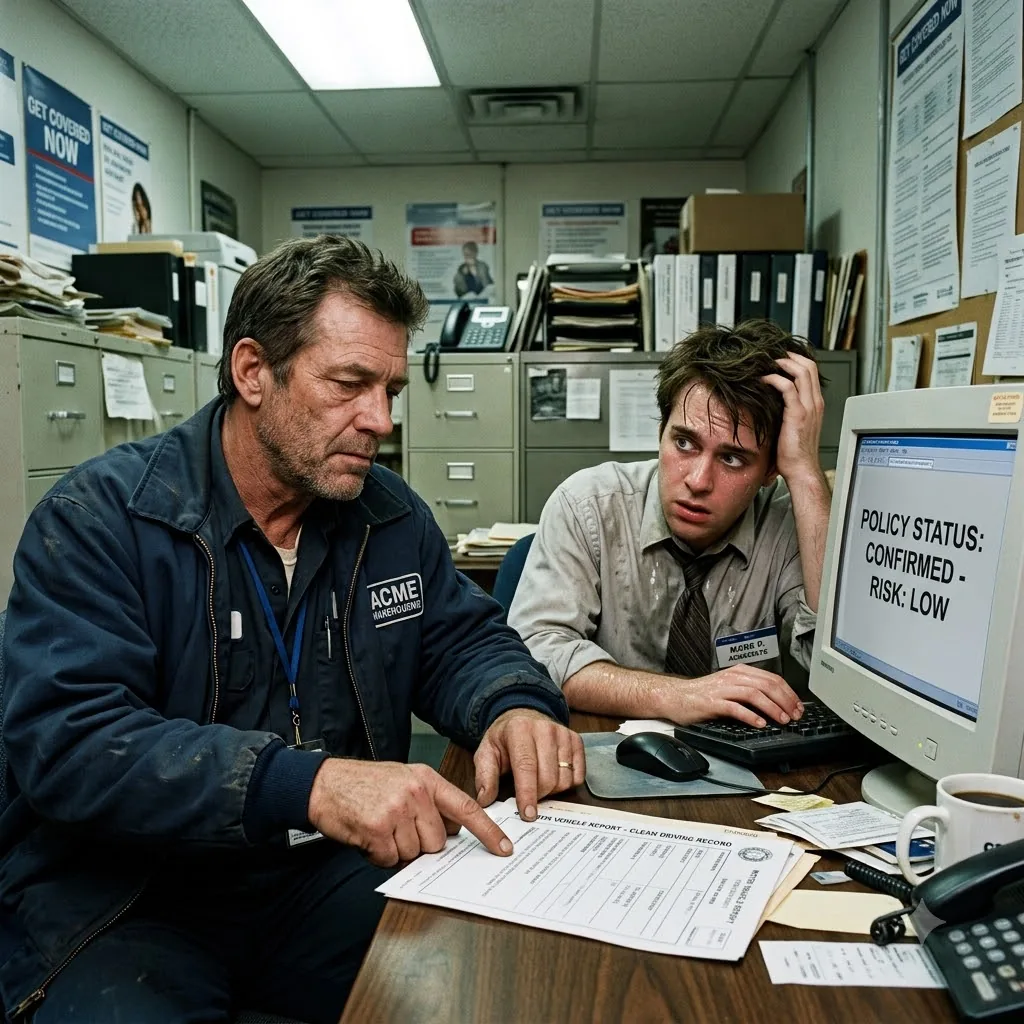
Arthur’s voice was a dry rasp as he spoke into the telephone receiver, his hand cupping the mouthpiece as if the ancient desktop computer could eavesdrop. Elias sat frozen in the vinyl chair, his eyes locked on the trembling of Arthur’s shoulders. The broker gave an employee identification number, then read Elias’s street address-442 Oakwood Drive-with the grim cadence of a man reading a death sentence.
Elias strained to hear the voice on the other end, but only a tinny, robotic hum leaked from the earpiece. He looked back down at the printed page on the desk. The premium wasn’t a typo. There were no extra zeros accidentally keyed in. It was a calculated, precise figure, ending in forty-three cents, formulated by a server in a cold room a thousand miles away. It equated to roughly fourteen months of his warehouse salary.
“Yes, I see the designation,” Arthur whispered into the phone, stealing a panicked glance at Elias. “But he’s in my office. He’s been a client for a decade. The old policy hasn’t expired for another three hours. Can we just bridge it?”
A pause stretched in the claustrophobic office. Elias felt the sweat pooling at the base of his spine. The recycled air tasted suddenly metallic, thick with unspoken disaster.
Arthur swallowed hard, his Adam’s apple bobbing sharply. “I understand. Automated enforcement. I’ll tell him.”
The broker placed the handset back onto the cradle. The plastic click sounded like a vault slamming shut. Arthur took a slow, rattling breath and pushed his wire-rimmed glasses up to his forehead. He refused to meet Elias’s gaze, choosing instead to stare at the frayed edge of his desk blotter.
Elias asked what was going on, keeping his tone carefully measured despite the roaring in his ears. He asked if there was a glitch with the zip code, some clerical error crossing his file with a commercial trucking route.
Arthur shook his head. He explained that there was no glitch. The central underwriting algorithm, a new predictive model adopted by every major provider in the state over the weekend, had reclassified Elias’s neighborhood. It wasn’t based on crime rates or past weather events. It was a forward-looking risk assessment. Arthur didn’t know what the machine predicted was going to happen on Oakwood Drive, only that the danger assigned to that specific geography was absolute. To comply with state laws requiring them to offer coverage to existing customers, the algorithm simply generated a premium designed to mathematically force a cancellation.
Elias leaned forward, the vinyl chair groaning under his weight. He explained that his wife was at home with their two young daughters on Oakwood Drive right now. If the insurance company knew something-if there was an environmental hazard, a structural threat, a gas line issue-they had to tell him.
Arthur raised his hands in a defensive, helpless gesture. He said the human underwriters didn’t even know. The algorithm was a black box. It ingested billions of data points and spat out risk matrices. No one at the regional office could see the underlying variables. They only saw the mandate: clear all liabilities from that grid immediately.
The injustice of it hit Elias with physical force. He stood up, the cramped walls of the office suddenly closing in. He reached into his chest pocket, feeling the worn edge of his checkbook. He told Arthur he just needed basic liability. The absolute state minimum to keep his car on the road, to get to his shift at the logistics warehouse in forty-five minutes. He offered to sign a waiver exempting his home address, anything to keep his legal status intact.
Arthur turned the computer monitor slightly, just enough for Elias to see a flashing red banner at the top of the portal. The broker’s voice broke as he explained the worst part. Because Elias’s address had been flagged under the new ‘critical risk’ protocol, the system had automatically triggered an immediate policy void. The three-hour grace period was gone. As of two minutes ago, Elias’s ten-year streak of flawless, insured driving was erased.
Elias pulled his smartphone from his pocket. His hands were shaking now, mirroring Arthur’s earlier panic. He opened a browser and went to a direct-to-consumer competitor, frantically typing in his name, vehicle identification number, and address. He hit submit, praying for a loophole. The loading wheel spun for exactly two seconds before returning a stark red error message: *Coverage Unavailable. Address Ineligible for Risk Pool.*
It was a shared database. The mathematical apathy had quarantined him instantly, locking him out of the system everywhere.
His phone buzzed in his palm. A text message from his wife, Sarah, illuminated the screen. *Don’t forget the kids’ asthma medicine on the way home from work. Love you.*
Elias stared at the words. The medicine cost forty dollars. The electric bill was due Friday. If he didn’t clock in at the warehouse by two o’clock, the floor manager would fire him under the new, zero-tolerance attendance policy. If he lost the job, they lost the house on Oakwood Drive anyway.
He looked up at Arthur. He asked if the state Department of Motor Vehicles had been notified of the sudden cancellation.
Arthur nodded miserably. He warned Elias that the new municipal traffic cameras, the ones installed on every major intersection last month, were tied directly into this cloud database. They read license plates in real-time. If Elias drove his uninsured sedan, the cameras would flag him instantly. It meant a mandatory impoundment of the vehicle, a suspended license, and a fine that would bankrupt him before the weekend.
Elias turned his back on the broker and pushed out of the stifling office. He stepped onto the sun-baked concrete of the sidewalk. His dependable, rusted sedan sat parked at the curb, holding the only key to his family’s survival. He gripped his car keys tightly, the jagged metal digging painfully into his palm.
Then, he looked toward the intersection that led to the highway. Parked perfectly in the shadow of a sprawling oak tree was a city police cruiser. On its roof, two black, cylindrical cameras were rotating slowly, scanning the traffic lane, their unblinking electronic eyes waiting for him to turn the ignition.