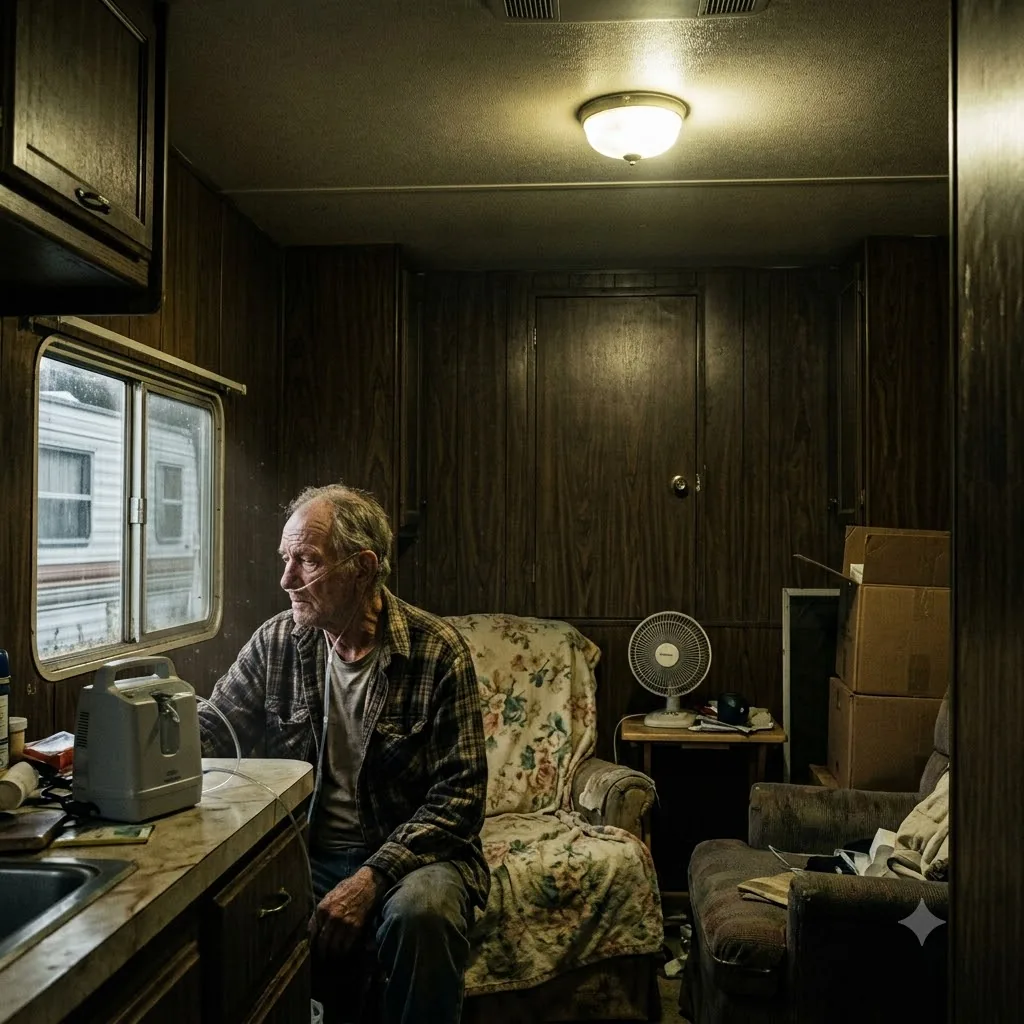
Story code: ST-001691
Part 3: The Subterranean Shunt
The iron pipe finally spat Silas out into a blinding, clinical white light. He tumbled through a rusted ventilation grate, his shoulders scraping against the jagged edges, and collapsed onto a floor so pristine it felt like ice against his cheek. He lay there in a heap of wet canvas, mud, and trembling bone.
His mouth opened and closed like a landed fish. The air here was freezing, aggressively air-conditioned to protect the machines, and it hit his starved lungs like shattered glass. He dragged a breath in. It wasn’t the pure, concentrated flow of his tank, but it was air. He coughed, a wet, rattling sound that was instantly swallowed by the deafening, synthetic roar of a thousand server racks processing data in perfect unison.
He forced his eyes open. He was in the belly of the Apex beast. Aisles of towering black cabinets stretched out in immaculate geometric lines, glowing with millions of tiny, pulsing blue and green LEDs. It was a cathedral of digital commerce, sterile and humming with the valley’s diverted electricity.
Silas pushed himself up to his hands and knees. His knuckles left thick smears of black Appalachian mud on the polished epoxy floor. He dragged himself to the nearest server rack, using the cold metal casing to haul his body upright. His legs shook violently. His lungs were still operating on a desperate deficit, screaming for the medical tank he had left wedged in the pipe behind him, but he forced himself to stand.
“Hey! Stop right there!”
The voice cut through the mechanical drone. Footsteps, rapid and hard-soled, echoed down the aisle.
A man rounded the corner of the server bank. He wasn’t tactical security. He wore a crisp, logo-embroidered polo shirt and tailored slacks, an ID lanyard bouncing against his chest. He held a glowing tablet in one hand. He stopped short, his eyes widening at the sight of the mud-caked, wheezing old man bleeding onto his clean-room floor.
“How the hell did you get in here?” the manager demanded, his voice pitching up with a mix of authority and panic. He tapped furiously at his earpiece. “Command, I have an intruder in Sub-Level B. The pressure drop on the perimeter sensors wasn’t a pipe burst. Send a team down here immediately.”
Silas didn’t look at him. He didn’t care about the radio, or the security team, or the immaculate rows of blinking lights. He closed his eyes for a fraction of a second, overlaying the memory of the cavernous coal-dust room from forty years ago onto the sterile white hallway in front of him. The servers were just furniture. The bones of the mountain were still here.
He started walking. Each step was a dragging shuffle. He kept his left hand pressed against the server racks for balance, smearing mud across the pristine glass doors.
“I said stop!” The manager stepped into the center of the aisle, blocking the path. “You are trespassing in a federally secured data enclave. You are contaminating a Class-3 clean room. Sit down on the floor and put your hands on your head. Now.”
Silas kept walking. His breath wheezed in his throat, sounding like a torn bellows. He reached into his heavy canvas pocket, his fingers finding the coarse, rusted iron of the antique mining spanner.
“Are you deaf, old man?” The manager held his ground, though his eyes darted nervously to the thick mud dropping from Silas’s coat. “You’re looking at federal prison time. Apex Energy has zero tolerance for industrial sabotage. You take one more step and I will physically restrain you.”
Silas didn’t slow down. He didn’t even look at the manager’s face. He walked straight at him, his gaze locked on the far wall. When he was two feet away, the manager reached out, attempting to aggressively shove Silas’s shoulder.
Silas shifted his weight, dipped his shoulder, and drove the solid, unyielding mass of his body forward. He wasn’t a large man anymore, but he carried the dense, stubborn gravity of the earth he used to dig. He collided with the manager, sending the younger man stumbling backward into a server rack. The manager gasped, wiping furiously at the wet mud Silas had transferred to his crisp shirt.
“You crazy son of a bitch!” the manager yelled, shrinking back as Silas pushed past him. “Security is going to break you in half!”
Silas reached the far wall of the corridor. There were no flashing lights here. No sleek black cabinets. It was a blank stretch of painted concrete, interrupted only by an unmarked, dull gray panel door. It was roughly three feet square, sitting flush with the wall. To the untrained eye, it looked like a standard structural access hatch for the building’s massive HVAC system.
Silas leaned his forehead against the cold metal of the panel, trying to catch his breath. His heart was hammering a dangerous, irregular rhythm against his ribs.
The manager recovered his footing and marched over, keeping a safe distance but emboldened by Silas’s apparent exhaustion. “That’s a sealed bulkhead,” the manager sneered, holding up his tablet as if to record the pathetic sight. “You’re out of your mind. There’s nothing in there for you. It’s a closed-loop facility. You can’t hack it, you can’t break it, and you’re not leaving here.”
Silas finally turned his head. His eyes, rimmed with red and sunk deep into his pale, hollow face, locked onto the manager. The corporate bluster, the jargon, the crisp polo shirt-it meant absolutely nothing.
Silas pulled his hand from his coat pocket, revealing the massive, rusted iron spanner.
The manager laughed, a sharp, nervous sound. “What is that? A wrench? You think you’re going to pry open a Level-4 magnetic seal with a piece of antique junk?”
Silas didn’t answer. He didn’t have the breath to waste on words. He looked at the flat surface of the gray panel. In the bottom right corner, hidden beneath a thick layer of industrial semi-gloss paint, was a recessed, star-shaped indentation. It wasn’t a magnetic lock. It wasn’t digital. It was a purely mechanical deadbolt, forged fifty years ago when the room behind the wall housed the main power feeds for the deep-mine excavators.
Apex Energy had built a multi-million-dollar fortress of digital security. They had installed biometric scanners, razor wire, and climate-controlled clean rooms. But they had built it directly on top of the old electrical infrastructure to save a few million on copper cabling, blindly trusting that the past was dead and buried.
Silas jammed the jagged, rusted teeth of the spanner into the painted recess.
The manager stopped laughing. “Hey. Stop. You can’t touch that. That’s a high-voltage conduit housing.”
Silas gripped the iron with both hands. His knuckles went white. He threw his remaining body weight against the bar, fighting the rust and the decades of neglect.
For a second, nothing happened. Then, a sharp, metallic *crack* echoed over the drone of the servers. The paint around the recess shattered into a dozen white flakes.
Silas twisted the spanner hard to the right. Deep inside the wall, a heavy steel tumbler slid back with a resounding, mechanical *clunk*.
The manager’s tablet slipped from his fingers, shattering on the epoxy floor. “Wait,” he breathed, the corporate authority evaporating from his voice. “Wait, wait, wait, what are you doing?”
Silas pulled the spanner free. The unmarked gray panel swung open on heavy, groaning hinges.
Inside, there were no microchips. No delicate cooling systems or digital interfaces. It was a cavernous metal box containing three massive, arm-thick copper busbars and a single, giant, industrial throw-lever. It was the primary analog electrical shunt-the main vein that connected the entire crypto farm to the town’s diverted power grid.
The manager stared into the steel box, his face draining of all color. The impenetrable, high-tech corporate fortress was a lie, built on top of a physical skeleton that the old man fully understood.
Silas reached into the box. He wrapped his trembling, mud-caked fingers tightly around the thick rubber grip of the massive throw-lever, and looked back at the manager.