Story code: ST-001843
Part 2: The Ghost-Net Escrow
Marcus stared at the flickering green interface. The text was blocky, stripped of the friendly, rounded fonts the rideshare company used to pacify its drivers and disguise its ruthless efficiency. It read: GHOST-NET ROUTING. PRIORITY COURIER REQUIRED. IMMEDIATE CLEARANCE: $850.00 USD. The cursor blinked, waiting in the silence of the cabin. There were no terms of service, no user agreements to scroll through, and no ratings to maintain. Just a single, glowing box that said ACCEPT.
Eight hundred and fifty dollars. It was exactly what he needed to pay off Trey, with a fifty-dollar margin to fill his gas tank and buy a stale sandwich. But this was fundamentally wrong. Ghost-nets were urban legends among drivers-backdoor dispatch protocols used by black-market fixers who hijacked legitimate server nodes to move illicit goods without leaving a digital footprint. Tapping into one meant actively crossing the line he had drawn in the sand two years ago.
He looked at the faint, oily smudge Trey’s steel rings had left on the driver’s side window. That small blur on the tempered glass was a tangible promise of shattered teeth and fractured ribs. He had tried to play by the rules. He had kept his car immaculate, his rating perfect, his head down. But the algorithm had locked him out anyway. The sterile tech world did not care if he starved, and the street only cared if he paid. The trap had closed from both sides.
Marcus reached out, his hand trembling just enough to betray his panic, and pressed his thumb against the green text.
The screen flashed violently white. The high-pitched chime sounded again, louder this time, and suddenly his car’s dashboard navigation system overrode itself, syncing directly with the hijacked phone. A new route materialized on his center console, glowing in a harsh, neon green line.
Marcus shifted the sedan into drive and pulled away from the curb. The route dragged him far away from the decaying concrete of Trey’s territory, guiding him up into the pristine, manicured elevations of the Westside tech corridor. Here, the roads were perfectly smooth, the streetlights cast a clinical, blinding white glow, and the buildings were towering monoliths of steel and reflective glass. Marcus gripped the steering wheel, feeling the tension coil tightly in his neck. He was an invader in this ecosystem. His immaculate sedan fit in aesthetically, but he knew the invisible cameras and traffic sensors lining these streets were logging his license plate, measuring his speed, and categorizing him as a temporary, low-level service asset.
The ghost-net application guided him to a subterranean loading dock beneath a massive, unmarked architectural block. The heavy steel gate slid open automatically as his bumper approached, triggered by a proximity spoof from the phone.
The underground dock was freezing, brightly lit by humming rows of fluorescent tubes. A man stood waiting in the dead center of the concrete loading bay. He wore a sharply tailored, expensive suit, but his silk tie was pulled loose, and sweat beaded heavily on his forehead. He did not look like a hardened street thug; he looked like a mid-level corporate executive watching his entire life vaporize.
The man rushed to the back door of the sedan, yanking it open before Marcus even had the chance to shift into park. He shoved a matte-silver, heavy-duty Pelican case onto the pristine leather seats. It hit the upholstery with a dense, metallic thud that made Marcus wince.
“Keep the climate control exactly at sixty-five degrees,” the executive snapped, his voice thin and tight with absolute panic. “Do not attempt to open the latches. Do not stop at any lights until you reach the drop zone.”
Before Marcus could ask a single clarifying question, the man slammed the door shut and sprinted back toward a set of reinforced service elevators.
The green app chimed, updating the route instantly. The destination was a commercial warehouse district by the shipping docks. Estimated travel time: thirty-two minutes. A progress bar indicated the payout was currently processing in a decentralized escrow. Marcus hit the accelerator, steering the heavy sedan back out into the cool evening air.
As he merged onto the main expressway, the app interface pulsed an angry, flashing red for a fraction of a second. A text overlay appeared over the map: WARNING. NETWORK INTERCEPTION DETECTED. EVASIVE MANEUVERS STRONGLY RECOMMENDED.
Marcus checked his rearview mirror. A matte-black SUV with heavily tinted windows and zero chrome detailing had seamlessly merged into his lane, sitting exactly three car lengths behind his bumper. It was not drifting or weaving like a street racer; it was tracking him with cold, algorithmic precision. Marcus steadily applied pressure to the gas pedal, pushing the sedan up to eighty miles an hour. The SUV matched his speed instantly, closing the gap to a single car length.
He signaled left and jerked the steering wheel hard to the right, diving down a curved off-ramp at the last possible second-a reckless, dangerous maneuver that would have earned him a one-star rating and an instant permanent ban on his old rideshare app. The SUV did not even flinch. It cut brutally across the painted gore point, kicking up a massive shower of gravel and debris, and stayed glued to Marcus’s rear bumper.
This was not a local street crew trying to jack his car. This was corporate retrieval, a highly funded security apparatus that did not care about traffic laws or collateral damage.
Marcus’s hands flew over the steering wheel, his old survival instincts flaring back to life, burning away the docile driver he had pretended to be. He was treating the meticulously cleaned sedan like a getaway vehicle, sliding through a yellow light at a massive intersection, tires screaming against the asphalt. In the back seat, the silver briefcase began to emit a low, mechanical hum, accompanied by a faint blue glow leaking from its seams.
He risked a glance at the dashboard app. The green routing line was frantically recalculating, but a new digital timer had appeared, counting down from five minutes. If it hit zero, the escrow protocol would automatically cancel. No money. No way to pay Trey. He would be dead by midnight.
Suddenly, the sedan’s internal speakers crackled with static. The ghost-net app vanished entirely from the center console screen, violently replaced by the car’s native diagnostic interface. A synthetic, flawlessly polite corporate voice filled the cabin.
“Unauthorized proprietary cargo detected within the cabin,” the automated voice stated calmly. “Remote immobilization protocol has been initiated for your safety.”
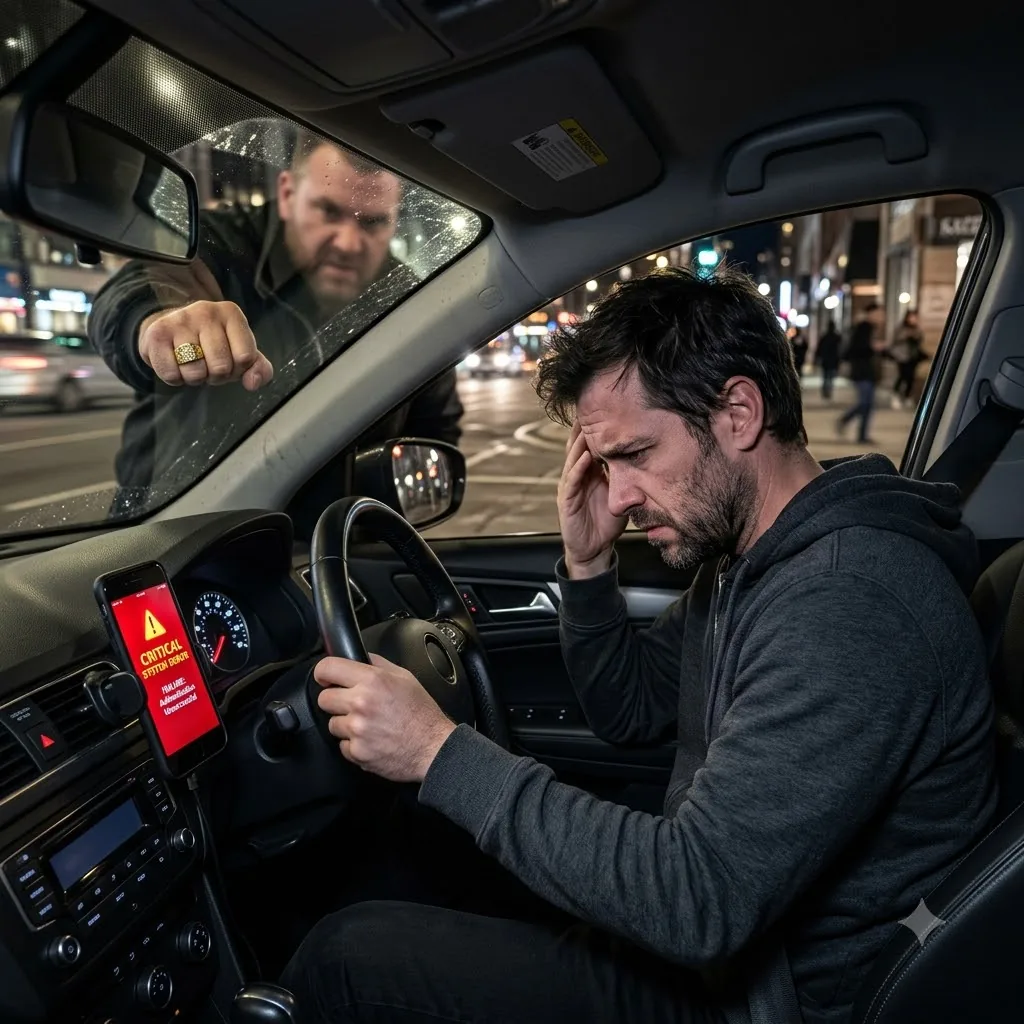
The accelerator pedal went completely dead, turning into a useless piece of plastic under Marcus’s foot. The steering column locked rigid in his hands, completely unresponsive, as the heavy sedan hurtled forward toward a concrete retaining wall at sixty-five miles an hour.