Story code: ST-001637
Part 2: Containment Breach
The man in the crisp navy polo shirt did not draw a standard police-issue service weapon. As his hand emerged from beneath the hem of his shirt, his fingers were wrapped around a matte-black pistol fitted with a thick, blocky suppressor. It was a tool designed for quiet, unrecorded violence, not a wellness check.
Marcus did not consult the laminated de-escalation flowchart. Five years of government bureaucracy evaporated under the sight of the elongated barrel. Operating entirely on a surge of blind panic, Marcus slammed his palm down on the heavy red buzzer button hidden beneath the lip of his desk.
A harsh, electronic buzz vibrated through the bulletproof glass. The magnetic lock on the heavy reinforced door leading from the waiting room to the patient hallway disengaged with a loud, metallic clack.
The bleeding veteran did not hesitate. She lunged forward, her muddy boots scrambling for traction on the slick linoleum. She threw her shoulder against the heavy door, wedging herself through the opening just as the hydraulic closer began its automatic cycle.
The man in the polo shirt abandoned his deliberate pace. He sprinted across the waiting room, his rubber-soled shoes silent on the floor. He lunged for the door handle, but the heavy pneumatic arm pulled the door flush into its steel frame. The magnetic lock engaged with a heavy, definitive thud just a fraction of a second before the man’s hand clamped around the handle.
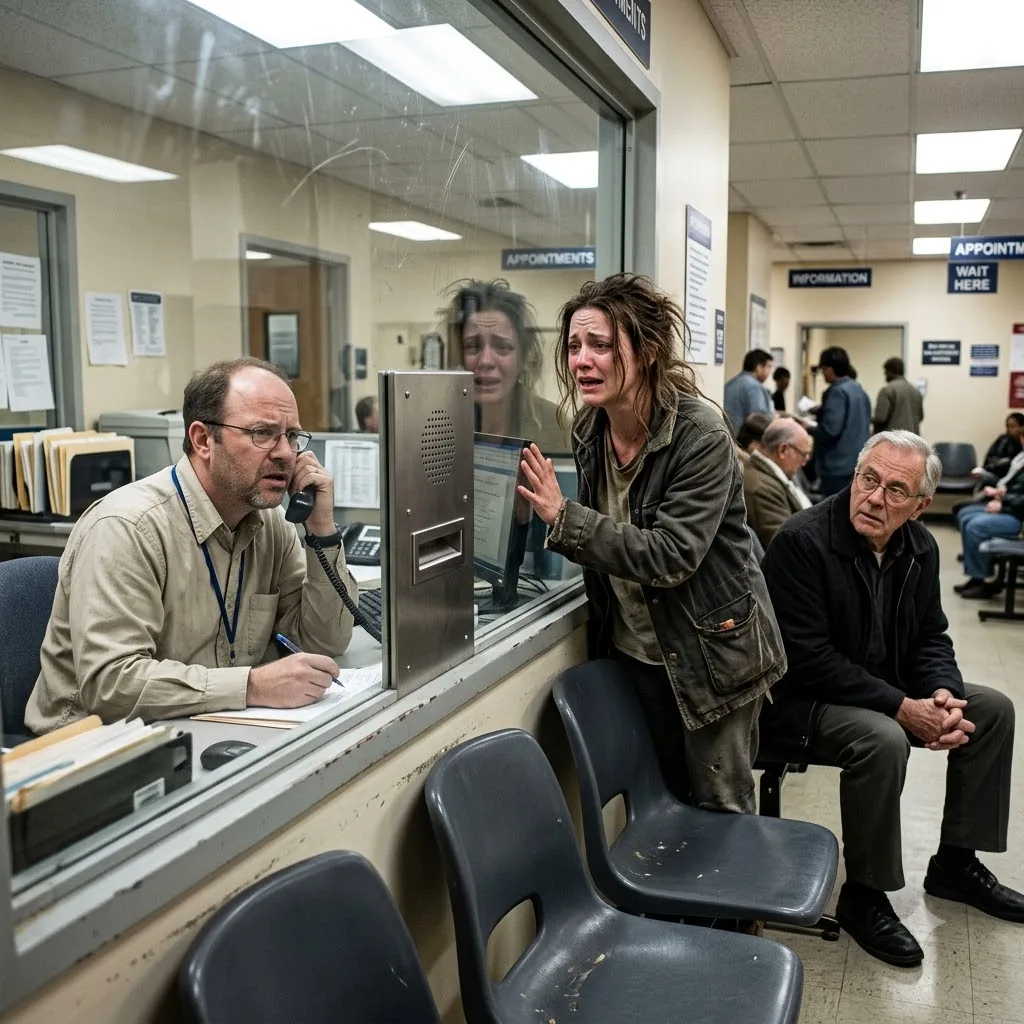
Marcus snatched his hand away from the buzzer, his heart hammering against his ribs like a trapped bird. He was safe inside his reception booth. The booth was entirely enclosed in bulletproof polycarbonate, accessible only by a single internal door that opened directly into the same patient hallway the veteran had just entered.
The man in the polo shirt did not shout. He did not pound his fist against the reinforced door. He simply turned and walked the few steps to Marcus’s reception window. Up close, the man’s eyes were entirely devoid of adrenaline. They were dead, assessing, and calculating.
The man raised his left hand and pressed a leather wallet against the glass. Marcus leaned in slightly, his breath fogging the inside of the pane. There was no gold shield. There was no police star. It was a stark white laminate card bearing a holographic federal seal, a scannable barcode, and bold black letters that read: BIOSECURITY OVERSIGHT.
“Override the door lock, Marcus,” the man said. His voice carried through the cheap desk speaker, perfectly steady and devoid of urgency. He had read Marcus’s plastic name tag. “The individual in the corridor is an unauthorized biological hazard. You are interfering with an active federal quarantine protocol. Open the door now.”
Marcus looked away from the man’s flat eyes and glanced down at his transaction tray. The drops of blood that had fallen from the veteran’s cuff were not coagulating like normal blood. The dark, crimson liquid was bubbling faintly. A thin wisp of acrid smoke rose from the cheap stainless steel of the tray. The blood was actively pitting the metal, eating into the smooth surface like battery acid.
“What is that?” Marcus whispered, his microphone picking up the tremble in his voice.
“That asset is contaminated,” the man said, lowering the badge. “She is leaking a Class 4 synthetic compound. You are now exposed, Marcus. Open the door so my team can secure the hazard and begin your decontamination.”
Marcus turned his head to look through the internal window of his booth, which faced the patient hallway. The veteran was slumped against the wall, her oversized olive jacket sliding against the white drywall. She was using her teeth and her right hand to rip a strip of fabric from her shirt, desperately trying to tie a makeshift tourniquet above her bleeding left forearm.
She looked up, catching Marcus’s terrified gaze through the internal glass. She shook her head violently.
“Don’t listen to him!” she rasps, her voice echoing in the empty, fluorescent-lit corridor. “It’s not a pathogen! It’s not a disease! They didn’t find something in me. They lost something in me. And they’re going to burn this whole clinic to the ground to get it back.”
Behind Marcus, the intake quota monitor on his desk continued to blink its aggressive crimson light, a surreal reminder of the mundane afternoon that had just violently unraveled.
The man in the waiting room realized Marcus was not going to push the button. He did not raise his suppressed pistol to the bulletproof glass. Instead, he reached into his tactical pants and produced a thick, cylindrical device that looked like a large steel marker. He twisted the top cap off and casually jammed the exposed end into the physical keyhole of the magnetic security door.
A blinding white spark flared from the keyhole. The man took a half-step back as a harsh, synthetic hissing sound filled the waiting room. A thick plume of gray smoke began to billow from the door frame, carrying the sharp, metallic stench of melting brass and burning insulation.
Marcus realized with a sickening jolt that his bulletproof cage was only safe as long as the exterior door held. Once the man burned through the lock and entered the patient hallway, he would have direct access to the flimsy wooden door at the back of Marcus’s booth.
“They’re tracking the leak,” the veteran gasped from the hallway, struggling to her feet. She clutched her bleeding arm tightly to her chest, intentionally letting the acidic blood drip onto her own thick jacket rather than the floor. “We have to get to the basement. To the MRI suite. The magnetic shielding is the only thing that blinds their scanners.”
The door frame groaned, the thick metal warping under the extreme heat of the thermal breaching charge. Marcus looked at his blinking quota screen one last time. He grabbed his heavy steel stapler-the only blunt object within reach-and shoved his rolling chair backward.
He threw open the internal door of his booth and stepped out into the sterile white hallway, coming face-to-face with the bleeding veteran.
A loud, structural crack echoed from the waiting room as the door’s locking mechanism finally began to shear apart under the intense heat.