Story code: ST-000367
Part 3: The Handoff That Would Not Hold
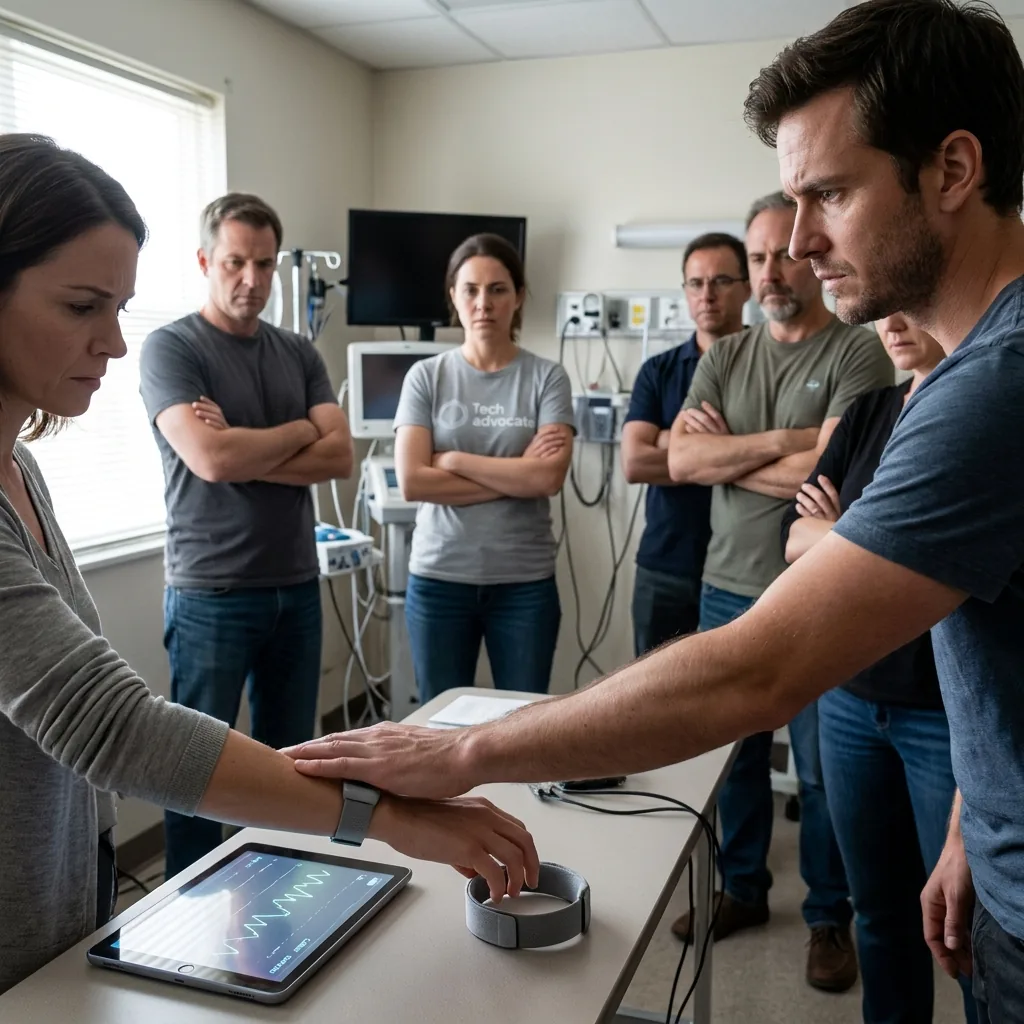
Noah kept looking at that one line on the stacked log, the one with his name and the unresolved handoff, while the rest of the room stayed fixed on the screen. Nobody spoke for a beat. The implant interface kept its soft beep. The sync band sat on its pad with its lights dim and steady, like it had no interest in the argument at all.
Tessa reached for the band again, slower this time. Noah put his hand flat on the table and did not move it away when she stopped. “We are not doing this by raw timestamp alone,” he said. His voice was still even, but the edge had gone thin. “The family needs support, not a spreadsheet war.”
“Then show the support,” Tessa said.
Evan was still in the demo chair. He had one hand on the armrest and one hand curled around the edge of the link cradle. He looked from the screen to Noah and back again. “What did it say?” he asked.
Noah answered too fast. “It says the system needs a cleaner handoff.”
That was not what the screen said, and the staffer by the wall glanced at me when he said it. She had the tablet tucked against her ribs now, and her thumb hovered over the corner of the display as if she wanted to keep it from refreshing again. The room had already seen the mismatch. Noah was still trying to talk around it.
Tessa lifted the band and turned it so the face caught the demo lights. “The handoff is clean when the person doing it finishes it,” she said. “The record shows who finished it.”
Noah looked down at the band for the first time instead of the people around it. He reached toward it, then stopped with his fingers still open in the air. He did not touch it. He turned that into a sentence instead. “You keep stepping between the patient and the process.”
I saw the relative nearest the door shift her weight and look at the band, then at Tessa, then at Noah. The accusation had already lost its polish. It was not landing the way it had in the first part of the session. The log was still open. The names were still there. Every attempt to call that interference only put more light on the fact that Tessa had been the one keeping the routine moving.
I reached for the monitor controls and pulled the log back to the top. The earlier entries stayed where they were: band check, charge confirmation, manual calibration, reset, handoff. Tessa’s identifier sat on each of them. Noah’s single unresolved attempt sat below them like a bruise under clear glass.
“Mara,” Noah said, using my name like he expected me to back him up. “You can see the room needs order.”
I kept my hand on the monitor edge. “I can see the order in the log,” I said.
That was all it took to change his face. Not much. Just a small tightening around the mouth and a blink that lasted longer than the others. He tried another angle. “Logs can be incomplete.”
“So can handoffs,” I said.
Tessa did not smile. She just set the band down between them and pressed the confirmation strip with two fingers. The display gave a clean chime and opened the care details beneath the log. The current line showed the next step due, and the system placed the responsibility marker beside Tessa’s name again. Not Noah’s. Hers.
Evan watched the marker move. “Then why is he talking like that?” he asked.
Noah answered before anyone else could. “Because someone has to keep the plan from drifting into one-person control.”
The line sounded practiced, but the room had already seen too much to let it stand on its own. The staffer by the wall finally said, very carefully, “The band did not record one-person control.”
Noah looked over at her. She did not look away, but she did lower her eyes to the tablet after she spoke, like the sentence had cost her something. That was the first time I noticed she was choosing words the way people do when they know the room is keeping score.
The monitor refreshed again, and the system brought up the incident note attached to the unresolved handoff. It was short, automatic, and plain. No long explanation. No commentary. Just the record that a transfer had been attempted by someone who had not completed the required sequence, followed by the correction done by Tessa so Evan could stay on schedule.
Noah read it with his head still. He could not make the screen say anything else. He tried one more time anyway. “That note needs context,” he said.
Tessa put one hand on the back of the demo chair and leaned just enough that Evan could hear her clearly. “The context is there,” she said. “I did the routine. He did not.”
The room stayed quiet after that, but it was not the same quiet as before. It had edges now. The kind that comes when everybody can see the shape of the problem and one person is still pretending not to.
Then Noah reached for the care interface, and the screen locked to his badge. A small red message appeared under the current session title: caregiver controls restricted pending supervisor confirmation.
No one moved for a second. The band was still on the pad. The log was still open. And now the room had a visible lock on the exact resource Noah had been trying to claim as his authority.