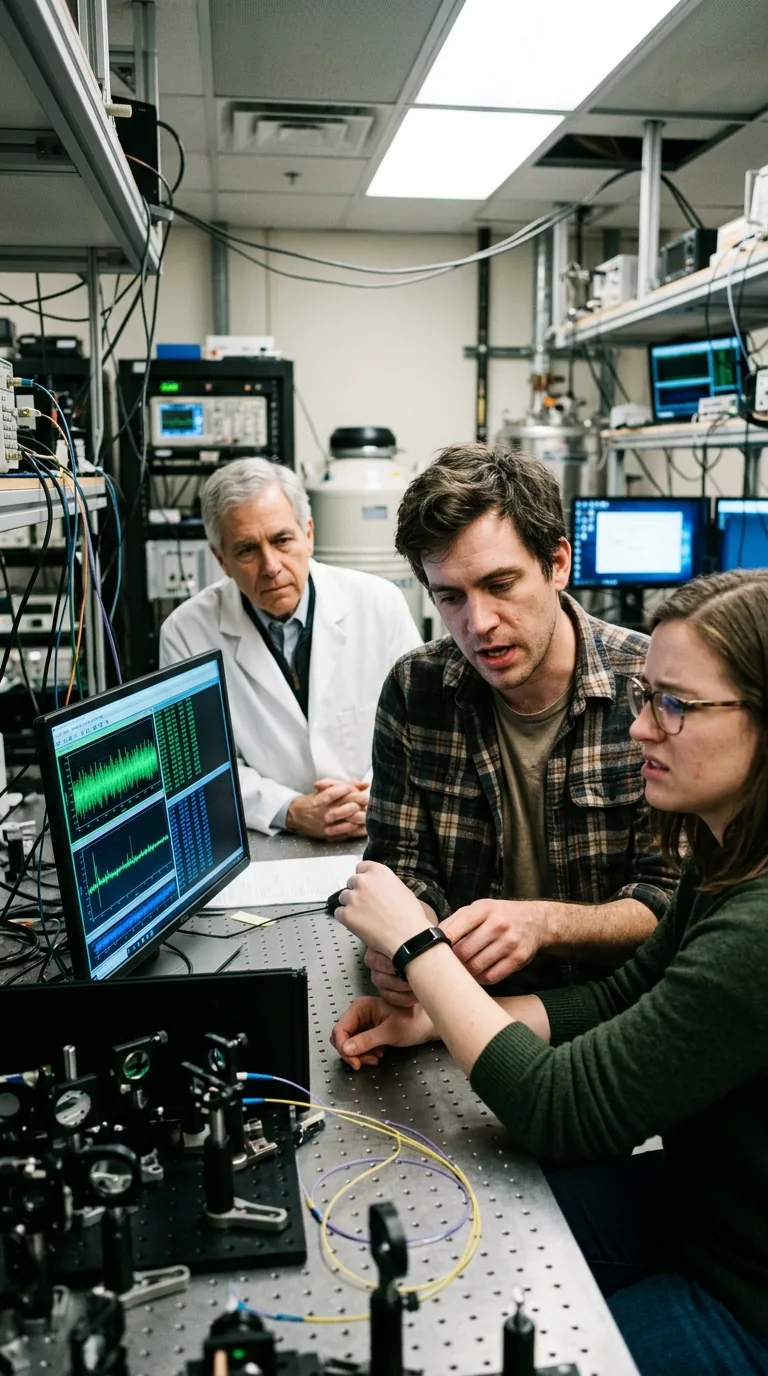
Story code: ST-000233
Part 2: The Explanation Kept Moving
By the time the next run should have started, nobody was setting the next sample. Maya stood at the side bench with her notebook open, the bracelet still in event memory mode, while Evan kept offering new explanations faster than the room could test the old ones. Every version required the same thing: that everyone ignore the order they had just watched happen.
Dr. Holt did not restart the sequence. She stood near the main monitor and said, “Pull the live trace buffer for the last two minutes. Don’t summarize it. Show it.”
Evan was already at the console. “We can do that, but if the wearable injected noise into Maya’s response timing, that doesn’t tell us much.”
Maya looked up from the notebook. “Injected noise into my response timing?”
He did not answer her directly. He clicked through the lab software with the same confident speed he used when he was explaining things to visitors. On the monitor, the buffer opened in a narrow graph window with timestamp marks along the bottom.
Nina moved closer to the screen. “There,” she said, not pointing at first, then lifting one finger. “Twelve fourteen and nine.”
A brief rise sat on the trace exactly where she said it did.
Nobody said that solved it. The mark was not huge. It did not need to be huge. It only needed to exist for the first denial to become a problem.
Evan leaned back slightly from the keyboard. “That can happen from a handling artifact. Someone shifting at the bench. Cable tension. It’s not evidence of a system event.”
Maya kept her tone level. “A minute ago you said it didn’t happen. Now it happened, but it means something else.”
One of the students at the back stopped typing.
Evan gave the same small smile he had used before. “I’m saying your bracelet made you overcall a minor fluctuation. That’s different from denying a fluctuation exists.”
Nina looked from the graph to Maya’s wrist. “You did say the second before I repeated it,” she said. “But the trace was already there when I looked up.”
That sentence narrowed the room. It did not accuse anyone. It just fixed the order again.
Dr. Holt asked, “What feeds the bracelet event marker?”
Maya answered first. “The synced sensor stream from the run rack. It flags outside range based on the threshold you approved Monday.”
Evan added, “With a local display layer that can lag or overreact.”
“Can lag,” Dr. Holt said. “Can it pre-trigger before the rack timestamp exists?”
Evan paused with one hand on the mouse. “Not pre-trigger, no. But a wearable can make a normal oscillation look dramatic if the user is waiting for one.”
That was the second trap, and it was worse than the first. The bracelet was now being treated as both too unreliable to trust and technical enough to justify ignoring what it showed. Maya did not move from the bench. She tapped the bracelet awake and read from the stored event screen.
“Event marker twelve fourteen and nine point three one,” she said. Then she looked at Nina. “What’s the graph mark?”
Nina bent closer to the monitor. “Twelve fourteen and nine point two eight to point three two, depending where you count the rise.”
The numbers sat nearly on top of each other.
Evan answered before Dr. Holt could. “That’s exactly the kind of close-enough match that fools people. If she saw the screen and then looked at her wrist, she’d naturally connect them.”
Maya did not raise her voice, but she held out her notebook so the page faced the room. The fresh entry was there in dark pen pressure: 12:14:09, written before the run had ended, before the buffer pull, before the graph window was expanded on screen.
“I wrote it before you exported anything,” she said. “And Nina repeated it before we stopped.”
Nina nodded once. “I did.”
The grad student by the fridge finally spoke. “I heard that too.”
Evan turned halfway toward him, then back to the console. “You heard people saying a number. That’s not the same as validating device accuracy.”
No one answered right away. The cooling pump kept up its even noise. The graph window stayed open. Maya’s bracelet screen dimmed again and then returned when her thumb brushed it.
Dr. Holt stepped closer to the console. “Open the threshold settings used for this run.”
Evan did not move for a second. Then he clicked into another panel. A configuration page came up with the approved range, the sync source, and the operator access line at the bottom.
Maya’s eyes went to the threshold first because that was the argument he had been making all morning. Nina’s went lower.
“Wait,” Nina said. She leaned in and read more carefully. “Why does it show a settings modification at twelve thirteen?”
The room went still in the small, practical way labs go still. No dropped glass, no gasps, just hands stopping over keyboards.
Evan kept one hand on the mouse. “Routine calibration touch. It wouldn’t affect this.”
Dr. Holt did not look at him when she answered. She was reading the bottom line of the panel. “Then we need the access trail for that touch.”
Maya said nothing. She just looked from the bracelet on her wrist to the operator line on the screen. The visible object he had called a liar was now sitting in the same minute as an unexplained settings change.
Dr. Holt straightened and named it like policy, not debate. “No new runs until I review the timestamped access log.”
Evan’s hand stayed on the mouse, but he did not click.
And that was when the question in the room changed from whether Maya had imagined a spike to who had been inside the system one minute before her bracelet marked it.