Story code: ST-000718
Part 2: The Registry Scan
Susan’s voice dropped to a clinical, hushed monotone as the call connected. “Yes, I need to report a fraudulent SSN under a hospital compliance sweep. I have the individual here.”
Mateo’s brain processed the words through a thick, suffocating sludge. The instinct to survive overriding the leaden weight in his muscles, he threw his upper body across the laminated desk. Susan gasped, jerking backward in her rolling chair, but she was too slow. Mateo’s trembling fingers clamped over his state ID card, snatching it from her blotter. He didn’t wait to see her reaction. He pushed off the desk, his boots slipping on the industrial carpet, and threw his weight against the heavy frosted-glass door of the cubicle.
“Security!” Susan’s voice echoed down the beige corridor, sharp and panicked.
Mateo stumbled into the hallway, his shoulder slamming hard against the wall. The fluorescent lights overhead strobed in sickening, uneven pulses as his blood sugar continued its relentless climb. Every step toward the exit felt like wading through chest-deep water. He kept his head down, weaving through a sudden influx of outpatient traffic, ignoring the shouting behind him. He burst through the sliding automatic doors and into the unforgiving wall of afternoon heat.
By the time he reached the Honda, his lungs were burning, pulling in shallow, useless breaths. He fumbled the keys, dropping them twice onto the melting asphalt before finally managing to jam the metal into the door lock. He threw himself into the driver’s seat, locked the doors, and cranked the ignition. He didn’t turn on the air conditioning; the compressor would drain the last quarter-tank of gas he had left.
His body was eating itself. The unmistakable symptoms of diabetic ketoacidosis were accelerating. A sharp, cramping pain twisted deep in his abdomen, and his mouth tasted violently of rotting apples and acetone. He needed insulin, and he needed it before the acid in his bloodstream shut down his organs entirely.
But he had no money, and his bank account was permanently locked. Worse, Susan had just handed his name and unverified status to the federal tip line. Going to his apartment was suicide; if immigration enforcement had a rapid-response unit in the area, they would check his registered address first.
He stared at the passenger seat, his blurred vision landing on his heavy canvas tool bag. His specialized roofing nailer and impact driver were inside. They were his livelihood, worth at least six hundred dollars on a job site, but right now, they were his only currency.
Mateo shoved the Honda into gear and steered out of the hospital lot, aiming for a dusty strip mall on the edge of the city limits. There was a pawn shop there, far enough from Oakridge General that the sirens he vaguely heard in the distance wouldn’t be looking for him. The drive took twenty minutes. He spent most of it fighting the urge to close his eyes, slapping his own cheek repeatedly to stay conscious as dark, fuzzy rings closed in on his peripheral vision.
He practically fell out of the car when he parked in front of the pawn shop’s barred windows. He dragged the heavy canvas bag over his shoulder. The strap dug violently into his collarbone. Inside, the shop smelled of old dust and cheap electronics. Mateo dumped the bag onto the scratched glass counter, his hands shaking so violently the metal tools clattered against each other.
The pawnbroker, a heavily tattooed man eating a sandwich, barely glanced at the tools. “Fifty bucks.”
“They’re worth… six,” Mateo managed to croak, leaning his elbows on the glass just to remain upright. “Need… hundred.”
“Fifty. Take it or leave.” The broker wiped mustard from his lip, unimpressed by the desperate, sweating man bleeding out in front of him.
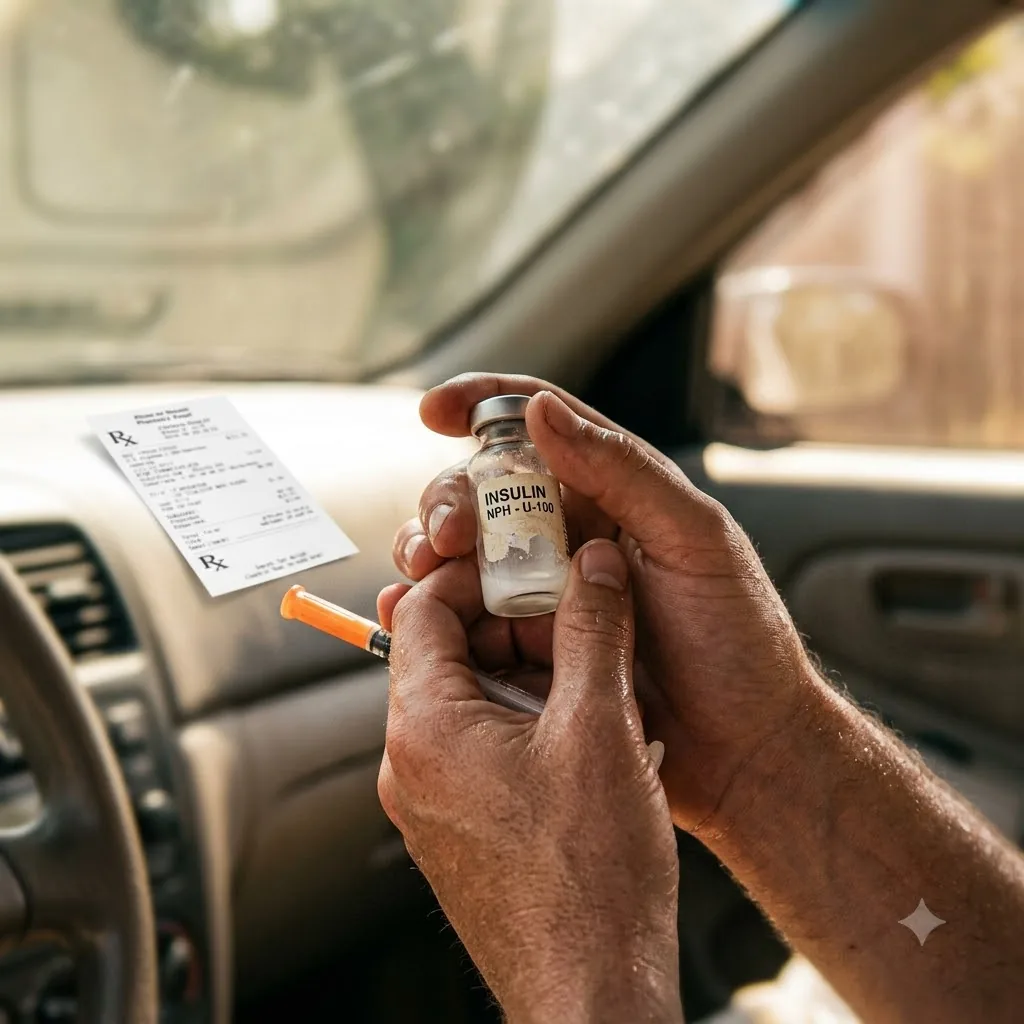
Mateo didn’t have the breath to argue. He nodded weakly. The broker slid a single fifty-dollar bill across the glass. Mateo snatched it, leaving his livelihood behind without a second glance. He had the cash. In this state, older, synthetic human insulin-Novolin R-could be purchased over the counter at any big-box pharmacy for twenty-five dollars. It wasn’t the Lantus his body was used to, and managing the peaks would be brutal, but it would stop the DKA.
He drove three blocks to a massive, sprawling grocery supercenter. The walk across the scorching, football-field-sized parking lot was a blur of pure agony. His knees buckled twice, scraping against the pavement, but he forced himself up. He was dying. The physical reality was no longer a threat; it was an active process. He dragged his feet through the automatic doors, the sudden blast of air conditioning making him shiver violently.
He clung to the aisles for support, making his way to the pharmacy counter at the back of the store. A young pharmacy technician with a bright blue smock was typing at a terminal.
“Novolin R,” Mateo gasped, slapping the crumpled fifty-dollar bill onto the counter. “One vial. Please.”
The technician looked up, startled by his pale, dripping face. “Uh, sure. Let me get the pharmacist to unlock the fridge.”
Mateo leaned his entire weight against the counter, his eyes squeezing shut. He had made it. He just needed the vial, and he could inject it in the bathroom. He could survive the afternoon.
“Alright, that’ll be twenty-four ninety-nine,” the technician said cheerfully, returning with the small, cold box. She tapped the screen. “Because it’s a restricted over-the-counter sale, state law requires me to scan a valid ID to log the transaction. Just need your driver’s license or state card.”
Mateo froze. The ringing in his ears amplified into a deafening roar.
He looked at the small barcode scanner resting on the counter. He looked at the technician, whose hand was outstretched. And then he noticed the security camera mounted directly above the register, and the armed store guard casually leaning against the photo-development kiosk just fifteen feet away.
If he handed over his ID, the scan would instantly hit the state registry. The exact same registry Susan had just flagged with the federal tip line. The system would lock him out, the terminal would alert the authorities, and the guard would hold him until the police arrived. If he refused, she would put the insulin back in the fridge, and he would be dead before sunset. He reached a trembling hand into his pocket, his fingers brushing against the plastic edge of his ID card, physically trapped between the immediate collapse of his failing organs and the inescapable snare of the state grid.