Story code: ST-000374
Part 2: The Bureaucracy of Brokenness
David’s hand shot out. His palm slammed flat against the center of his manila folder, pinning it to the desk before the caseworker could slide it entirely into the outgoing tray. The smack of flesh against cardboard echoed sharply in the small cubicle.
The caseworker froze, his hand hovering mid-air. He blinked behind his wire-rimmed glasses, a flash of genuine alarm crossing his face before settling into deep, bureaucratic irritation. “Mr. Miller. Remove your hand.”
David wanted to obey. His brain screamed at him to apologize, to maintain the quiet, respectful persona that had kept him alive this long. But the image of the freezing, repossessed sedan waiting for him in the commuter lot flashed behind his eyes. If he walked out of this building today without a housing voucher or a bed in the psychiatric ward, he would not survive the weekend. The terrifying, buzzing pressure in his chest finally breached the dam of his willpower.
He stopped fighting the tremor.
The rigid control he had held over his muscles snapped. Immediately, his right arm began to vibrate with violent, uncontrolled spasms. His hand, still pressed against the folder, rattled against the cheap laminate of the desk. The sound was a rapid, erratic drumming. He let his spine collapse, his perfect posture dissolving as he slumped forward in the plastic chair. His shoulders hunched toward his ears, and the frantic bouncing of his left foot returned, shaking his entire side of the cubicle.
“I can’t… I can’t leave,” David stammered, his voice cracking. He abandoned the measured, polite cadence he had practiced in the gas station mirror. He let the raw, breathless panic bleed into his vocal cords. “I am sleeping in a car. It’s twenty degrees at night. I don’t have money for gas to keep the heater on.”
The caseworker sighed, a heavy, exhausted sound that communicated he had seen this exact performance a hundred times before. He leaned away from the rattling desk. “Sir, suddenly deciding to exhibit symptoms because you didn’t get the answer you wanted does not change the intake criteria. You walked in here perfectly calm. You are clearly capable of composure. We have veterans in the waiting room who do not know what year it is.”
The accusation of faking it felt like a physical blow to David’s ribs. The pristine camouflage he had built was working too well; even when he tried to strip it away, the system saw only a calculated manipulation.
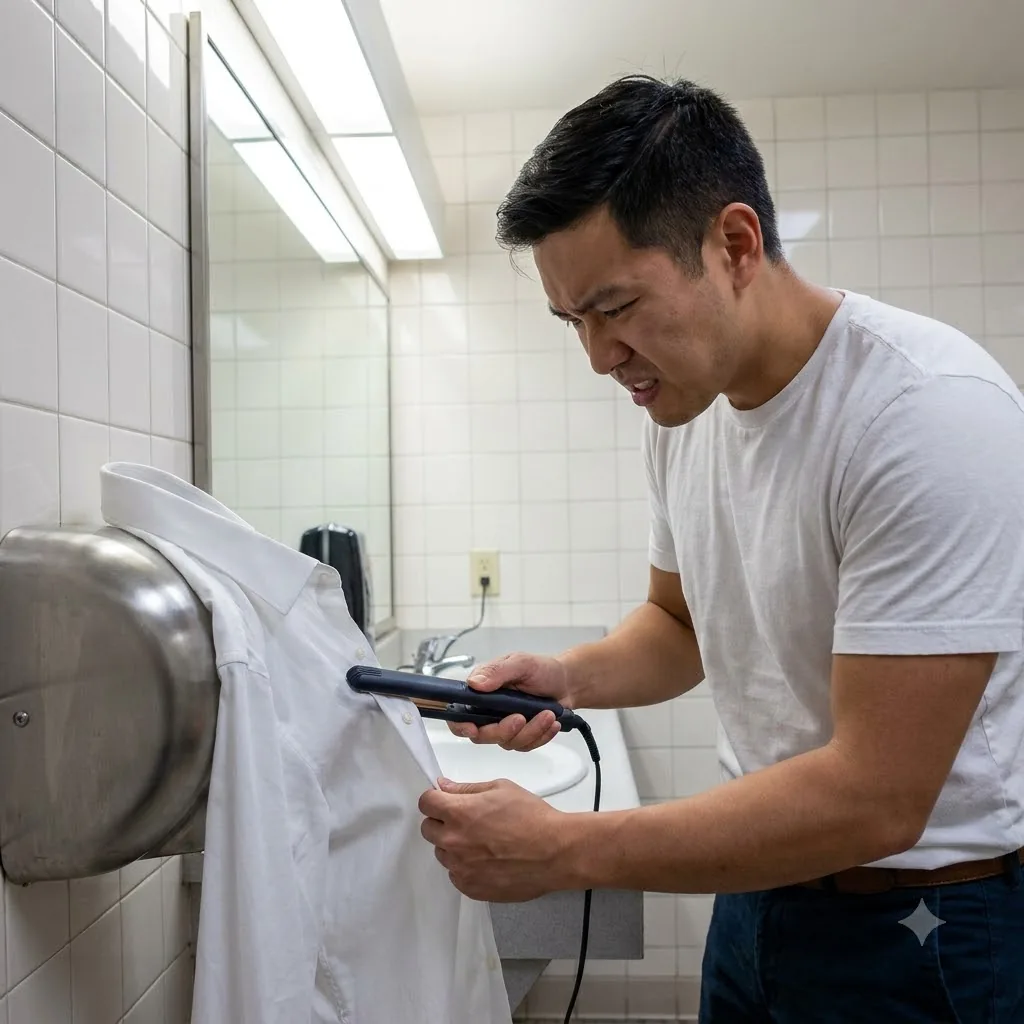
“I’m not faking it,” David choked out, the tremor traveling up his neck, making his jaw chatter. “I spent my last two dollars on coffee just so they’d let me use the bathroom mirror to iron this shirt.”
The caseworker looked at the pale blue collar. “With what iron, Mr. Miller?”
David’s face flushed with a hot, burning humiliation. He reached down and hoisted his heavy canvas duffel bag onto his lap. His shaking fingers fumbled with the zipper, the metal teeth catching twice before he ripped it open. He plunged his hand past the tightly rolled sleeping mat and pulled out the pink travel hair straightener. The cord dangled pathetically as he dropped the plastic device onto the caseworker’s desk, right next to the keyboard.
The caseworker stared at the bright pink plastic. His nose wrinkled in obvious distaste. “Put that away. This is highly inappropriate.”
“I used it on my collar,” David pleaded, his voice rising in pitch, drawing the attention of someone in the adjacent cubicle. “I clamped it on my shirt so I wouldn’t look homeless. So you wouldn’t treat me like trash. But I am. I am completely out of my mind, I promise you. Look.”
David grabbed the cuff of his crisp, pale blue sleeve. With a violent jerk, he ripped the button free. It pinged off the caseworker’s monitor and bounced into the carpet. David shoved the fabric up past his elbow, exposing his forearm.
The skin was a battlefield of raw, red scratches and half-healed scabs. For weeks, the nocturnal panic attacks had driven him to dig his own fingernails into his flesh, an involuntary grounding technique to stop the terrifying sensation of falling. He shoved his arm across the desk, pushing the bleeding evidence of his mental decay right into the caseworker’s personal space.
“Look at me!” David begged, the last remnants of his pride evaporating into the harsh fluorescent light. Tears of pure shame pricked the corners of his eyes, blurring his vision. “I am tearing myself apart. I am begging you for a bed.”
The caseworker did not look at the scratched arm with empathy. He looked at it with the cold, clinical distance of a man assessing a liability. He slowly rolled his chair backward, creating a physical barrier. He reached for the black telephone on the corner of his desk.
“Security to cubicle four,” the caseworker said into the receiver, his voice flat and urgent. “I have a hostile claimant escalating.”
“I’m not hostile!” David cried, his hands flying up in a surrender gesture, his left hand shaking just as violently as his right. “I’m just asking for the emergency protocol! You said you needed severe distress!”
“Lower your voice, Mr. Miller, or you will be permanently barred from this facility,” the caseworker warned, placing the receiver back in its cradle. “You are creating a disturbance.”
David stared at the man’s computer screen. The digital checkbox for ‘Immediate Psychiatric Danger’ remained empty. A sickening realization settled like lead in David’s stomach. The pink hair straightener, the raw, bleeding arms, the desperate begging-it was still just categorized as a minor disturbance. It wasn’t enough to trigger the lifeline he needed.
He heard the heavy, squeaking tread of combat boots on the linoleum in the main hallway. Two security guards were jogging toward cubicle four.
David looked at the blue pushpin stuck in the cubicle wall. If he walked out quietly with the guards, he remained a nuisance, a rejected file, a man who would quietly freeze to death in a repossessed car by Monday. The system only opened its emergency doors for bodies that were entirely broken. He realized with terrifying clarity that to prove he was in mortal danger, he couldn’t just show them his shattered edges. He was going to have to let them watch him shatter completely.