Story code: ST-000574
Part 3: The Proprietary Blend
The vibration of the Honda engine had stopped registering in Elias’s hands, replaced by a deep, throbbing numbness that crawled all the way to his shoulders. He swung the wand in relentless, sweeping arcs, blasting the wet stucco. A slurry of pulverized Desert Sand paint and dirty water pooled around his boots. The sun had dipped below the rooflines, casting long, bruised shadows across the driveway.
He was maybe sixty percent finished. The garage was entirely gray limestone now, and he was working his way across the front bay window.
Headlights swept over the wet concrete. A dark gray sedan pulled sharply to the curb, parking directly behind Arthur’s golf cart, which had returned silently in the dusk.
Elias didn’t stop. He kept his thumb pinned on the trigger, stripping another foot of paint.
A man in a tan windbreaker stepped out of the sedan, holding a thick manila envelope. He didn’t look like a lawyer; he looked like a courier who wanted to go home. He walked up the driveway, side-stepping the milky runoff, and raised a hand.
Arthur Pendelton marched right behind him, a smug, tight smile plastered across his face.
“Elias Vance!” the man in the windbreaker shouted over the engine roar.
Elias held the wand for three more seconds, stripping one final vertical stripe, before he finally released the trigger. He reached down and hit the kill switch on the compressor. The sudden silence in the neighborhood was deafening, broken only by the sound of water dripping from the eaves.
“Yeah,” Elias breathed, wiping his gritty forehead with the back of his forearm.
The man shoved the envelope into Elias’s chest. “You are hereby served with a temporary restraining order from the county court, acting on behalf of the Oakridge Estates Homeowners Association. You are ordered to cease and desist all exterior property modifications immediately. Have a good night.”
The courier turned and walked briskly back to his sedan.
Arthur stepped forward, planting his penny loafers safely on a dry patch of concrete. He looked at the jagged, half-stripped facade of Elias’s house and let out a short, triumphant breath.
“I warned you, Elias,” Arthur said, his voice dripping with practiced sympathy. “You just couldn’t leave well enough alone. The injunction is active. If you turn that machine back on, the police will arrest you for contempt. Your house is now frozen in a state of catastrophic violation. We will proceed with the foreclosure on Friday, and you will be responsible for the association’s legal fees.”
Elias stood in the puddle of runoff. He looked down at the court order in his hands. He didn’t rip it up. He didn’t yell. Slowly, the tight, panicked knot in his chest began to loosen.
He turned his back on Arthur, walked into the garage, and dropped the restraining order on his workbench.
“Running inside won’t change anything!” Arthur called out, his voice echoing off the concrete walls. “The board meets tomorrow to finalize the lien!”
Elias didn’t run inside. He picked up the heavy, dust-covered 1998 Oakridge Estates Charter from the workbench. With his other hand, he grabbed the rented spectrophotometer. He walked back out to the driveway and stopped a few feet from the HOA President.
“You’re right, Arthur,” Elias said, his voice completely level. “I can’t wash another inch of my house. I’m frozen.”
“Good. Acceptance is the first step,” Arthur said, adjusting his lanyard.
Elias flipped the heavy binder open. He turned past the zoning definitions and stopped on page forty-two, where the fluorescent yellow highlighter jumped off the yellowed paper.
“The thing is, Arthur, when I was reading the charter to find the original surface exemption, I didn’t just read Section B,” Elias said. “I read Section A. The foundational aesthetic mandate.”
Arthur rolled his eyes. “We don’t use the 1998 guidelines anymore, Elias. The architectural committee updates the approved color palettes every three years. Your paint wasn’t on it.”
“The committee updates them,” Elias agreed. “But I checked the bylaws on how the committee gets its authority. According to Article Nine of this charter, the architectural committee can only enforce the aesthetic mandates laid out in this original document. And Article Four, Section A is very specific.”
Elias held the binder up, angling it so Arthur could see the dense text.
“It says: ‘To maintain perfect uniformity, all exterior surfaces must exclusively utilize Oakridge Original Sand, a proprietary blend manufactured by Vanguard Chemical, exact Hex Code #8B7F71.'”
“Vanguard Chemical went bankrupt in 2004,” Arthur snapped, waving his hand dismissively. “They don’t exist. That’s why the board created the approved palette lists. To adapt. This is a waste of time.”
“But you didn’t have the legal authority to adapt,” Elias said softly.
Arthur froze, his hand dropping to his side. “What?”
Elias tapped the bottom of the page. “Section C. ‘This foundational aesthetic mandate, including the proprietary Vanguard color code, may only be amended or superseded by a unanimous, notarized vote of one hundred percent of the deeded homeowners.’ Did you ever get a unanimous, notarized vote from every single homeowner in Oakridge Estates to abandon Vanguard Chemical?”
Arthur’s jaw tightened. “That’s a clerical technicality. The board has executive discretion.”
“No, you don’t. The charter strictly prohibits executive discretion on the foundational color,” Elias corrected. “Which means the architectural committee’s modern color palettes are legally void. The only valid, charter-approved paint is Vanguard Hex Code #8B7F71.”
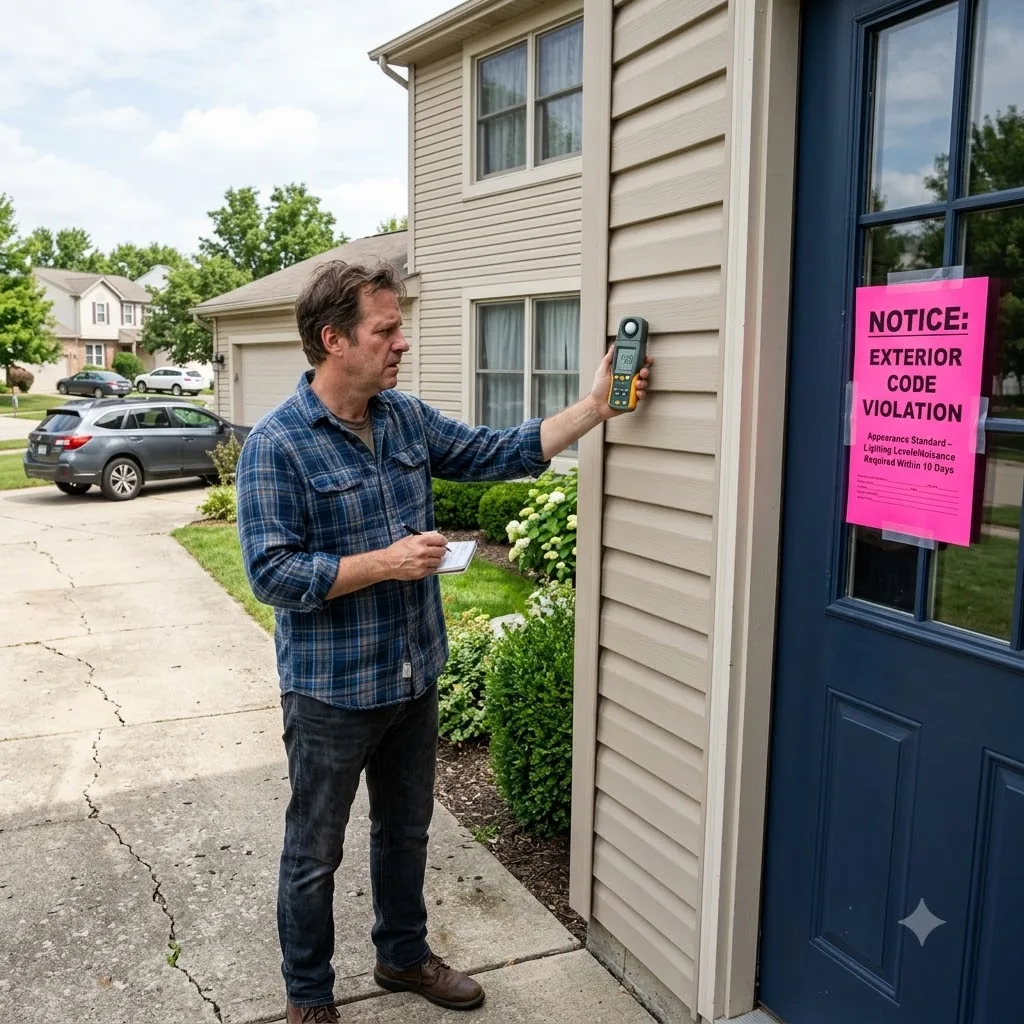
Elias raised the heavy, industrial spectrophotometer. “I rented this to prove my Desert Sand paint was mathematically compliant with your fake rules. But on my way back from the rental shop, I stopped by your house, Arthur.”
Arthur took a half-step backward. The color drained from his face, leaving his cheeks a blotchy, pale pink. “You trespassed on my property?”
“I stayed on the public sidewalk,” Elias said. “I leaned over your bushes and pressed this right against your siding. You repainted last spring, didn’t you? You used Sherwin-Williams ‘Alabaster’. The Light Reflectance Value is 82. Vanguard’s proprietary hex code translates to an LRV of precisely 41.5.”
Arthur stared at the digital screen on the device as if it were a live grenade.
“Every single house in this neighborhood that has been repainted since Vanguard went bankrupt in 2004 is in violation of the foundational charter,” Elias said, his voice ringing clearly in the quiet dusk. “Including yours. And since the board never legally amended the rule, the charter’s original penalty schedule still applies.”
Elias flipped to the back of the binder. “Section G. Unauthorized exterior modifications incur a fine of one hundred dollars per day, retroactively applied to the date of application.”
Arthur swallowed hard. His eyes darted from the binder to Elias’s face.
“You painted your house eighteen months ago,” Elias said, doing the math in his head. “That’s five hundred and forty days. You owe the Oakridge Estates Homeowners Association fifty-four thousand dollars, Arthur. Personally.”
Arthur’s mouth opened, but no sound came out. His hands fumbled uselessly with his clipboard.
“In fact, every single member of your board has repainted in the last decade,” Elias continued, stepping closer. “By your own rules, the board owes millions in back-dated fines. The only way to cure the violation, since Vanguard paint no longer exists, is to invoke the single exemption left in the charter.”
Elias pointed to his half-stripped, limestone-gray garage.
“Section B. Exposing the original, developer-installed stucco,” Elias said. “I’m the only house in the neighborhood currently coming into compliance. The rest of you are facing foreclosure.”
Elias held out the court order. “So, do you want to cancel this injunction, or should I march down to the county courthouse tomorrow morning and file a class-action enforcement suite against you and the entire board?”
Arthur stood paralyzed in the fading light. He stared blankly at the muddy runoff soaking into his pristine penny loafers, then slowly looked up at the stark gray limestone wall, unable to form a single argument as the weight of his own rulebook crushed him.