Story code: ST-000575
Part 2: The Exemption
The sudden absence of resistance sent Arthur pitching forward. He stumbled over the brass threshold, his finger instinctively contracting on the staple gun’s trigger. A sharp, mechanical *CRACK* echoed through the foyer as a heavy-duty steel staple drove itself violently into the mahogany doorframe, missing the homeowner by a fraction of an inch.
Arthur caught his balance, his polished loafer scuffing against the pristine hardwood floor of the entryway. He gasped, his heart hammering against his ribs, and looked up to offer a sharp reprimand for the sudden opening of the door. The words died in his throat.
Marcus Shaw, the owner of number forty-two, sat in the center of the foyer. He was not standing. He was strapped into a massive, mechanized wheelchair, its thick rubber tires resting directly on the expensive Persian rug. Marcus’s right leg was elevated on a padded mechanical arm, heavily wrapped in thick white bandages and secured by a terrifying cage of external steel pins and carbon-fiber rods.
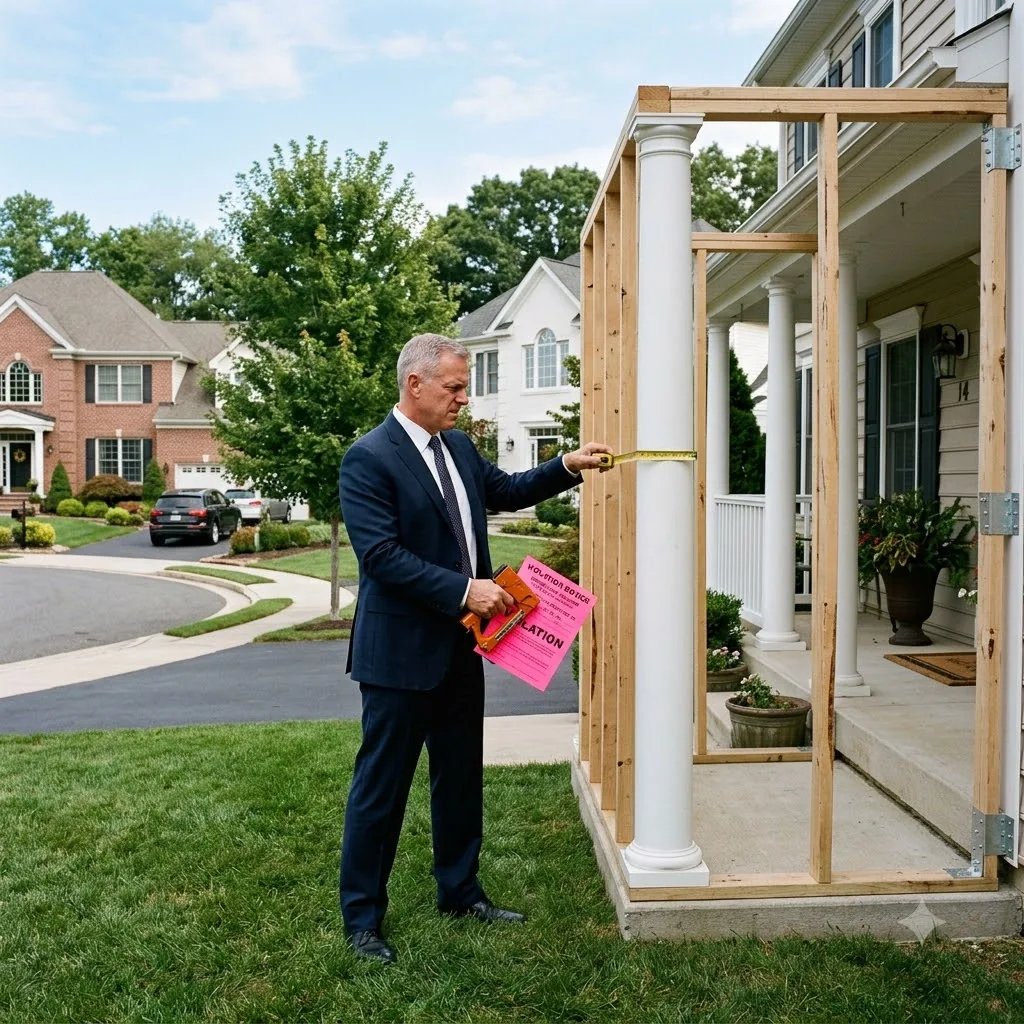
Arthur stared at the apparatus, his mind instantly recalibrating the raw pine structure outside. The high-friction grip tape. The sloped, continuous incline. The forty-eight-inch width. The lack of decorative stairs. It wasn’t an industrial loading dock. It was a wheelchair ramp.
A heavy silence hung in the entryway, broken only by the low, electronic hum of Marcus’s wheelchair.
“Were you just about to shoot a staple into my front door?” Marcus asked, his voice rough and laced with heavy exhaustion. His face was pale, shadowed with dark circles, and he wore a loose hospital gown tucked into sweatpants that had been clumsily cut up the seam to accommodate the metal halo around his shin.
Arthur quickly lowered the heavy industrial tool, smoothing the front of his blazer with his free hand. He felt a brief, microscopic flicker of heat rise in his cheeks, but years of enforcing the Oakridge Estates Homeowner’s Charter quickly doused any latent embarrassment. A ramp was a structure. All structures required a permit. The fact that Marcus had suffered a catastrophic injury did not negate the necessity of paint swatches.
“Mr. Shaw,” Arthur began, his voice dropping into the authoritative, bureaucratic register he used for annual board meetings. “You opened the door abruptly. I was simply executing my duties as the compliance officer. Which brings me to the matter of the unapproved timber modification currently sprawling across your front lawn.”
Marcus blinked, his eyes darting from the heavy metal staple gun in Arthur’s hand to the bright neon orange sticker sitting atop the clipboard. “Modification? You mean the ramp? I was in a horrific head-on collision on Interstate 95 last week. I just got discharged from the surgical ward three hours ago. My brother built that ramp over the weekend so I could actually get into my own house.”
“A tragic circumstance, Mr. Shaw, truly,” Arthur said, his tone perfectly even. “And I wish you a very speedy recovery. However, sympathy does not suspend the bylaws. Paragraph four, section B, clearly states that any exterior structural additions must be submitted to the Architectural Review Committee thirty days prior to construction.”
“I was in a medically induced coma thirty days ago!” Marcus shouted, his hands gripping the armrests of his chair.
“Which is unfortunate,” Arthur replied, pulling the thick manila envelope from under his arm. “But it does not excuse untreated pine. It does not excuse a lack of aesthetic compliance. And it certainly does not excuse building a structure fourteen inches past the setback allowance. The bylaws do not contain an exemption clause for personal emergencies.”
Arthur stepped back onto the wooden landing, adopting a formal posture as he extended the clipboard. “I have audited the violations. Five hundred dollars for initiating construction without a permit. Two hundred dollars per day for fourteen days of visual blight. Fifty dollars per day for each foot the structure encroaches past the setback line. The total is seven thousand dollars, due immediately.”
Marcus stared at Arthur as if he were looking at an alien life form. Down on the sidewalk, Arthur noticed motion. Mr. and Mrs. Gable had paused their evening dog walk, lingering by the edge of the driveway. Further down, the Johnsons were standing on their porch, watching the confrontation.
Arthur felt a surge of righteous vindication. The neighborhood was watching. They were looking to him to hold the line. If he gave Marcus Shaw a pass because of a sad story and a broken leg, tomorrow there would be neon pink sheds, rusted car parts on lawns, and chain-link fences. Anarchy always began with a single unpunished infraction. He had to be strong for the community.
“I am not paying you a single cent,” Marcus hissed, his knuckles turning white as he leaned forward in his chair. “And you need to get off my property before I call the police.”
“The police have no jurisdiction over neighborhood deed restrictions,” Arthur corrected smoothly, peeling the bright neon orange violation sticker from its backing. He leaned forward and slapped the incredibly sticky adhesive directly onto the center panel of the mahogany door. “You are officially served.”
Marcus’s face contorted in absolute rage. He threw his hand down onto the wheelchair’s joystick, driving the heavy machine forward with a sudden mechanical lurch. The heavy rubber tires slammed into the threshold, forcing Arthur to step backward quickly to avoid getting his polished loafers crushed.
“You have until Friday at five o’clock to remit the seven thousand dollars and submit a retroactive blueprint,” Arthur said, raising his voice so the watching neighbors could hear the full extent of his unyielding authority. He turned his back on the furious man and began marching down the abrasive grip tape. “Or the Association’s contractors will be here on Saturday morning with chainsaws to remove this unapproved hazard at your expense.”