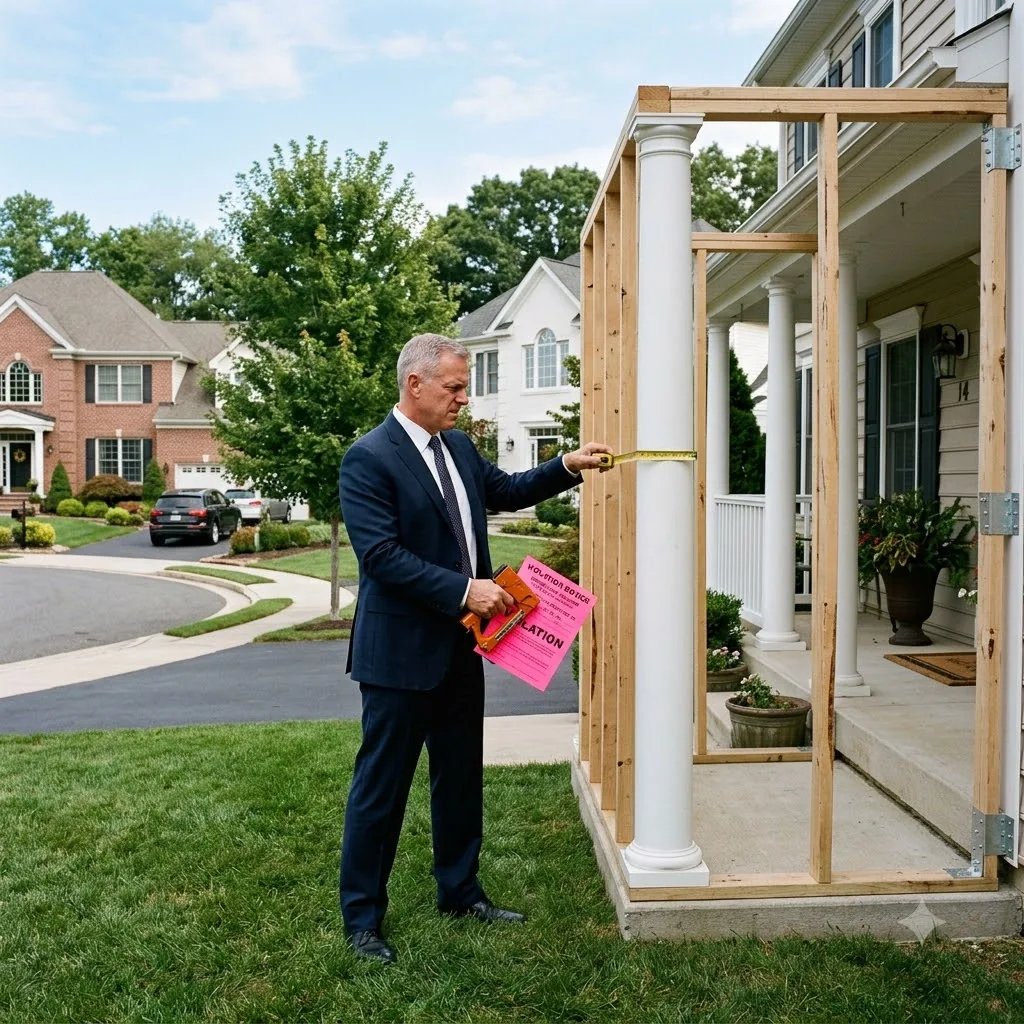
Story code: ST-000575
Part 3: The Artilleryman
The Oakridge Estates community center smelled faintly of stale percolator coffee and industrial floor wax. Arthur sat perfectly rigid at the center of the folding banquet table, meticulously arranging his three fountain pens so they lay parallel to his leather-bound clipboard. The emergency Thursday night board meeting had drawn an unprecedented crowd. Every folding chair was occupied, and residents lined the back walls, murmuring in hushed, expectant tones. Arthur spotted Mr. and Mrs. Gable in the second row, and the Johnsons hovering near the water cooler. They had all come for a show. They had come to see the line held against neighborhood anarchy. Arthur relished the heavy tension in the room. This was his arena.
He reached forward and tapped the microphone, producing a sharp thump that instantly silenced the room.
“Next item,” Arthur announced, his voice echoing with bureaucratic authority. “Property forty-two. Unpermitted structural modification and extreme setback violation.”
The double doors at the back of the room swung open, and the heavy, mechanical hum of Marcus Shaw’s wheelchair immediately cut through the quiet. Marcus navigated the polished linoleum floor, his shattered leg jutting forward in its terrifying cage of steel pins and carbon fiber. But Arthur’s eyes quickly bypassed the homeowner, locking onto the man walking beside the chair.
He was tall, built with a dense, rigid posture, wearing a faded olive-drab field jacket and heavy, scuffed work boots that squeaked faintly against the pristine floor. He possessed the calloused hands and steady, unblinking gaze of a man accustomed to hard labor. The brother. The rogue carpenter who had ruined the street’s aesthetic.
Arthur leaned back in his chair, folding his hands over his ledger. “Mr. Shaw,” he said smoothly. “And you must be the unauthorized contractor. You have exactly three minutes to address the board before the demolition order for this Saturday is finalized.”
The tall man stepped up to the podium, ignoring the microphone completely. He planted his heavy boots shoulder-width apart. “My name is Elias. I built the ramp.”
“With untreated pine, Mr. Elias,” Arthur corrected, clicking his pen. “Without a single blueprint submitted to the architectural committee. I assume you are here to offer an emotional plea or request a hardship waiver based on your brother’s medical emergency. Let me save this board’s time. Sympathy does not suspend the bylaws. The rules-”
“I’m not here to ask for a waiver,” Elias interrupted. His voice wasn’t raised, but it carried a dense, commanding weight that easily reached the back of the room.
Arthur paused, his pen hovering over the clipboard. “Excuse me?”
Elias reached into his jacket, withdrew a rectangular slip of paper, and dropped it onto the laminate podium. “Cashier’s check. Seven thousand dollars. The fine is paid.”
A low murmur rippled through the seated neighbors. Arthur stared at the green slip of paper from twenty feet away, his mind struggling to process the disruption to his script. People were supposed to plead. They were supposed to crumble under the financial weight of the citations and agree to dismantle the offending structures. The money wasn’t the point; the leverage was. By paying the exorbitant fine outright, this rough-hewn carpenter had just bought the ugly wooden structure the right to exist while a retroactive permit was fought over in committee.
Arthur straightened his spine, attempting to regain control of the room. “Payment of the penalty does not excuse the immediate visual blight, Mr. Elias. The structure is still non-compliant.”
“I didn’t come here to argue about pine boards,” Elias said, his gaze locking onto Arthur. It wasn’t a glare of anger. It was an analytical, dissecting stare that made Arthur’s skin prickle beneath his tailored blazer. “I came because I wanted to see the man who stapled a neon penalty to a doorframe while my brother was bleeding inside.”
Arthur bristled, his face flushing hot. He leaned aggressively into the microphone. “My reputation as a strict enforcer of the community charter is no secret, sir. I do not apologize for maintaining standards.”
Elias shook his head slowly. “I know your reputation. I’ve known all about you for years. Just not from the neighborhood.”
Arthur frowned, a deep crease forming between his brows. “What are you talking about?”
Elias gripped the edges of the podium. “I know about you from David.”
The name hit Arthur like a physical blow to the sternum. All the air vanished from his lungs. His fingers clamped down so hard on his fountain pen that the plastic casing groaned in the quiet room.
*David.*
It had been six years. Six years of absolute, echoing silence. Six years since the screaming match in the driveway, since David had thrown a canvas duffel bag into the trunk of a beat-up sedan and driven out of Oakridge Estates without looking back. Arthur had forbidden his wife from mentioning the boy’s name at the dinner table. He had buried himself in the HOA, in the absolute safety of rulers, bylaws, and controllable variables.
“I-” Arthur choked out, his bureaucratic armor instantly evaporating. The faces of the watching neighbors blurred into a meaningless wash of color.
“Second Battalion, Eleventh Marine Artillery Regiment,” Elias said, his voice dropping into a quieter, lethal register. “We served together in Helmand. He was my spotter. We shared a tent for nine months.”
Arthur’s heart hammered frantically against his ribs. The perfectly organized ledger on his clipboard suddenly looked like absolute gibberish. He opened his mouth, desperately searching for a procedural rule, a point of order, anything to stop the bleeding, but his throat had completely seized.
“David talked about his old man all the time,” Elias continued, stepping out from behind the podium, closing the distance to the board table. “He told me how you used to measure the grass with a steel ruler. How a scuff on the hardwood floor was treated like a moral failure. He said you were a man who cared far more about how things looked on the outside than what they actually were on the inside.”
The community center was dead silent. Even the hum of the fluorescent lights seemed to vanish. Arthur sat frozen, his pristine polished loafers suddenly feeling like lead weights.
“I always thought he was exaggerating,” Elias said, his voice laced with a quiet, absolute disgust that echoed off the linoleum walls. “He told me you were the kind of man who would watch someone bleed to death if they were ruining the carpet. I told him no father was actually like that. I didn’t believe him.” Elias paused, his eyes drilling into Arthur’s pale face. “Until I saw that staple in the mahogany.”