Story code: ST-000594
Part 4: The Desert Bee
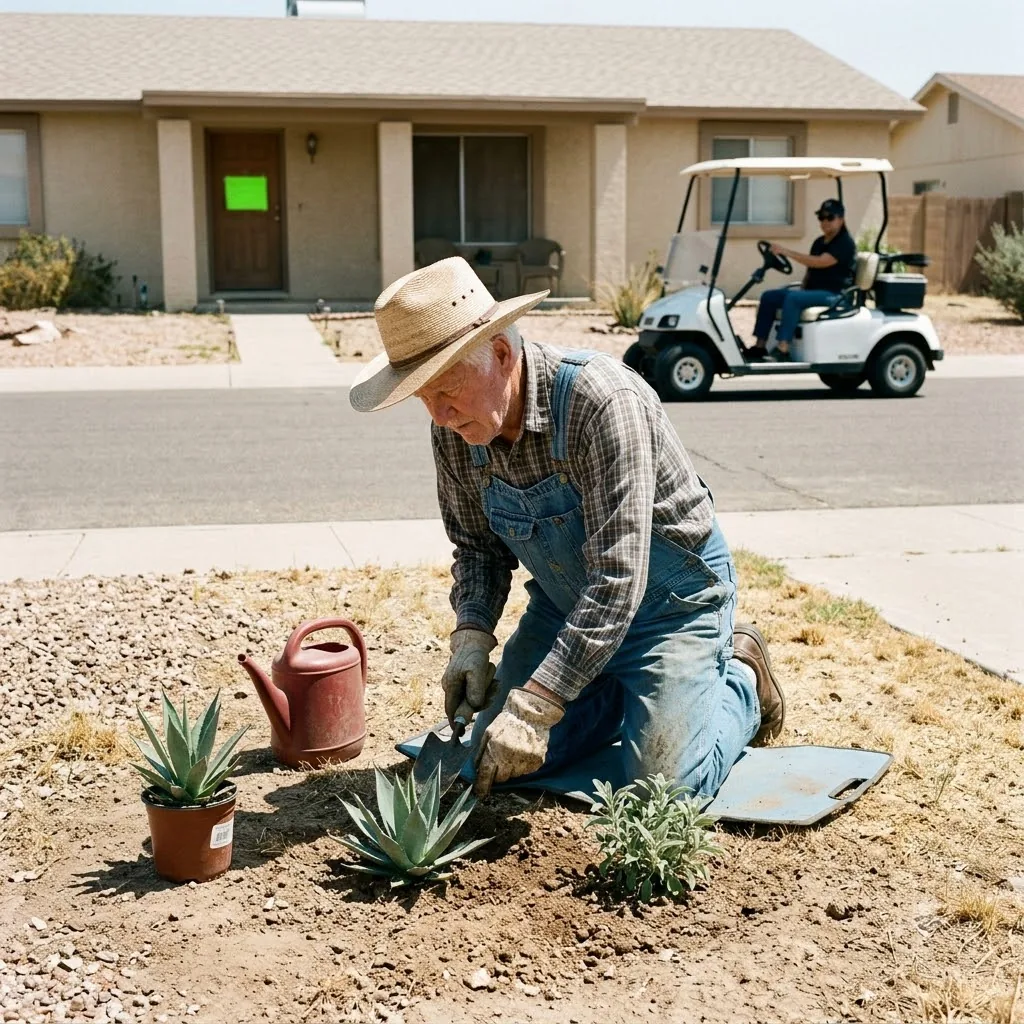
September arrived without relief, bringing a dry, baking heat that trapped the Oakridge cul-de-sac in a suffocating haze. Elias knelt on a frayed foam pad in his front yard, meticulously spreading a thin layer of cedar mulch around the base of the native sage bushes. The harsh Texas sun beat down on his neck, but he didn’t mind the sweat. He worked slowly, his bare hands pressing the fragrant wood chips into the baked clay.
The silver-green leaves of the sage were thriving. They had taken root in the unforgiving soil, demanding almost nothing in return. Around them, the last remnants of the dead Bermuda grass had finally crumbled into dust, leaving Elias’s yard a stark, pale island amid a sea of chemically sustained emerald lawns.
He sat back on his heels, a familiar ache settling into his lower back. He wiped the grit from his forehead with the back of his work glove. Down the street, the rhythmic, hissing *thwack-thwack-thwack* of an oscillating sprinkler echoed off the pavement. It was his next-door neighbor, Mark, wasting hundreds of gallons of water in the midday heat.
Elias stood and brushed the dirt from his jeans. He saw Mark standing at the edge of his driveway, coiling a heavy green garden hose.
“Afternoon, Mark,” Elias called out, raising a weary but genuine hand in greeting.
Mark froze. He glanced at Elias, then looked down at his own pristine, artificially vibrant grass. Without a word, Mark turned his back, walked into his garage, and hit the button to lower the door. The heavy metal panel slammed shut, echoing like a gunshot in the quiet cul-de-sac.
Elias let his hand fall to his side. The rejection stung, a dull, hollow throb in his chest, but it was no longer a surprise. It had been this way for a month.
He had won at the clubhouse. He had slammed the state property code onto the mahogany table and watched Arthur Vance’s smug composure shatter in front of the board. The fifteen hundred dollars in landscaping fines had been voided, legally erased. Elias had paid the five-hundred-dollar penalty for the nursery pots left on his porch, a check that had drained his bank account down to a terrifying hundred and fourteen dollars. For two weeks, he had survived on boiled rice, frozen peas, and tap water, waiting for his pension check to clear.
He had saved his home. The neon-green envelopes had stopped appearing on his door. The threat of foreclosure had evaporated entirely.
But he had broken the unspoken social contract of Oakridge, and for that, there was no forgiveness.
Arthur Vance had kept his power. Though humiliated at the open forum, Vance had merely pivoted his strategy, painting Elias not as a victim of bureaucracy, but as a selfish outlier trying to drag down the neighborhood’s property values. The older man in the third row who had asked about his own dead grass had been quickly silenced behind closed doors. The subdivision closed ranks. Now, when Elias walked to his mailbox, living room blinds snapped shut. When he went to the community center to drop off his monthly dues, conversations stopped entirely until he walked out the heavy glass doors.
Thirty years of quiet, neighborly existence-of shared tools, casual waves, and holiday cards-had been wiped out by a dozen native sage plants and a refusal to be bullied into bankruptcy.
Elias picked up his empty plastic mulch bags and dragged them toward the side gate. He walked back to the front porch and sat down on the top concrete step. The oppressive, manufactured perfection of Oakridge stretched out before him. The pristine lawns suddenly looked grotesque to him, a fragile illusion maintained by fear, crushing debt, and thousands of gallons of stolen water.
The silence of the street was heavy, suffocating. He was entirely alone in the house he and his late wife had built. The victory over the HOA felt cold, an isolating wall that separated him from the only community he had left. He leaned his elbows on his knees, burying his face in his rough, calloused hands. The sheer exhaustion of the past month pressed down on his shoulders. He had kept his sanctuary, but it had become a fortress.
A low, rhythmic vibration broke the stillness.
Elias lifted his head. The sound was incredibly faint, barely audible over the distant, mechanical hum of the neighborhood air conditioning units.
He looked toward the dry dirt. Hovering just inches above the pale, dusty leaves of the largest sage bush was a solitary desert bee. It was small, its fuzzy body striped in dull gold and ash. It circled the newly bloomed purple flowers of the sage, its wings a blur of translucent motion.
Elias held his breath, terrified of startling the tiny creature. He watched as the bee dipped lower, finally landing delicately on the rim of a purple petal. It climbed inside the flower, entirely oblivious to the manicured lawns, the watchful eyes behind the tinted windows, and the heavy, isolating silence of the cul-de-sac.
It was just a bee and a plant, doing exactly what they were meant to do in a harsh, dry world.
Elias watched the bee work. The tight, anxious knot that had lived in his chest for weeks began to loosen, unraveling slowly into the hot September air. He leaned back against the wooden frame of his front door, a quiet, fragile peace settling over him as the tiny golden insect moved from blossom to blossom, bringing life to his defiant patch of earth.