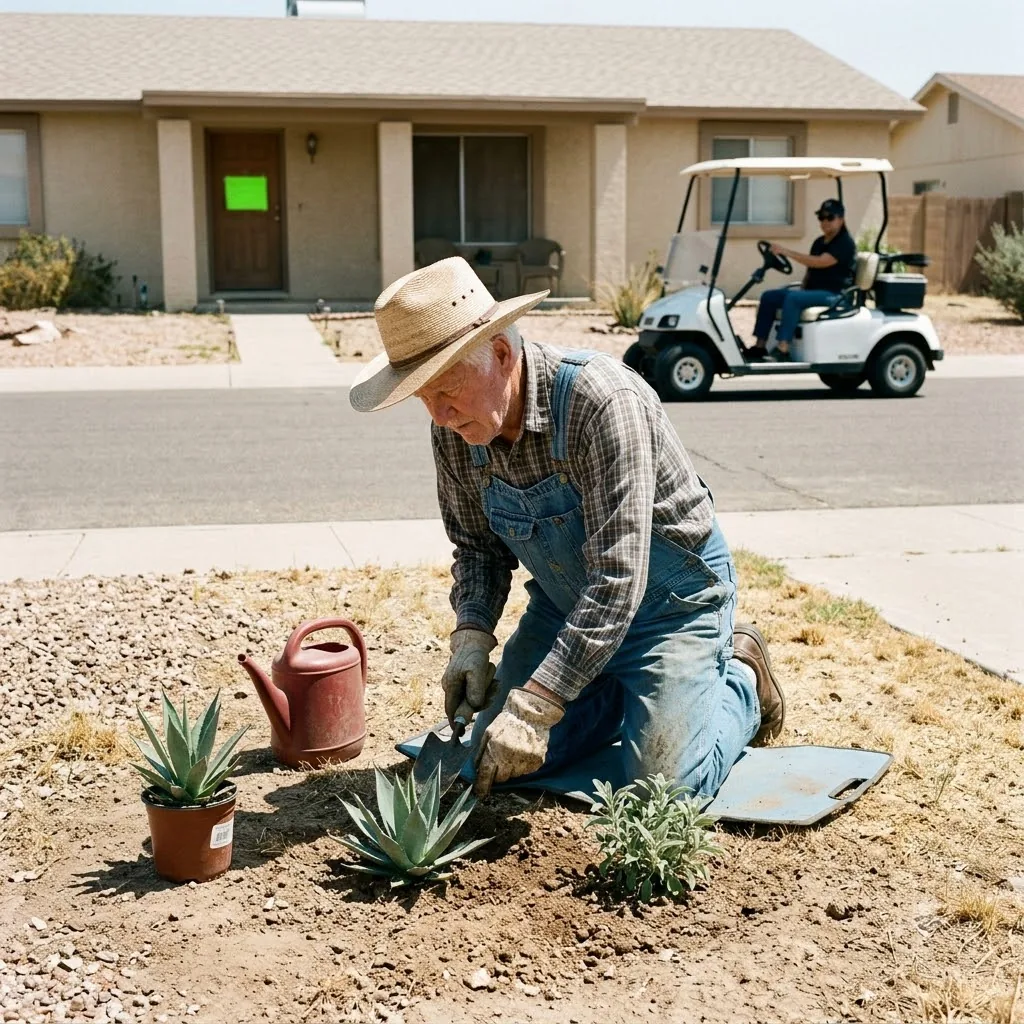
Story code: ST-000594
Part 2: The Burden of Bureaucracy
The standoff stretched, seconds thick and heavy in the August heat. Elias refused to blink, his fingers digging into the crumpled neon-green paper until his knuckles turned white. Down the street, the white golf cart remained perfectly still. The shadow of the oak tree obscured the HOA president’s face, but Elias could feel the weight of the man’s gaze pressing against him. Then, with a slow, deliberate turn of the steering wheel, the cart rolled forward. The electric motor whined, a high-pitched mechanical sneer, as the vehicle glided past Elias’s property and disappeared around the corner of the cul-de-sac.
Elias let out a breath he hadn’t realized he was holding. His knees trembled slightly as the adrenaline receded, leaving behind a hollow, sickening ache in his stomach. He turned and walked into his house, locking the deadbolt behind him.
The air conditioning inside was broken, another casualty of his dwindling bank account, but the shaded interior still felt marginally cooler than the scorched front yard. Elias walked to the kitchen sink and turned the faucet, letting the water run just long enough to wet a dish towel. He scrubbed the dirt from his face and hands, careful not to waste a single drop. Every gallon mattered now.
He sat heavily at the small, scratched dining table. The crumpled citation sat before him like a toxic spill. Fifteen hundred dollars. He pulled his worn checkbook from the drawer and flipped it open. His current balance was six hundred and fourteen dollars. His next pension check wouldn’t arrive for two weeks, and it would barely cover groceries, his property taxes, and the minimum payment on his credit card. Paying the fines was mathematically impossible.
“They know,” Elias whispered to the empty room. “They know exactly what they’re doing.”
He pushed back his chair and went to the hall closet, digging through a stack of old shoe boxes until he found it: a thick, three-ring binder covered in a layer of gray dust. It was the Oakridge Homeowners Association Declaration of Covenants, Conditions, and Restrictions. He had received it thirty years ago when he and his late wife first moved in, back when the neighborhood felt like a community and not a surveillance state.
Elias carried the heavy binder back to the table and began turning the yellowed pages. He scanned the dense, bureaucratic jargon, his finger tracing the tiny print. He skipped past the sections on approved paint colors and driveway paving materials, hunting for the dispute resolution clause. After twenty minutes of squinting, he found it buried in Article VII, Section 4.
*”Any homeowner subject to a punitive assessment may file a formal grievance with the Architectural Review Committee. Upon physical receipt of said grievance, all accumulating fines shall be stayed for a period of no less than fourteen days pending a hearing.”*
A stay. Fourteen days. It wouldn’t erase the debt, but it would stop the clock. It would prevent them from issuing that final, lethal five-hundred-dollar citation that would trigger foreclosure. It would give him time to figure out a plan, maybe contact Legal Aid or a local news station.
Elias grabbed a legal pad and a pen, his hand shaking as he wrote out a formal notice of grievance. He cited the drought, the necessity of the native sage, and requested an immediate hearing. He signed it, tore the sheet from the pad, and folded it sharply.
The HOA clubhouse was a half-mile away, located at the gated entrance of the subdivision. Elias didn’t want to waste the gas in his old truck, and he needed the walk to burn off the anxious energy vibrating in his chest. He stepped back out into the blistering heat, ignoring the plastic nursery pots still scattered on his porch.
The walk felt like a march through hostile territory. Every lawn he passed was a lush, chemically sustained emerald green. Sprinklers hissed in the midday sun, wasting thousands of gallons of water in flagrant defiance of the city’s drought warnings. Elias kept his head down, his boots heavy on the concrete, clutching the folded paper in his pocket like a shield.
The clubhouse was a sprawling building with a clay tile roof and large tinted windows. Elias pushed through the heavy glass doors, instantly hit by a wall of aggressively cold, artificially scented air. The lobby was impeccably clean, boasting leather armchairs and a polished mahogany reception desk.
Standing behind the desk, organizing a stack of neon-green envelopes, was Arthur Vance.
Vance was a tall, unnervingly neat man in his early sixties, dressed in a crisp polo shirt tucked tightly into khaki shorts. When the heavy doors clicked shut, Vance looked up. A thin, perfectly symmetrical smile spread across his face.
“Elias,” Vance said, his voice smooth and conversational. “I didn’t expect to see you down here today. I thought you’d be busy with your… landscaping.”
“I’m filing a grievance,” Elias said, his voice raspy from the heat. He walked to the desk and slapped the folded paper onto the mahogany surface. “Article VII, Section 4. It puts a stay on all fines until a hearing is convened. You have to stop ticketing me.”
Vance didn’t touch the paper. He merely tilted his head, his smile unwavering. “A grievance. I see. And what exactly are you grieving, Elias? The fact that you tore up an approved Bermuda grass lawn without submitting a modification form?”
“I can’t afford the water for Bermuda grass, Arthur. Nobody can. The city is in a Level 3 drought emergency.”
“The city does not govern Oakridge,” Vance replied pleasantly. “The bylaws do. And the bylaws require a uniform aesthetic. You are devaluing the entire street with those weeds.”
“It’s native sage. It’s a recognized xeriscape plant.” Elias tapped his finger on his written appeal. “File the grievance. Stop the fines.”
Vance sighed, a dramatic display of manufactured pity. He picked up the piece of paper, unfolded it, and glanced at it for less than two seconds. Then, he slid it back across the desk.
“I’m afraid I have to reject this application,” Vance said.
“You can’t reject it,” Elias snapped, his pulse hammering in his ears. “The bylaws say upon physical receipt, the fines are stayed.”
“Yes, but you didn’t read Article VII, Section 5, Elias.” Vance tapped a perfectly manicured fingernail against the mahogany. “All landscape modifications submitted for review-even retroactively-must be accompanied by a certified blueprint from a licensed landscape architect. Without a blueprint, the grievance is structurally incomplete. It’s invalid.”
Elias stared at him, the blood draining from his face. “A licensed architect? That costs thousands of dollars.”
“Standards must be maintained,” Vance said, his voice dropping to a cool, businesslike monotone. “Which reminds me.”
Vance pulled a pen from his breast pocket and picked up one of the neon-green envelopes. He began writing on the citation inside.
“While I was doing my rounds earlier,” Vance murmured as he wrote, “I noticed an accumulation of debris on your front porch. Empty plastic containers. Article IV clearly states that porches must remain free of refuse, storage items, and trip hazards.”
“I was planting,” Elias breathed, his chest tightening in panic. “I only set them down for a minute.”
“A violation is a violation,” Vance said. He capped his pen and slid the bright green envelope across the desk, placing it directly on top of Elias’s rejected appeal. “That is a Class C infraction. Five hundred dollars.”
Elias looked down at the envelope. It was the fourth one.
“That brings your outstanding balance to two thousand dollars,” Vance said, looking Elias directly in the eyes. The polite smile was gone, replaced by a look of predatory calculation. “As per the bylaws, the Association will initiate foreclosure proceedings on Monday morning at nine o’clock. Unless, of course, the balance is paid in full by certified cashier’s check before the weekend.”
Elias stood paralyzed in the freezing, sterile air of the clubhouse, the crushing weight of the green envelope pinning him to the floor.