Story code: ST-000650
Part 3: The Ordinance
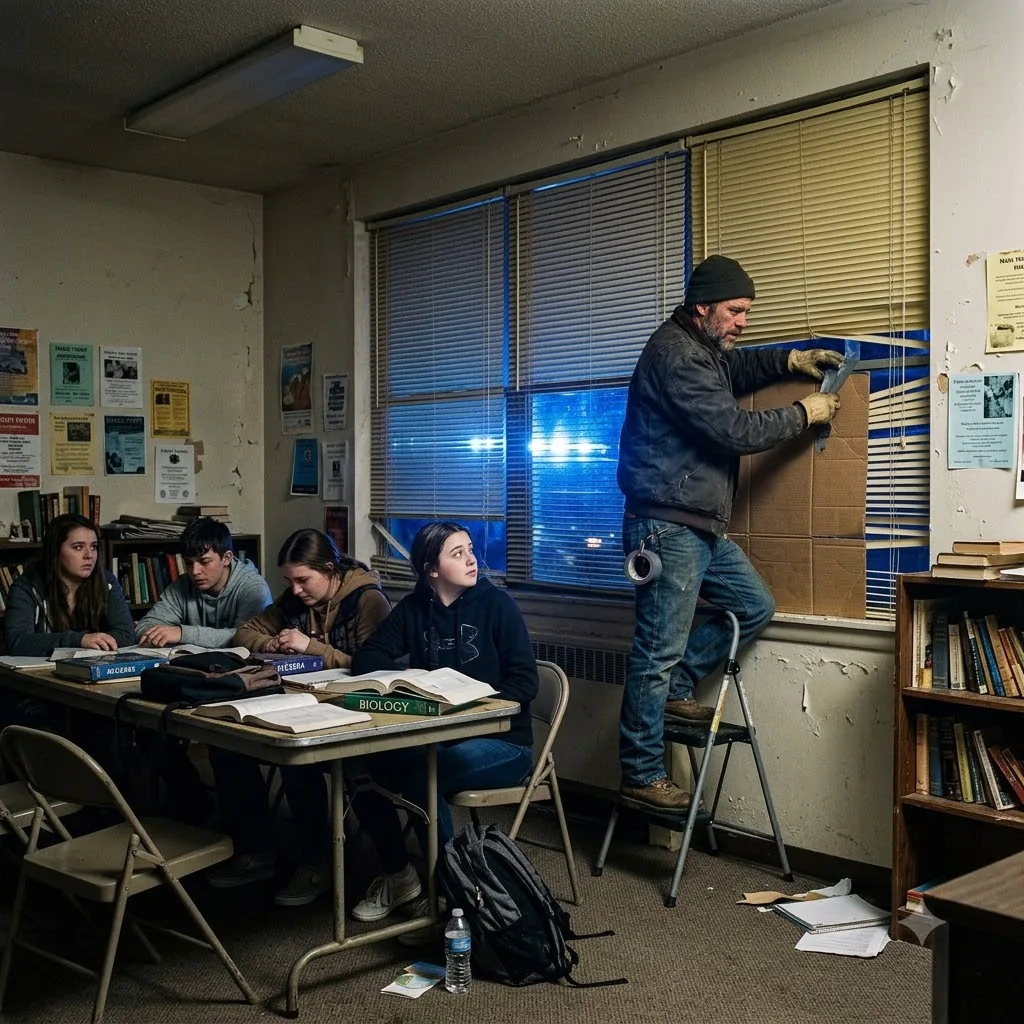
The marble floor of the Municipal Town Hall felt too polished, too exposed. Marcus stood near the drinking fountain in the west corridor, clutching a manila folder tight enough to crease the thick paper. It had been forty-eight hours since he had twisted the deadbolt at the community center, letting the blinding blue strobe light and three uniformed officers spill into his reading room. He had kept his hands raised and his voice perfectly level while they hauled away the boxes of donated books, citing a pending “decency inspection.”
He had come to the town hall tonight to file a formal grievance before the city council meeting. He just needed a signature from the clerk to prove the confiscated titles were standard educational materials, exempt from the new ordinances.
“You’re wasting your time with the paperwork, Vance.”
Marcus froze. He recognized the heavy, metallic cadence immediately. It was the same voice that had broadcast his Department of Corrections ID number across his neighborhood two nights ago.
Marcus turned slowly. Captain Miller stood at the end of the alcove, blocking the exit to the main lobby. The precinct commander wasn’t in his riot gear tonight, but his dress uniform was just as intimidating, the brass pins gleaming under the recessed lighting. Miller took a slow step forward, his polished shoes silent on the marble.
“Captain,” Marcus said, keeping his tone carefully neutral. “I’m just here to submit a public records request. The code says I have forty-eight hours to contest a confiscation.”
“And I’m telling you, it’s a waste of ink,” Miller said, closing the distance between them. He glanced at the manila folder in Marcus’s hands with a look of utter boredom. “Those boxes are already locked in an evidence cage. They’re a public safety hazard. We can’t have explicit, disruptive materials circulating in a volatile neighborhood. It incites the gangs. It threatens the peace.”
“They’re history books,” Marcus said, his pulse beginning to thud against his ribs. He forced himself to keep his hands visible at his sides. “There is no explicit content in them. I read the city ordinance, Captain. Code 412 is about restricting obscenity and sexually explicit media for minors. Half of what your men took were memoirs about the civil rights movement. You can’t justify holding them under a decency law.”
“Decency is a broad term, Vance. It means whatever the community needs it to mean to keep the streets quiet.” Miller stopped two feet away. There was no one else in the corridor. The muffled sounds of the council meeting echoed faintly from the double doors down the hall, leaving them entirely isolated.
“I need those books for my students,” Marcus said, his voice dropping to a harsh whisper. “They’re studying for their GEDs. Keeping them off the corner is the definition of public safety. You taking those books is doing the exact opposite of your job.”
Miller tilted his head, a slow, cold smile spreading across his face. The practiced facade of a concerned public servant vanished, replaced by something far more calculated.
“‘The police force functioned not as peacekeepers, but as an occupying army, enforcing economic segregation through targeted harassment and systemic violence,'” Miller recited perfectly, his voice dropping into a low, mocking register.
Marcus stared at him, his breath catching in his throat.
“Page one-hundred-and-forty-two of *The Redline Divide*,” Miller continued, his eyes locked onto Marcus’s. “Or how about chapter four of that other hardcover you had sitting on the display table? ‘The myth of neighborhood safety is often built on the suppression of minority assembly.’ You think I don’t read what we log?”
Marcus tightened his grip on the folder. The chilling realization settled heavy in his stomach. The strobing lights, the cataloging of ISBNs, the aggressive knock on the door-none of it was about complying with the city council’s clumsy new decency laws. The precinct wasn’t blindly enforcing a municipal statute. They were actively weaponizing it.
“You’re suppressing the curriculum,” Marcus whispered, the truth ringing loud in his own ears. “You aren’t looking for obscenity. You’re trying to stop them from learning how this city actually works.”
“I’m keeping my sector under control,” Miller said softly. “I spend every night dealing with corner boys who think they own the block. The last thing I need is a convicted felon handing those same kids a pile of academic manifestos that tell them the badge is their enemy. You’re teaching them to question authority, Vance. I don’t tolerate that in my district.”
“That’s illegal,” Marcus said, his voice trembling with a dangerous mix of anger and disbelief. “You can’t ban historical facts just because they criticize the department. That’s not what the ordinance is for.”
“The ordinance is a tool,” Miller said, dismissing the argument with a wave of his hand. “Just like the strobe light. Just like the parole system. Which brings me to why I followed you down this hallway.”
Miller unclipped the radio from his shoulder and let it drop to his chest. He reached around to the back of his duty belt, his hand resting casually on the steel cuffs tucked into their leather pouch.
“Turn around and place your hands flat against the wall, Vance,” Miller ordered, the smug conversational tone instantly replaced by the sharp bark of command.
Marcus didn’t move. “For what? I haven’t done anything. I’m standing in a public building.”
“Parole compliance check,” Miller said, stepping into Marcus’s personal space, radiating an absolute, suffocating authority. “Your conditions stipulate that you must maintain lawful employment and refrain from associating with known criminals. Since I just determined your after-school reading program is distributing illicit materials, it’s no longer a lawful enterprise. And since two of those kids sitting at your table on Tuesday night have juvenile records, you’re associating with known offenders.”
“That’s a lie,” Marcus pleaded, panic finally breaking through his disciplined calm as he took a half-step back. “They’re students. You can’t twist the terms like that.”
“I just did,” Miller said, unfastening the leather strap on his pouch. The metallic click of the handcuffs sliding free echoed sharply off the polished marble. “Hands on the wall, Marcus. Or I add resisting arrest to the violation, and you never see the outside of a cell again.”
Marcus looked at the heavy oak doors down the hall, where the city council was debating laws they thought were protecting children, completely oblivious to the captain who was currently rewriting the rules in the shadows. He looked back at Miller, the cold steel rings dangling from the officer’s thick fingers, waiting for Marcus to make a single wrong move.