Story code: ST-000650
Part 2: Contraband
Marcus stood on the concrete stoop, the rhythmic assault of the blue strobes burning afterimages into his retinas. The sheer absurdity of it held him paralyzed for three more flashes. *Nine seven eight.* The global prefix for book publishing. They weren’t looking for drugs. They weren’t looking for weapons or gang colors. They were cataloging the new donations from the county library’s surplus drive, logging the ISBNs to run them against the newly passed municipal decency ordinances.
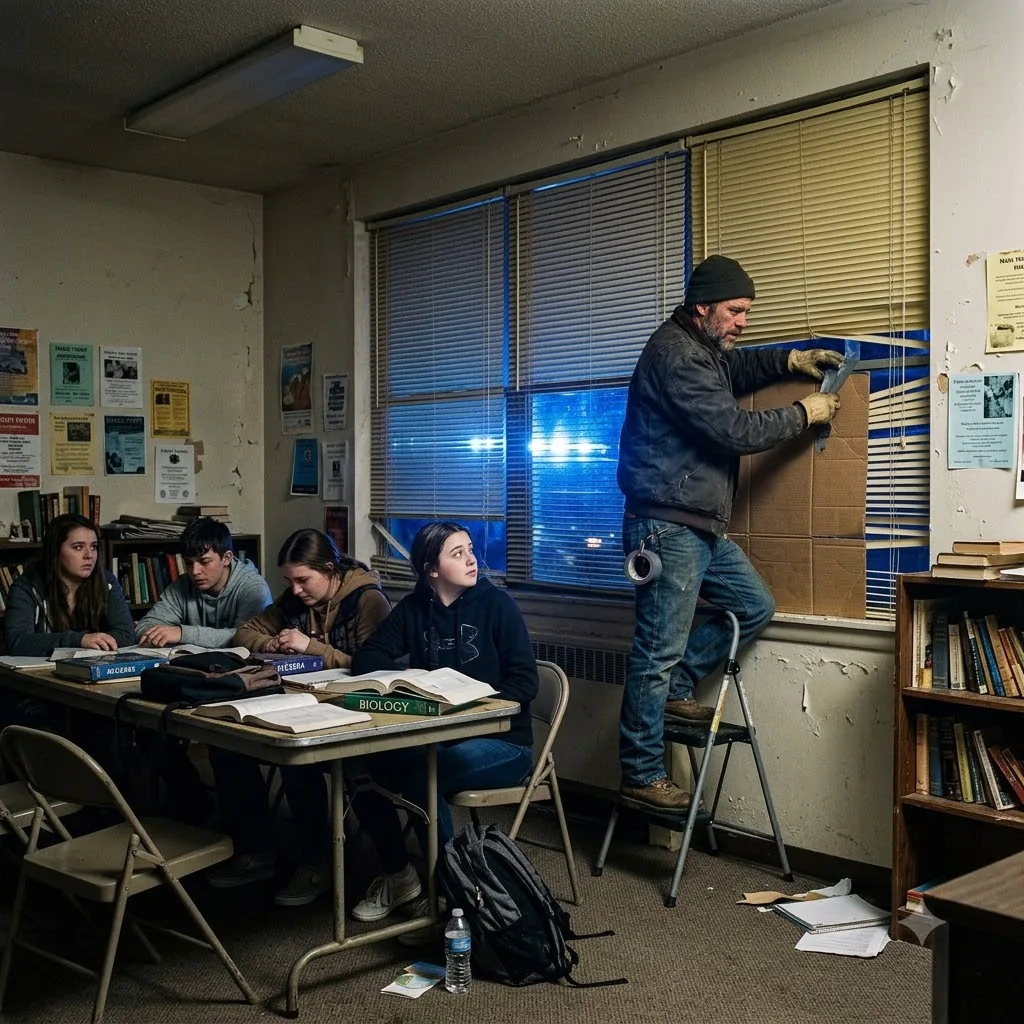
Last month, the city council had authorized aggressive fines and closures for unauthorized community centers, leveraging vague statutes about “protecting minors from explicit ideological content.” Marcus had mostly ignored the news broadcasts on the small television in the corner office. He was entirely focused on keeping these specific teenagers alive, teaching them reading comprehension so they could pass their GEDs and get off the corner. He didn’t care about the political theater downtown. But the theater had just parked a diesel-powered surveillance tower on his doorstep.
Marcus pulled the heavy metal door shut, cutting off the chill of the evening air but not the relentless blue glare piercing the gaps in his makeshift cardboard armor. He hurried back into the reading room. The teenagers had stopped pretending to read.
“What are they saying, Mr. Marcus?” Sarah asked. Her voice trembled. She had her backpack fully zipped and clutched tightly against her chest, her body angled toward the back hallway, ready to bolt out the alley exit.
“They’re reading the barcodes off the books,” Marcus said, keeping his voice strictly level. Panic was contagious in environments like this. He couldn’t afford for them to panic, and he certainly couldn’t afford to lose his own temper. “The new boxes we got yesterday from the downtown coalition.”
Malik frowned, standing up from his chair. “Why? They’re books. They ain’t illegal.”
“Depends on who you ask lately,” Marcus muttered. He moved to the front display table. The boxes were stacked high, filled with titles that had been purged from the public high school across the avenue. Books about systemic inequality, queer memoirs, histories of the civil rights movement that refused to sugarcoat the violence of the past. Marcus hadn’t even unpacked them all yet. He just wanted a full library to keep the kids engaged.
The PA system squealed again, piercing the thin glass. “Nine seven eight. One five zero. One one three.”
Marcus grabbed the top box. It weighed forty pounds, but he lifted it with ease, his broad shoulders tensing under his worn flannel shirt. “We’re moving them,” he announced, turning to the paralyzed room. “Everybody grab a stack. Take them to the old gym lockers in the back. Away from the windows.”
The kids hesitated. In their world, when the police set up a perimeter and turned on the lights, you didn’t make sudden moves. You kept your hands where they could see them and you didn’t touch anything that could be misconstrued as hiding evidence.
“I said move them,” Marcus barked, a little sharper than he intended. “They can’t audit what they can’t see.”
Malik nodded first, stepping forward to scoop up a massive armful of hardcovers. Sarah and the others quickly followed suit, abandoning their seats and swarming the display tables. They hurried back and forth in the strobe-lit room, carrying the controversial titles out of the harsh blue cones of light. Marcus dragged the second heavy box off the table, grunting as the cheap cardboard tore slightly under his grip.
Outside, the metallic voice on the loudspeaker abruptly stopped reading numbers. The sudden silence that followed was heavier than the noise, punctuated only by the low, vibrating thrum of the tower’s diesel generator.
Marcus froze, a cold knot forming deep in his stomach. He looked toward the window. Through a narrow slit between the taped cardboard, he saw the officer leaning against the cruiser lower his military-grade binoculars. The cop said something into the radio clipped to his shoulder, then raised a hand, pointing directly at the community center’s front door.
The PA clicked on again. The bored, monotonous tone was gone, replaced by a sharp, authoritative bark that echoed off the brick storefronts and rattled the windowpanes.
“Marcus Vance. State Department of Corrections ID number four-four-zero-nine. Put the boxes back on the table.”
The teenagers froze in the hallway. Sarah dropped a heavy textbook; it hit the linoleum with a loud, echoing slap that sounded like a gunshot in the tense silence.
Marcus felt the blood drain from his face. They had run his plates, or they had already profiled him before they even parked the tower. They knew exactly who ran this sanctuary. The casual mention of his DOC number wasn’t a standard police procedure; it was a targeted, deliberate threat. It was the officer reminding him that his freedom was entirely conditional, hanging by a bureaucratic thread that the local precinct could snip at any moment.
“Marcus Vance,” the loudspeaker boomed again, the voice dripping with manufactured authority. “You are in violation of Municipal Code 412, interfering with a public decency inspection. Return the materials to the window immediately.”
“Mr. Marcus?” Malik whispered, his eyes wide. He was holding a stack of autobiographies against his chest, his knuckles white. “What do we do?”
Marcus stared at the heavy metal door. If he put the books back, the police would log them all, flag the community center as a distributor of banned materials, and the city would padlock the doors by Friday. The neighborhood’s only safe haven, the only neutral ground where these kids could escape the corner gangs, would be gone forever. But if he refused? He was on parole for aggravated assault. Three years of his life had been swallowed by the state penitentiary, a concrete cage he swore to himself he would never return to. A single phone call from this lieutenant to his parole officer, claiming he was actively obstructing an investigation, would send him back to a six-by-eight cell before midnight.
Heavy footsteps crunched on the concrete stoop outside. The shadow of a broad-shouldered officer eclipsed the blue light filtering through the edges of the doorframe.
A heavy metal flashlight banged against the glass pane of the front door. *Bang. Bang. Bang.*
“Open it up, Vance,” a muffled voice shouted from the other side of the glass. “We’re conducting a compliance check. Open the door or we report you to your PO for non-compliance and harboring contraband. You’ve got ten seconds.”
Marcus looked at Malik, who was still clutching the books like a shield. He looked back at the taped-up windows, bathed in the violent, flashing blue light of a political war that had just shown up on his doorstep. The flashlight pounded against the glass again, harder this time, threatening to shatter the fragile barrier between his freedom and his students’ survival.