Story code: ST-000650
Part 4: The Reading Room
The concrete bench was freezing. Marcus kept his hands folded between his knees, tracing the calluses on his palms with his thumbs. It had been exactly three years and two months since he had last sat in a holding cell, but the oppressive atmosphere hadn’t changed. Industrial bleach layered over stale sweat and rusted iron. The precinct lockup was a sensory deprivation chamber designed to break a man’s spirit before he ever saw a judge.
His parole officer, Davis, wouldn’t be at his desk until eight in the morning. That meant Marcus had at least ten hours in this cage to imagine the revocation hearing. Captain Miller didn’t need a criminal conviction to ruin him. A parole violation only required a preponderance of evidence, and Miller carried a badge. “Associating with known offenders.” “Operating an illicit enterprise.” It was all bureaucratic fiction, but in the eyes of the State Department of Corrections, fiction printed on police letterhead was treated as absolute fact.
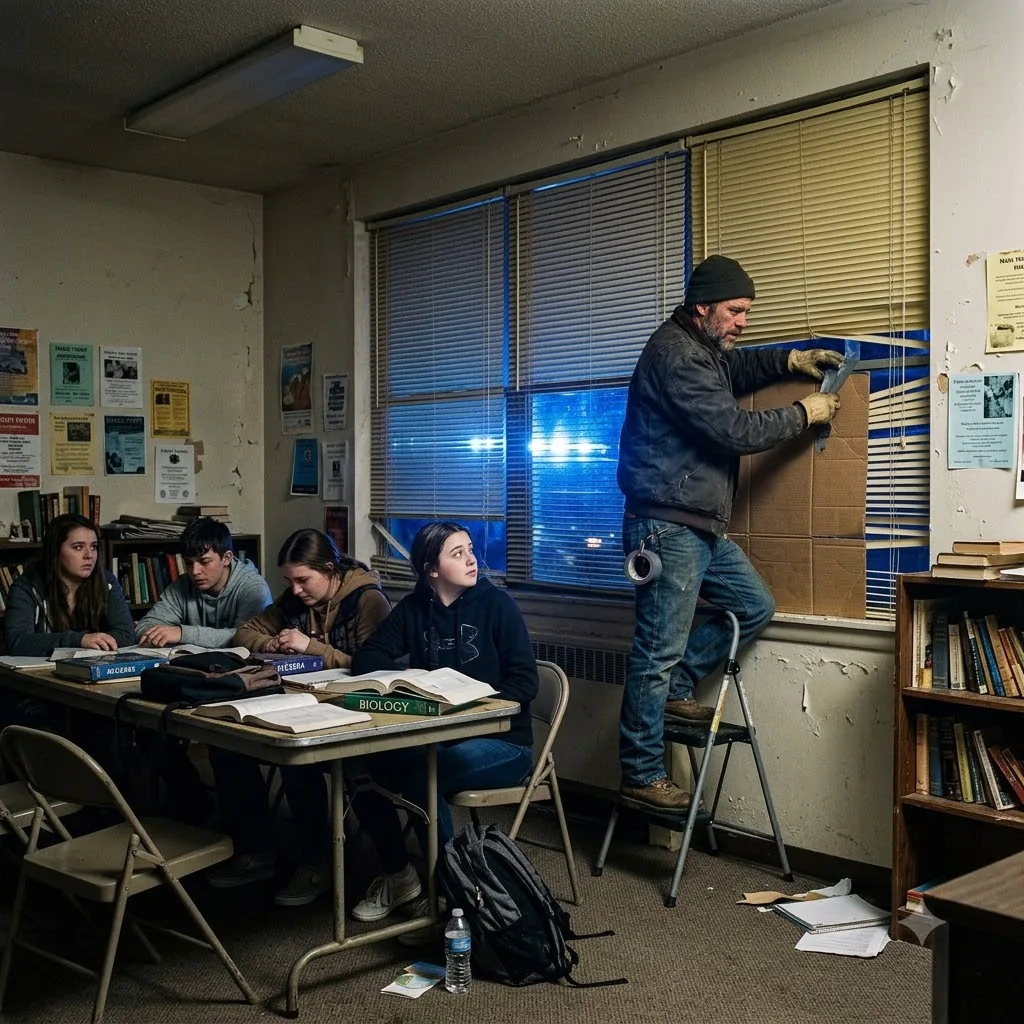
Marcus leaned forward, resting his forehead in his hands. The devastating reality of the night settled heavily into his bones. By now, Miller’s deputies had almost certainly chained the front doors of the community center. The landlord would terminate the lease the second he saw the padlock and police tape. The heavy boxes of history books, the memoirs, the civil rights texts he had carefully curated-they would molder in a precinct evidence locker until they were quietly incinerated under the guise of the new decency ordinance.
The sanctuary was gone. He had spent six exhausting months scrubbing graffiti, begging for donations, and building a neutral zone so kids like Malik and Sarah could survive long enough to graduate. He had tried to play by the city’s rules, and the city had simply rewritten the rules in the dark to crush him.
A low, rhythmic vibration pulled Marcus from his spiraling thoughts. He lifted his head. The holding cell was on the ground floor, its single, narrow window barred with thick steel and frosted at the edges, looking out over the precinct’s front parking lot. Usually, the night sounds of the station were predictable: the wail of approaching sirens, the heavy slam of cruiser doors, the muffled, angry shouts of suspects being processed.
But this was different. It was a voice. It wasn’t shouting or crying out. It was projecting. A steady, deliberate cadence echoing off the asphalt.
Marcus stood up, his joints aching from the tension. He stepped onto the thin metal rim of the cell’s toilet to get the angle he needed, pressing his cheek against the cold, reinforced glass to see out the clear sliver at the bottom of the pane.
The precinct lot was bathed in the harsh, blinding glare of two idling squad cars. Their high beams cut through the dark, illuminating the wide concrete steps leading up to the station’s heavy double doors. Two officers stood on the top step, their hands resting uncertainly on their utility belts, looking down at the asphalt in absolute confusion.
Sitting cross-legged on the cold pavement, directly in the path of the blinding headlights, were six teenagers.
Marcus held his breath. Malik sat dead center. Sarah was right next to him, her hood pulled down, her posture perfectly straight. Behind them sat the four other kids from the community center’s center table. They hadn’t run. They hadn’t scattered back to the corners or hidden in their apartments.
Malik was holding a battered, dog-eared paperback-an older, un-cataloged copy of a history textbook he must have shoved into his backpack before Miller’s raid. He had it open flat in his lap.
Marcus strained to listen. The thick glass of the holding cell muffled the audio, but the slow, deliberate rhythm of Malik’s voice carried clearly through the quiet night air. He was reading aloud. He wasn’t yelling. He wasn’t protesting in a way the police could easily shut down with a noise ordinance or a manufactured riot charge. He was simply reading the text.
One of the officers on the steps unclipped a heavy flashlight, shining a brilliant white beam directly into Sarah’s face, attempting to replicate the intimidation of the surveillance tower. Sarah didn’t even flinch. She simply waited for Malik to finish the paragraph, opened her own paperback, and let her voice rise to take over the next passage. They were running a reading circle in the middle of the precinct driveway.
Marcus watched the officers shift uncomfortably. They had no protocol for this. They couldn’t arrest teenagers for sitting quietly and reading books in a public space, not with the streetlamps illuminating them and the neighborhood windows looking down from the adjacent apartment blocks.
Miller had wanted to suppress the curriculum. The captain had weaponized the strobe lights, the decency ordinance, and the parole board to keep the neighborhood blind to its own history. He had locked Marcus in a concrete cage to stop him from teaching the next generation how to question authority.
Marcus stepped down from the window. The concrete bench behind him was just as cold, and the terrifying reality of his parole violation remained a heavy, suffocating weight. He might still go back to a six-by-eight cell at the state penitentiary. He might lose the next few years of his life to a fabricated charge.
But as he sat back down, listening to the muffled, unbroken voices of his students drifting through the reinforced glass, the tight knot of panic in his chest slowly dissolved. They didn’t need the reading room anymore. The sanctuary had never really been the building, and the lessons couldn’t be locked in an evidence locker. Marcus leaned his head back against the concrete wall and closed his eyes, smiling in the dark.