Story code: ST-000667
Part 2: The Standoff
Instead of a weapon, a bundle of heavy, bright yellow nylon emerged from the soaked canvas pouch. Flex-cuffs. Thick, industrial-grade zip-ties designed for mass detentions, looped together in a chaotic knot. Beneath them, clamped in his muddy palm, was a folded topographical map encased in a clear waterproof sleeve. The plastic was heavily smeared with fresh, bright arterial blood.
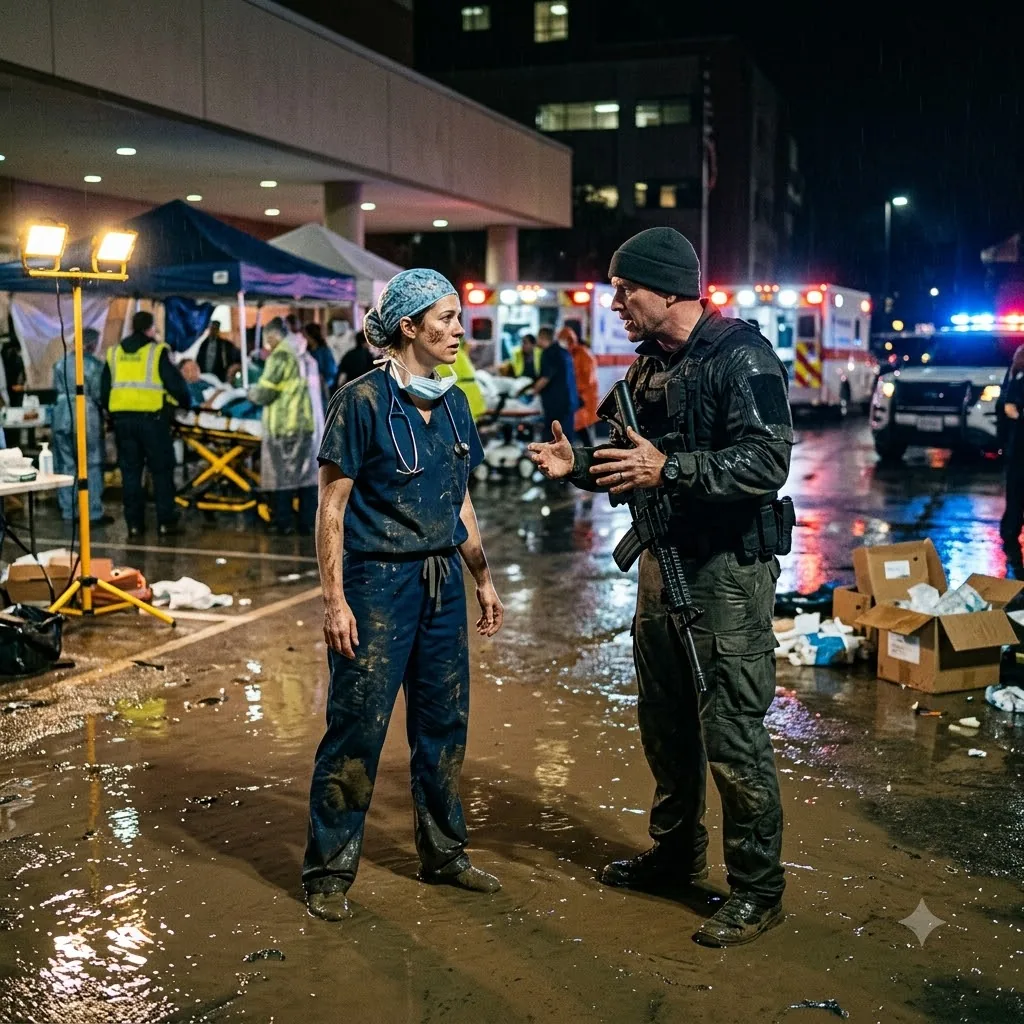
The militiaman didn’t strike her. He simply stepped into her space, using his armored bulk like a snowplow. The sheer kinetic force of his ceramic chest plate clipped Sarah’s shoulder, sending her sprawling backward. Her boots lost their minimal purchase on the river silt, and she hit the wet asphalt hard. The impact knocked the breath from her lungs in a sharp gasp, her elbows scraping raw against the abrasive, submerged pavement.
He didn’t even look down. He covered the remaining distance to the administration zone in three massive, splashing strides.
The shift coordinators, huddled behind flimsy plastic folding tables beneath a sagging blue tarp, scrambled backward in terror. Director Hayes, a civilian hospital administrator wearing a ruined, mud-stained dress shirt, tried to stand, clutching the hospital’s primary satellite phone to his chest like a useless shield.
The militiaman slammed the bloody, laminated map onto the center table. The sheer force of the blow cracked the cheap plastic surface loudly down the middle. He tossed the bundle of yellow flex-cuffs on top of the map.
“You,” he barked. His voice was a gravelly, dehydrated rasp, sounding like a man who had swallowed glass and inhaled smoke. He pointed a thick, trembling finger at the satellite phone in Hayes’s hands. “Put me on the open frequency with the Coast Guard command birds. Now.”
Hayes froze, his eyes darting to the black rifle slung across the man’s chest. “I… we can’t do that,” Hayes stammered, his voice pitching high with panic. “The military manages the airspace. We only use this unit to transmit patient manifests to the mainland. We don’t control the helicopters!”
“Reroute the heavy lifts,” the militiaman demanded, entirely ignoring the explanation. His right hand dropped back down to the pistol grip of his rifle. He didn’t raise the muzzle, but his thumb flicked the weapon’s safety selector switch. In the tense air, the metallic *clack* was terrifyingly loud. “Sector four. The ridge line. Tell them to send the birds now.”
The metallic click of the safety was the breaking point for the crowd. The patients nearest the administration tables realized the armed giant was threatening the staff. A wave of screaming erupted. People on crutches attempted to flee, slipping and falling in the oily, knee-deep water. A mother grabbed her bleeding teenager and dragged him under a folding cot. The sudden, desperate stampede knocked over a towering rack of oxygen tanks. The heavy metal cylinders crashed into the asphalt with a hollow, echoing clang that sounded exactly like a gunshot.
Sarah pushed herself up onto her knees, cold mud clinging to her scrubs. The panic was creating a deadly secondary crisis. Intravenous lines were being ripped from arms as patients fled the immediate zone. If she didn’t calm the crowd, people were going to be trampled to death in the muddy water.
Through the screaming, a new, sharp voice cut across the lot. “Drop the weapon! Step back from the table!”
From the perimeter of the medical supply trucks, Deputy Miller stepped into the aisle. He was a young, exhausted local cop whose uniform was soaked through to the skin. His service weapon was drawn, his arms trembling violently as he aimed at the militiaman’s broad, armored back. He was fifty feet away-a terrible, inaccurate distance for a handgun shot in a crowded, chaotic area.
The militiaman didn’t flinch, nor did he raise his hands. Slowly, deliberately, he grabbed Director Hayes by the front of his soaked shirt, hauling the older man directly over the cracked table. Hayes shrieked, his dress shoes kicking uselessly against the plastic. The militiaman spun, using the terrified administrator as a partial human shield against the deputy’s line of sight.
But the militiaman didn’t aim his rifle at the cop. With a terrifying, calculated calm, he swung the heavy barrel of the assault rifle downward, pressing the black steel flash hider directly against the center of the hospital’s primary satellite dish-the fragile white dome sitting on a Pelican case beside the table.
“You shoot me,” the militiaman roared at the deputy, his eyes wild and bloodshot under the dripping brim of his cap, “my finger spasms, and I blow your only comms unit to pieces! Then nobody gets out of this valley!”
Sarah finally regained her feet, holding her hands out, trying to make herself a non-threat. She was the only one close enough to clearly see the laminated map on the cracked table. Through the smears of fresh blood, she recognized the local topography. It was the upper foothills. The militia’s notoriously fortified compound was located in sector three. But the thick black marker circle on this map was drawn around sector four.
Sector four was the county elementary school. It was supposed to have been completely evacuated yesterday before the floodwaters crested. Why was a militiaman demanding heavy-lift helicopters for an empty building?
“Doctor,” the militiaman snarled, locking his intense, bloodshot eyes with Sarah over Hayes’s struggling shoulder. He jerked his chin toward the yellow flex-cuffs resting on the bloody map. “Pick them up.”
Sarah froze, the muddy water soaking through her sneakers. Deputy Miller was screaming commands that the militiaman was completely ignoring. The standoff was an absolute powder keg. If Miller fired, his hollow-point bullet would likely shatter against the ceramic armor plate on the militiaman’s back, and the ricochet would tear straight through the thin canvas of the trauma tents. If the sat-dish was destroyed, the hospital would instantly lose its ability to coordinate medi-vacs for the critical ICU patients slowly dying in the upper lot.
Suddenly, the militiaman’s chest rig crackled. A small, water-logged tactical radio clipped to his shoulder strap broke squelch. Through the heavy static, Sarah heard a voice. It wasn’t the gruff, tactical bark of a militia commander calling for backup.
It was the high, terrified wail of a young child, screaming over the deafening roar of rushing water.
The militiaman’s face twisted in a sudden, violent spasm of raw anguish. His massive hand tightened on Hayes’s collar until the administrator began to gag. He shoved the steel rifle barrel harder into the satellite dish, the expensive white plastic casing beginning to fracture under his weight.
“Pick up the cuffs, doc,” the militiaman repeated, his voice cracking with a terrifying, desperate finality. “Go tie up the cop. You have ten seconds, or I end the rescue for everyone.”