Story code: ST-000667
Part 4: The Blind Evacuation
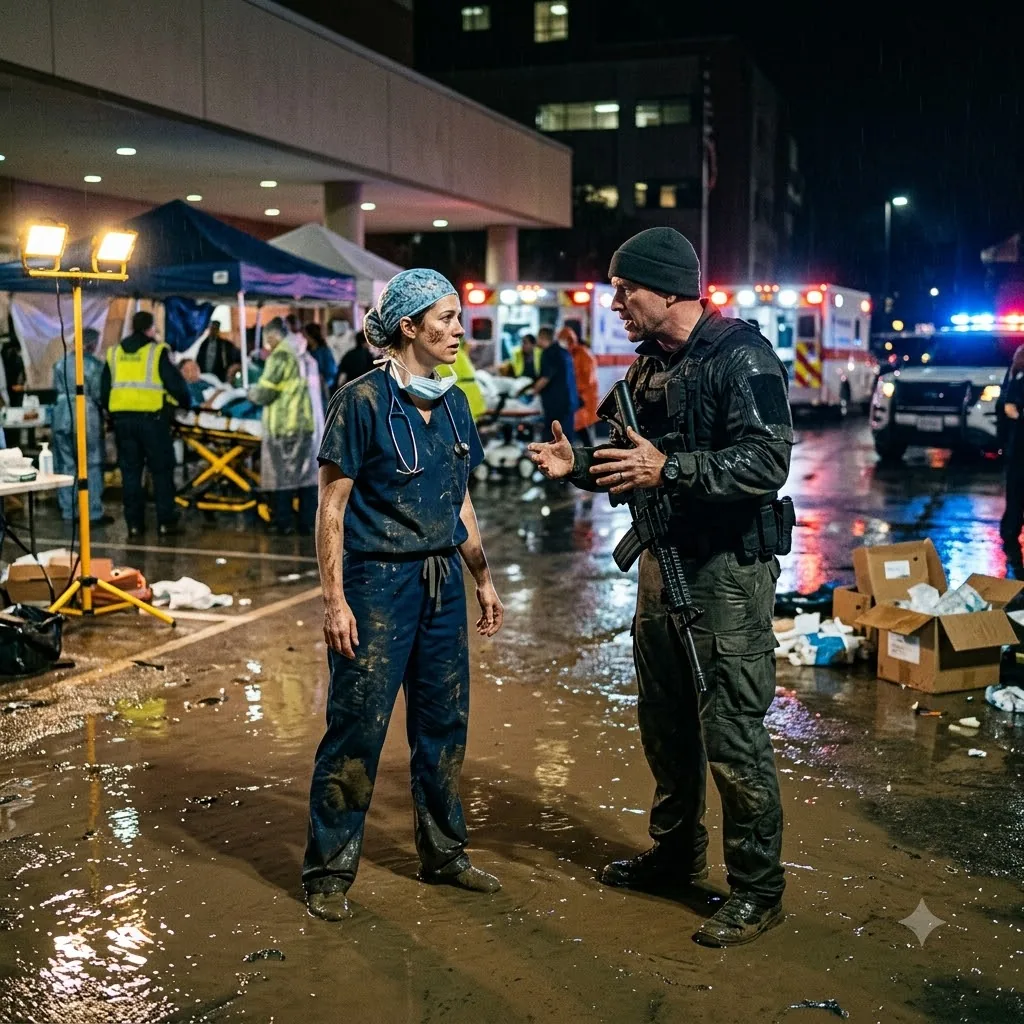
Sarah didn’t wait for Deputy Miller to holster his weapon or for Hayes to stop blubbering in the mud. She grabbed a sealed trauma kit from the nearest folding cot and broke into a heavy sprint toward the north barricade.
The air was a suffocating blanket of diesel fumes and stagnant water, but Sarah’s lungs burned with a different kind of urgency. Behind her, the heavy, splashing footsteps of the unarmed militiaman kept pace. Miller trailed them, his radio crackling with confused chatter from the other perimeter guards, but the deputy didn’t try to stop them.
At the edge of the floodwaters, parked half on a submerged concrete divider, sat a lifted grey pickup truck. The water lapped just inches below the passenger door. Sarah scrambled up the running board and yanked the handle.
A blast of suffocating, oven-hot air hit her face. Curled on the bench seat was a little girl, no older than eight, her skin flushed a dangerous, mottled purple. She was shivering violently, her small fingers clutching a damp camouflage jacket pulled over her chest. The smell hit Sarah immediately-the unmistakable, sweet-and-sour stench of necrotic tissue and raging infection.
“Maya,” the giant man gasped, wedging himself into the cab beside Sarah. His massive, calloused hands trembled as he brushed the wet hair from the girl’s forehead. “Daddy’s here. I brought the doctor.”
Sarah pulled back the jacket. The girl’s right thigh was tightly wrapped in a blood-soaked torn t-shirt. When Sarah peeled it away, she had to bite the inside of her cheek. A jagged, deep laceration carved across the quadricep, the wound edges grey and weeping. Angry red streaks marched up the child’s pale leg, disappearing beneath her shorts. Sepsis. The infection was actively dumping toxins into her bloodstream.
“She’s in hypovolemic shock,” Sarah said, her voice entirely devoid of the panic she’d felt facing the rifle minutes ago. This was her domain. This was medicine. “I need to get broad-spectrum antibiotics into her veins right now, or her organs are going to start failing. Pick her up. Keep her leg elevated.”
The militiaman scooped his daughter into his arms with terrifying gentleness. They hurried back to the triage lot.
The scene under the trauma canopies had fundamentally shifted. With the satellite uplink destroyed and the billing servers completely pulverized, the administrative bottleneck that had paralyzed the evacuation had completely evaporated. Hayes and the other coordinators were no longer staring at glowing screens, shouting about insurance clearances. They were frantically ripping open boxes of analog paper triage tags.
FEMA protocol had automatically triggered. The sky above the valley vibrated with a new, heavy thrum. Without the digital manifests holding them back, the Coast Guard and National Guard helicopters were dropping in, operating on visual trauma confirmation.
Sarah directed the father to the closest empty cot under the surgical awning. She didn’t ask for a name, a date of birth, or an insurance provider. She simply tore open an IV kit, found a vein in Maya’s limp arm, and pushed a massive loading dose of Rocephin directly into the line.
“Red tag,” Sarah shouted over her shoulder to Nurse Marcus, who was sprinting past with a handful of the heavy paper cards. “Sepsis, deep tissue laceration. She needs surgical debridement and a pediatric ICU. Get her on the next Blackhawk.”
Marcus didn’t check a tablet. He didn’t ask for clearance. He simply slapped a bright red cardboard tag onto the girl’s wrist and waved a bright orange flare toward the sky. The sheer, mechanical efficiency of pure triage had returned to the hospital. Blood, breath, and bone were the only currencies that mattered now.
Within twenty minutes, the deafening wash of a military heavy-lift helicopter flattened the trauma tents. Two flight medics sprinted down the ramp, loaded Maya’s stretcher, and hauled her into the vibrating belly of the aircraft.
Sarah stepped back, shielding her eyes from the rotor wash as the helicopter pitched upward, banking toward the mainland hospital that would save the girl’s leg, and her life.
When the dust settled, dawn was beginning to break over the flooded valley, casting a sickly, grey-blue light across the devastating expanse of brown water.
Sarah found the militiaman sitting on a stack of wooden pallets near the ruined administration tables. He was sitting completely still, his wrists bound in the heavy yellow flex-cuffs he had brought himself. Deputy Miller stood a few feet away, his weapon holstered, looking more exhausted than vigilant. The militiaman had surrendered the moment Maya was on the stretcher.
Scattered in the mud at the giant man’s combat boots were the contents of his wallet, which had spilled during the arrest. Sarah looked down at the plastic cards sinking into the river silt. A driver’s license. A family photo. And a shattered, trampled health insurance card, bearing the logo of the parent company that owned this very hospital.
Hayes stood a few yards away, staring blankly at the pulverized remnants of the server rack. He looked like a man who realized his empire was gone. Without those servers, without the billing data, the corporate entity that owned the hospital wouldn’t see a dime for any of the evacuations happening this morning. They would likely abandon the facility entirely. The valley’s medical safety net was permanently destroyed.
Sarah looked from the shattered million-dollar computer equipment to the plastic insurance card in the mud. She felt a cold, quiet dread settling in her stomach, heavier than the exhaustion of the thirty-six-hour shift.
For years, she had watched patients die slowly because their premiums lapsed, or because they couldn’t afford the out-of-network transfer fees. She had accepted it as the tragic, immutable reality of modern medicine. But standing in the wet gravel, watching the endless stream of rescue helicopters finally descending on the valley, she realized the truth.
The militiaman was a domestic terrorist going to federal prison. But the bureaucracy that had calmly, cleanly calculated his daughter’s life as a financial loss, and quietly ordered her to die in a flooded truck-that was the true violence. And all it took to stop it was a shattered piece of white plastic.