Story code: ST-000683
Part 2: The Cost of Failure
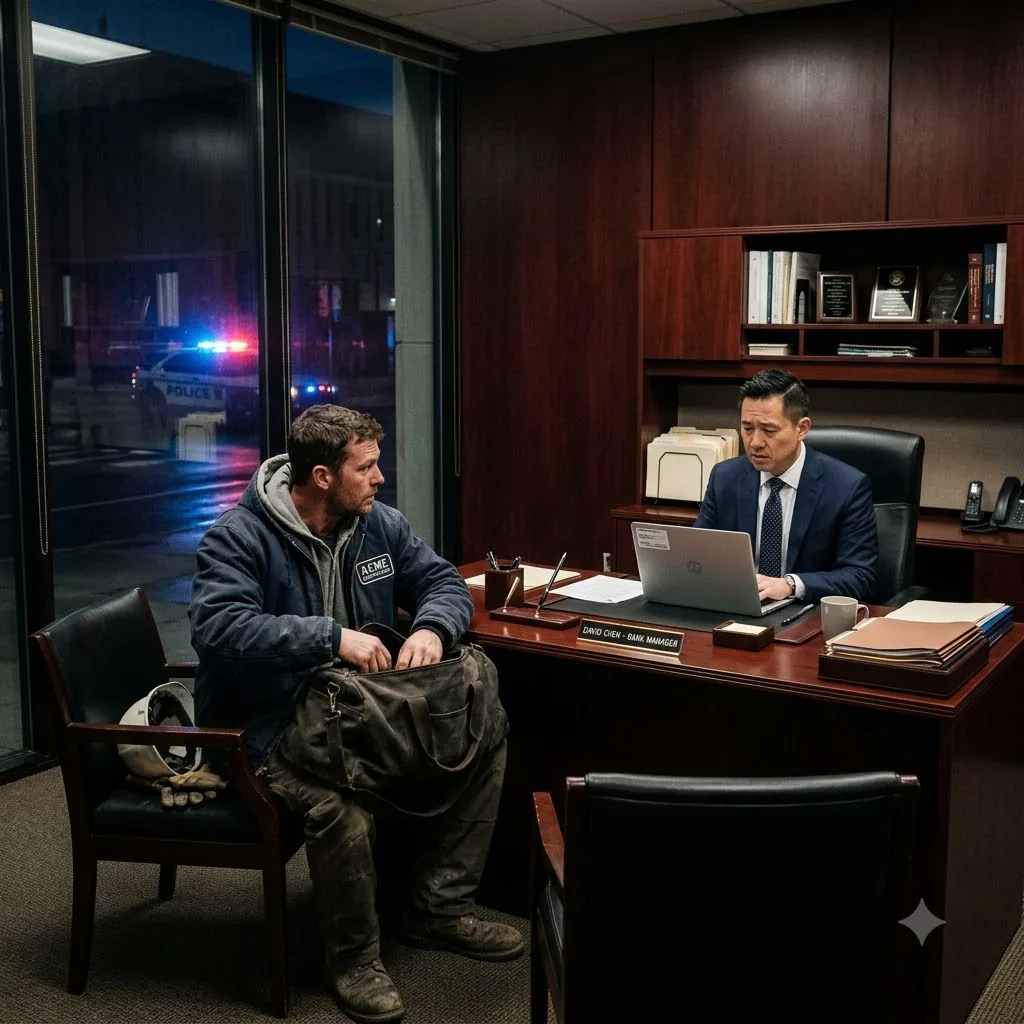
Sarah’s finger found the physical edge of the silent panic button mounted beneath her desk. She pressed upward with her thumb, feeling a quiet, satisfying click register against her skin. The bank’s security protocol promised a priority police response in under three minutes. But as she looked past the heavy steel object on her desk, watching the red and blue strobes of the lockdown drill pulse violently across the avenue, a sickening realization washed over her. The local precinct dispatch was currently managing a massive, multi-agency simulation. The silent alarm from a suburban bank branch would likely be pushed into an automated queue, buried entirely beneath a flood of simulated active-shooter radio traffic.
Mateo did not look at her face. His calloused, dust-covered fingers traced the thick braided wire leads protruding from the scarred steel casing. On Sarah’s primary monitor, the underwriting software softly chimed-an automated timeout warning. The system was logging her out for inactivity.
“Mr. Rodriguez,” Sarah said, her voice trembling despite a desperate attempt to channel her corporate hostile-situation training. “I need you to step back from the desk.” She used his formal name, trying to rebuild the sterile professional boundary the algorithm had provided. It failed entirely. The pristine mahogany desk, once an impenetrable symbol of her authority, now felt like a trap.
“Your system,” Mateo murmured, his voice completely devoid of the manic energy Sarah expected from a violent aggressor. He kept his dark eyes locked on the welded steel block. “It calculated my current debt. It calculated the global supply chain. It didn’t calculate the cost of a failure.”
He reached back down into the open maw of the olive-drab duffel bag. Sarah pressed herself backward, her rolling chair hitting the glass wall of her office. The cold pane sent a rigid shock up her spine.
Mateo pulled out a dense, rectangular 12-volt battery. Its black plastic casing was deeply scuffed, the heavy lead terminals gleaming dully in the chaotic light filtering through the window. Sarah’s breath hitched in her throat. The underwriting algorithm had flagged him as a high-risk borrower due to insufficient collateral, dismissing the context of his local contracting business as an irrelevant variable. Now, the context was sitting directly in front of her. She frantically tried to recall Chapter Seven of the employee handbook: *De-escalation*. Acknowledge the grievance. Offer an immediate alternative. Keep your hands visible at all times.
“We can run a manual appeal,” Sarah lied, the words tumbling out of her mouth in a breathless rush. She raised both hands to chest level, palms facing forward. “The regional manager… I can call him right now. We can override the liability matrix. Just leave the bag.”
The corporate jargon sounded utterly pathetic against the raw, industrial threat of the steel and wiring. Mateo didn’t even blink. He set the battery down next to her ruined ceramic mug and picked up the first braided wire.
Outside, a police megaphone crackles with intense, distorted volume. “ACTIVE THREAT SPOTTED IN WEST WING. INITIATING HARD LOCKDOWN.” The simulated voice of the tactical dispatcher echoed off the bank’s facade. The flashing strobes multiplied as two more cruisers aggressively blocked the intersection. The drill was escalating right on schedule. Sarah realized with terrifying clarity that no one was coming through the bank’s front doors to save her. The security guards in the lobby were likely distracted, watching the massive spectacle unfold across the street. She was entirely isolated inside her glass box, held hostage by the consequences of a mathematical denial.
“They practice,” Mateo said, gesturing vaguely toward the frosted window with the wire in his hand. “Every quarter, they practice hiding in the dark. They rely on hollow-core wooden doors and standard commercial deadbolts to hold back a nightmare.”
He stripped the end of the wire with his thick thumbnail, exposing the bright copper threading beneath the insulation. “I read the after-action reports from the state committee. Three seconds. That’s exactly how long it takes a determined threat to splinter a standard commercial hinge.”
Sarah stared at him, her mind frantically trying to parse his words through her paralyzing terror. He was talking about structural integrity. He was obsessing over the school across the street. She looked down at the dense, blocky object on her desk. It didn’t look like a conventional explosive. It had no digital timer, no plastic casing. It was built like a massive, oversized mechanical bracket. But the exposed wires and the heavy battery screamed immediate danger.
“Mateo, whatever you are trying to prove, you don’t have to do this,” she pleaded, her polished veneer cracking completely as a tear hot with panic spilled over her eyelid. “I don’t have the authority to disburse the funds. The software locks me out. I’m just a proxy for the algorithm.”
“The algorithm is blind,” Mateo stated, his tone hardening with cold finality. He connected the first wire to the battery’s negative terminal.
A sharp blue spark jumped in the dim office, leaving a faint, acrid scent of ozone hanging in the air. Sarah flinched violently, her hands flying up to cover her face. The harsh smell of an electrical burn cut cleanly through the sterile, air-conditioned atmosphere of the commercial lending department.
Mateo picked up the second wire. The positive lead. The chaotic red and blue lights from the street washed over his weathered face, casting deep, hollow shadows under his cheekbones. “The school board said they need a functional demonstration. They need physical proof it works before they issue a municipal contract. Your system said I don’t have the capital to build the prototype.”
He held the braided copper an inch above the positive terminal.
“But we can’t wait for the next fiscal quarter,” Mateo whispered. “Not while they sit over there, relying on hollow doors.”
He was going to arm it. Sarah’s eyes darted wildly to the glass door of her office, measuring the distance. Ten feet. But the heavy desk pinned her securely in the corner. If the steel casing fragmented, the mahogany would just become secondary shrapnel.
“Please!” Sarah screamed, abandoning the corporate script entirely, her voice cracking as the police strobes pulsed mercilessly against the white walls. “Don’t connect it!”
Mateo ignored her entirely. He lowered the copper wire onto the heavy lead terminal. A loud, mechanical hum instantly resonated through the desk, vibrating straight up through the soles of Sarah’s shoes. It wasn’t the high-pitched whine of a digital timer, but the intense, gathering strain of an electromagnetic capacitor drawing massive power. The scarred steel box began to shudder violently, its unseen internal mechanisms catching and grinding with terrifying force, just as the police sirens across the street erupted into a deafening, continuous howl.