Story code: ST-000683
Part 3: The Hollow Door
The mechanical whine hit a fever pitch, rattling Sarah’s teeth and sending a violent tremor through the pristine mahogany desk. She threw her arms over her head, tucking her chin to her chest, bracing against the glass wall for the concussive shockwave of a blast. The police sirens outside merged into a single, deafening roar. She clamped her eyes shut, waiting for the blinding flash, waiting for the heavy steel casing to shatter and tear through the sterile lending department.
Instead of an explosion, a brutal, metallic *CRACK* whipped through the office.
It sounded like a massive vault door slamming shut. The vibration in the floorboards vanished instantly. The acrid smell of ozone lingered in the air-conditioned air, but there was no fire, no smoke, no shrapnel. Just the muffled, distorted voice of the tactical dispatcher across the avenue echoing against the bank’s exterior.
Sarah kept her arms raised for three agonizing seconds. When nothing else happened, she slowly lowered her hands, her breath shuddering out in rapid, shallow gasps.
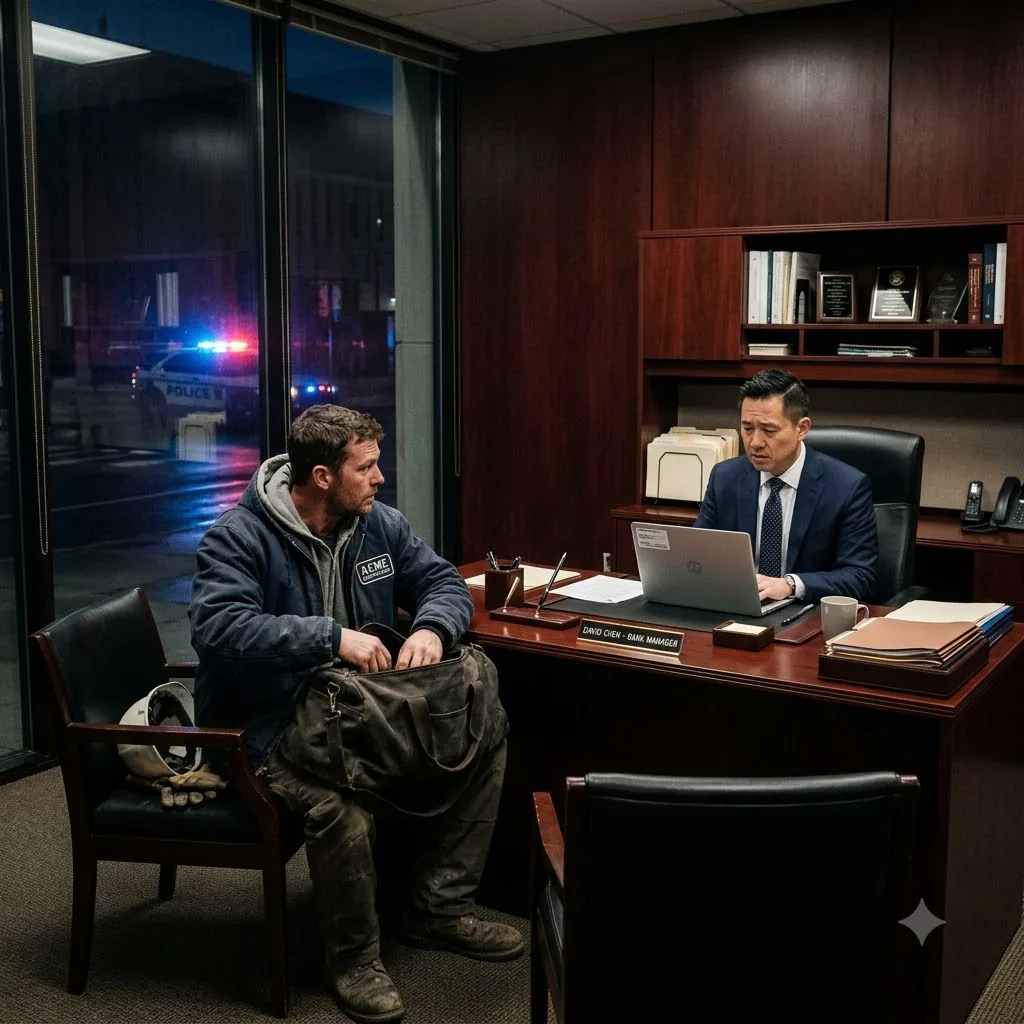
The scarred steel box sat exactly where it had been on the center of her desk, completely intact. But its shape had fundamentally changed. Four solid, three-inch-thick steel deadbolts had violently fired outward from the casing, punching into the empty air. The heavy metal pistons gleamed under the flashing red and blue strobes, fully extended and locked firmly into place. It wasn’t a bomb. It was a barricade. A massive, industrial-grade drop-bolt locking mechanism.
Mateo stood over the desk, his chest heaving as if he had just dragged the weight up a mountain. He reached down and smoothly unclipped the positive copper wire from the 12-volt battery terminal. The moment the electrical connection broke, the four steel pistons snapped back into the casing with a heavy, spring-loaded *clunk*.
“Electromagnetic rapid-deployment brace,” Mateo said, his voice flat, exhausted. “Four thousand pounds of sheer kinetic resistance. It retrofits directly over existing commercial door frames. The moment a teacher hits the panic button on their desk, it draws from an independent battery backup and fires the bolts into reinforced steel catch-plates.”
Sarah pressed her spine flat against the cold glass, her mind struggling to catch up to her spiking adrenaline. The primal terror of an explosive device was slowly giving way to a profound, disorienting confusion. She stared at the retracted bolts, then at the scuffed battery, and finally at Mateo’s calloused hands.
“You…” Sarah choked out, her throat completely dry. She swallowed hard, frantically trying to summon the authoritative senior lending officer she had been ten minutes ago. “You brought this into a federal bank… to give me a product demonstration?”
“I brought it because your algorithm told you my business was a liability,” Mateo replied, stepping around the massive desk. He didn’t move toward her; instead, he walked past her, stepping right up to the frosted glass window overlooking the avenue. “Your system looked at my debt-to-income ratio and my lack of liquid collateral. It didn’t look at what I was building. It didn’t care why I needed the inventory advance today, not next quarter.”
The red and blue lights washed over his weathered face. Outside, the tactical drill was reaching its peak. Officers in heavy tactical gear were sweeping the front lawn of the elementary school, their weapons drawn, moving in tight formations toward the main entrance. The flashing strobes painted the bank’s white walls in chaotic, rhythmic bursts.
Sarah pushed herself up in her rolling chair, her knees trembling so violently she wasn’t sure she could stand. “Mr. Rodriguez, you cannot just-”
“Come here,” Mateo interrupted, dropping the last traces of his weary edge, his tone replaced by a commanding, absolute gravity. He didn’t look back at her. He just pointed a thick finger at the glass.
“No,” Sarah whispered, her hand hovering over her silent alarm button again, though she knew the dispatch was entirely overwhelmed.
“Look at the school, Sarah,” Mateo commanded, using her first name for the first time. “Look at it.”
Compelled by the sheer, unyielding weight of his voice, Sarah slowly rose from her chair. She kept a wide berth between herself and the steel prototype on the desk, edging cautiously toward the window. She stood two feet away from him, staring out at the chaotic, simulated nightmare unfolding across the street.
“Second floor,” Mateo said, keeping his finger pressed against the cold glass. “The brick wing. Three windows in from the left.”
Sarah tracked his finger. She saw the darkened classroom window. The lights inside were entirely shut off, following the strict active-threat protocol she knew all too well.
“I walked that school with the municipal safety committee three weeks ago to measure the frames,” Mateo said softly, his breath fogging the pane. “I know the layout perfectly. That room is a corner class. Solid drywall. No secondary exit. Just one standard, hollow-core wooden door facing the main hallway.”
Sarah’s breath hitched. A cold spike of dread, entirely different from the fear she had felt moments ago, pierced straight through her chest.
“Right now,” Mateo continued, his eyes locked on the dark window, “there are twenty-two children sitting shoulder-to-shoulder on the linoleum floor in the far corner of that room, completely silent. They are hiding behind a teacher’s desk, relying on a deadbolt that I can snap with a standard crowbar in exactly three seconds.”
Sarah stared at the third window from the left. Her pulse hammered in her ears, drowning out the wailing sirens.
“Mr. Davis’s third-grade class,” Mateo said, turning his head slowly to look her dead in the eye.
The sterile, algorithmic shield Sarah had used to protect herself all afternoon instantly shattered into a million jagged pieces. The liability matrix, the regional manager’s parameters, the insufficient collateral thresholds-it all evaporated, leaving her entirely exposed. She didn’t need to check her phone. She didn’t need to look at the calendar. She knew exactly whose classroom that was.
“I saw the framed photo on your desk when I sat down,” Mateo whispered, his dark eyes boring into hers, offering absolutely no pity. “He’s wearing a yellow backpack in the picture. I saw him walk through those double doors this morning while I was taking my final measurements from the sidewalk.”
Sarah gripped the aluminum window frame, her knuckles turning bone-white. Her son was in that dark room. Her eight-year-old boy was sitting on the floor, waiting in the dark behind a flimsy wooden door, participating in a drill designed to simulate a monster tearing through the hallways.
“The school board voted to award me the contract tomorrow morning, contingent on proving I had the capital to manufacture the first twenty units by Friday,” Mateo said, gesturing back toward the heavy steel brace sitting on her mahogany desk. “My prototype works. It holds against anything short of structural collapse. But your algorithm said no.”
Sarah tried to speak, tried to cite the corporate policy, tried to tell him that she couldn’t override the automated risk model. But she looked from the heavy steel barricade on her desk to the dark window across the street, and the words died completely in her throat.