Story code: ST-000683
Part 4: The Metrics of Safety
The piercing wail of the police sirens cut off abruptly, leaving a sudden, ringing vacuum in the commercial lending department. Outside the frosted window, the tactical officers lowered their simulated rifles. The drill was over. The blinding red and blue strobes that had washed Sarah’s white walls in chaos flicked off, replaced by the flat, gray light of a Tuesday afternoon. Across the avenue, the heavy steel exterior doors of the elementary school swung open, and administrators in high-visibility vests stepped out onto the concrete steps to debrief the local precinct.
Sarah remained pressed against the glass, unable to tear her eyes away from the third window on the second floor. The lights inside Mr. Davis’s classroom flickered back on. She imagined the twenty-two children standing up from the linoleum floor, dusting off their jeans, completely unaware of the three-second margin that separated their simulated safety from a structural failure. She pictured her son, Leo, hoisting his yellow backpack onto his small shoulders, believing the hollow-core wooden door and the standard deadbolt were impenetrable shields.
Behind her, the rasp of a heavy brass zipper broke the silence.
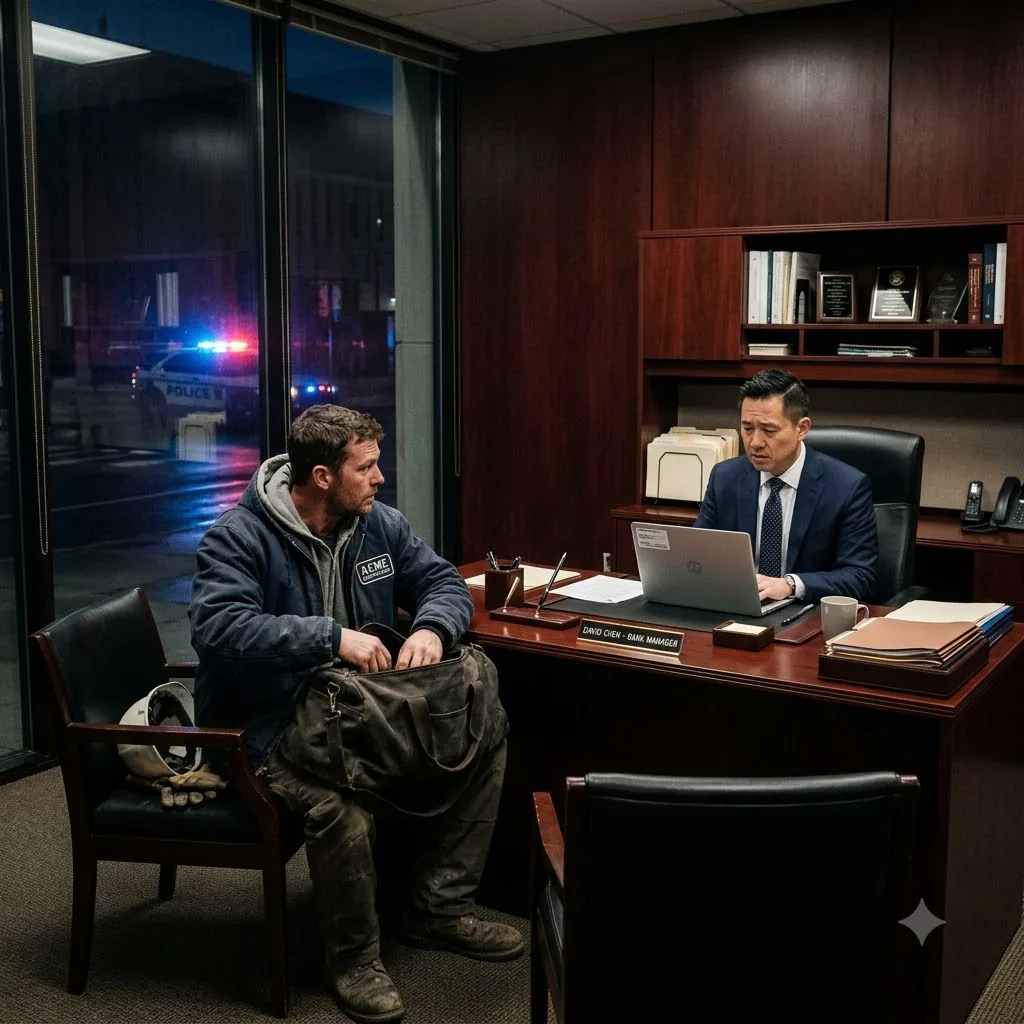
Sarah finally turned. Mateo was not looking out the window anymore. He stood over her mahogany desk, methodically packing up his equipment. He hoisted the scuffed 12-volt battery and lowered it into the dark maw of his olive-drab duffel bag. He coiled the braided copper wires around his thick forearm, tying them off before dropping them in next to the battery.
He did not touch the scarred steel prototype. The heavy, four-bolt drop lock remained sitting squarely in the center of her desk, its massive steel pistons retracted, a four-thousand-pound kinetic barrier that would never be installed.
Mateo reached across the polished wood and picked up the printed denial letter. He didn’t rip it up in a rage. He didn’t throw it at her. He simply folded the crisp white paper precisely in half, creasing it with a calloused thumb, and tucked it into the breast pocket of his canvas jacket.
“Wait,” Sarah whispered, her voice barely carrying over the quiet hum of the bank’s HVAC system. She pushed herself away from the cold glass, taking a single, unsteady step toward her desk. “Mr. Rodriguez. I can… I can try to escalate this. I can call the regional director.”
Mateo zipped the duffel bag closed and slung the heavy canvas strap over his shoulder. “You told me the algorithm accounts for all variables,” he said, his tone utterly devoid of the quiet desperation he had carried into the office. It was flat now. Resigned. “You said there is absolutely no room for a manual override.”
“I can make an exception,” Sarah pleaded, her fingers hovering over her keyboard. Her dual monitors had gone to sleep, displaying a floating, bouncing corporate logo against a black screen. She tapped the spacebar frantically. The login screen flashed, demanding her security credentials. “I can push it through as an emergency community-impact loan.”
“An appeal takes fourteen business days,” Mateo said. He adjusted the strap on his shoulder. “The school board votes tomorrow at eight in the morning. If I don’t have the proof of capital in hand, they pass on the contract. They use the budget to buy new tablets instead, and we wait another year for the next funding cycle.”
Sarah’s hands froze over the keyboard. She knew the underwriting timeline better than anyone. He was right. Even if she threw away her five years of spotless corporate adherence, even if she screamed at the regional director until she was fired, the bank’s internal processing matrix would never release commercial inventory funds overnight. The system was designed to move slowly, to eliminate risk, to protect the bank’s assets behind a wall of bureaucratic delay.
She had operated that machinery flawlessly, and it had worked exactly as designed.
“I’m sorry,” Sarah choked out, the tears she had fought back during the lockdown drill finally spilling over her lashes. “Please. I didn’t know.”
“I know you didn’t,” Mateo said softly. He looked at the framed photograph of Leo sitting beside her monitor, then at the heavy steel block sitting on the mahogany. “Leave that there. A reminder of the metrics.”
He turned and walked out of the glass doors of her office. The heavy canvas bag scraped against the doorframe, and then he was gone, disappearing down the carpeted hallway toward the main lobby.
Sarah stood alone in the quiet office. Through the window, she watched the police cruisers pulling away from the school, their sirens completely silent. The illusion of safety had returned to the avenue. But inside the lending department, the air felt suffocatingly thin.
She walked slowly to her chair and sat down. Her hands were shaking violently as she reached out and rested her palms flat against the cold, unyielding surface of the steel barricade on her desk. It was heavy, tangible, and real. She looked up at her monitors, where the algorithmic risk assessment waited behind a password prompt, utterly blind and deaf to the world it dictated. Sarah kept her hands pressed against the cold steel, staring across the street at the hollow wooden door she could not see, waiting for three o’clock, when she would have to look her son in the eye and pretend he was safe.