Story code: ST-000687
Part 3: The Displacement
The muffled, angry buzzing against Marcus’s ribs suddenly stopped. A split second later, the flesh-toned earpiece tucked deep inside his right ear-his direct audio link to the executive board managing the livestream-hissed with static.
“Marcus.” It was the chief legal counsel, her voice a compressed, icy drill in his ear canal. “Cut the microphone. Have security remove the trespasser. Do it now, or you’ll be clearing your desk before your flight lands.”
Marcus stared down at the crumpled, water-stained pages his sister had slammed onto the podium. The Vanguard Holdings watermark glared back at him. Beside it sat his leather-bound binder, the meticulous script of his presentation detailing jobs, green energy, and tax revenue. It was a beautiful, seamless fiction.
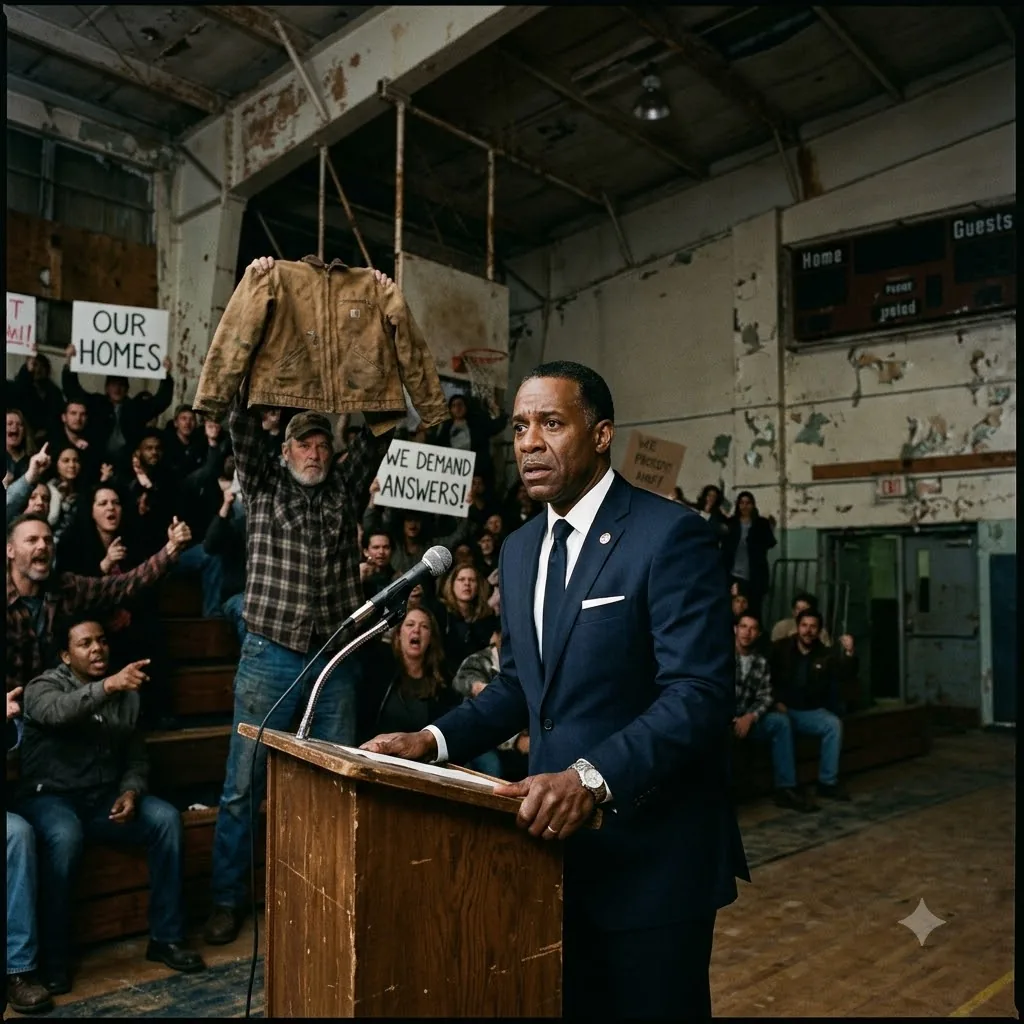
He looked at Sarah. She hadn’t moved. She wasn’t backing down. Behind her, draped over the bleacher, the scorched canvas of their father’s mill jacket seemed to swallow the glare of the gymnasium lights. He knew the smell of that coat when his father used to walk through the front door-a suffocating mix of sulfur, sweat, and slow death. The mill had ground their father down to dust, and now Vanguard was here to pave over the remains.
“Marcus, I am giving you a direct order,” the voice in his ear snapped.
At the back of the room, Ellis took a definitive step forward. The regional director leveled a glare at Marcus and drew a rigid thumb across his throat. The universal signal. *Kill it.* The two heavy-set guards at the doors started moving down the center aisle, their boots thudding aggressively against the hollow floorboards.
The crowd shifted, a low, ugly murmur rising from the bleachers. Chairs scraped. Knuckles cracked. Two hundred people who had already lost everything were watching men in corporate polo shirts march toward one of their own.
“Sarah, you gotta get out of here,” Marcus whispered, his chest tight.
“Read it, Marc,” she said, her voice shaking but unbroken. “Read the displacement clause.”
“Five seconds, Marcus,” the earpiece hissed. “Four. Three.”
Marcus reached up. He dug his index finger into his ear canal, pinched the tiny plastic receiver, and pulled it out.
The sudden silence in his head was deafening. He looked at the earpiece sitting in his sweaty palm. It was the tether to his corner office, his unvested stock options, his entirely fabricated identity.
He dropped it onto the hardwood floor. He brought his wingtip shoe down and crushed it. The plastic snapped with a sharp, final crack.
Marcus grabbed the microphone stand. He didn’t adjust his posture. He didn’t deploy the open, non-threatening hand gestures Vanguard had drilled into him. He slouched forward, bracing his weight against the cheap particle board, and looked directly into his sister’s eyes.
When he spoke, the sanded boardroom baritone was completely gone. His voice dropped an octave, flattening out, catching the hard consonants and dragging the heavy vowels of the Oakridge valley.
“They ain’t fixin’ the water, Sare,” Marcus said. The microphone caught the raw, unpolished grit in his throat, blasting it across the gymnasium. “And they ain’t lookin’ to pay for the cleanup.”
The gym went dead silent. Halfway down the aisle, the two security guards froze, unsure of their orders now that the executive on the stage had suddenly gone off-script.
Marcus picked up the crumpled Phase Two document. He didn’t read from it; he knew the exact mechanics of the deal. He had helped draft the preliminary risk assessments himself, though he had buried his head in the sand when the final legal strategy took shape.
“Section Four, paragraph twelve,” Marcus said, turning his gaze from Sarah to the sea of faded denim and steel-toed boots in the bleachers. He locked eyes with the man in the third row who had shouted at him earlier. “The displacement clause. Vanguard knows the heavy metals in the aquifer are migrating toward the municipal reservoir. They got the core samples three months ago.”
“Shut off the PA system!” Ellis bellowed from the back doors, abandoning all pretense of corporate composure. He scrambled toward a metal control panel bolted to the gym wall.
“They ain’t capping the poison to save money,” Marcus shouted, his voice cracking as he rushed to get the words out before the power was cut. “It’s the whole strategy! If they leave the toxins, the state EPA condemns the residential grid in two years. Property values go to absolute zero. The town goes bankrupt.”
Sarah stared at him, her lips parted in shock. She had stolen the document, but she hadn’t understood the full legal machinery hiding behind the environmental numbers.
“Once the town goes bankrupt,” Marcus continued, gripping the podium so hard his joints ached, “Vanguard triggers the displacement clause. They buy out the rest of the valley through emergency eminent domain for pennies on the dollar. They don’t just want the mill site. They want your houses. They want the land your houses sit on to build the regional distribution hub. They’re gonna bleed yinz out and wait for you to leave.”
A heavy, violent silence slammed into the room. No one breathed. The absolute brutality of the corporate math hung in the humid air, undeniable and bare.
*Screech.*
The microphone fed back with a deafening squeal, and then the PA system clicked off. Ellis stood by the wall breaker, breathing hard, his hand still resting on the heavy gray switch.
Without the amplification, the sheer size of the gymnasium threatened to swallow Marcus. But he didn’t need the microphone anymore. He stepped out from behind the podium, leaving the tailored leather binder behind. He moved to the edge of the stage, standing directly above Sarah.
“That’s the pitch,” Marcus said, projecting his unvarnished voice across the fifty feet of open air separating him from his boss. “That’s the green initiative.”
Ellis stood frozen by the breaker box. For the first time all evening, the regional director had no prepared statement, no deflection, and no legal shield. He was backed against the concrete wall, staring at two hundred betrayed locals who were slowly, uniformly turning their heads away from the stage, and locking their eyes entirely on him.