Story code: ST-000858
Part 3: Zero Liability
Mateo’s fingers clamped down on the edge of the printed access log. Before Vance could pull the manila folder away, Mateo ripped the page out from under the resignation form.
“Give that back,” Vance snapped, his flat, corporate demeanor cracking for the first time. He half-stood, reaching across the massive mahogany table.
Mateo stepped out of reach, his eyes scanning the cascading lines of raw metadata. He didn’t know the intricacies of backend server architecture, but he knew how hospital audit logs were structured. Every clinical error flag in the Epic system generated a standard ‘E-CLIN’ prefix. The alphanumeric string buried immediately preceding his 14:02 lockout had absolutely nothing to do with clinical metrics.
`SYS_AUTO_TERM // HR_RISK_CLASS_4 // IMM_DACA_PENDING`
Mateo read the line again. The letters blurred for a fraction of a second, then sharpened with a violently cold clarity. The lingering adrenaline from the trauma bay surged back into his bloodstream, no longer a desperate survival instinct for his patient, but a hot, rising fury.
He looked up from the paper. “HR risk class four? DACA status pending?”
Dr. Thorne, the Chief Medical Officer, closed his eyes and pinched the bridge of his nose. He didn’t say a word, sinking lower into his expensive leather chair.
“What is this, Vance?” Mateo demanded, stepping back toward the table, his bloody scrubs standing in stark defiance of the sterile executive suite. “You just sat there and told me Sentinel flagged my keystroke cadence. You said it was tracking my cognitive fatigue and transfusion ratios.”
Elena Rostova did not flinch. She adjusted the screen of her silver laptop, her eyes moving rapidly across her data dashboards. “Sentinel operates utilizing multi-modal threat assessments, Dr. Ruiz. Clinical fatigue was a secondary correlative factor.”
“Secondary?” Mateo’s voice echoed off the glass walls. “You used my patient’s massive transfusion as a cover?”
“Sit down, Dr. Ruiz,” Vance said. He settled back into his chair and adjusted his cuffs, his brief flash of panic replaced by an exasperated, casual sigh. He looked at Mateo not as a physician, but as a tedious administrative hurdle. “There is no need for theatrics. The board is finalizing an acquisition by Vanguard Health next quarter. Vanguard requires a perfectly clean liability sheet. No pending litigation, no high-risk employment contracts, no unpredictable operational variables.”
“I am a third-year trauma resident,” Mateo said, his voice dropping to a dangerous whisper. “My clinical scores are in the top one percent of this hospital. I am not a variable.”
“You are a Deferred Action for Childhood Arrivals recipient,” Vance replied, using the exact same tone he would use to describe a malfunctioning MRI machine in the east wing. “Your renewal is tied up in a federal backlog. The current political climate indicates a thirty-eight percent probability that DACA protections will be frozen or entirely repealed within the next fiscal year.”
Mateo felt the air stall in his lungs. The biting air conditioning of the room suddenly felt freezing against his damp skin. “You’re talking about my life. My ability to legally exist in this country.”
“Sentinel doesn’t evaluate human lives, Mateo,” Vance said smoothly. “It evaluates financial exposure. An uncredentialed resident mid-program is a two-hundred-thousand-dollar sunk cost to this institution. If you lose your work authorization, you become a legal and financial liability to Vanguard Health. The algorithm was instructed to purge future liabilities. It flagged your immigration status, deemed your contract a high-risk liability, and automatically terminated your residency.”
Mateo stared at the Chief Operations Officer. The man was completely calm. He was discussing the total destruction of Mateo’s medical career as if it were a routine software update.
“It fired me,” Mateo whispered, the absolute absurdity of the reality finally anchoring in his mind. “A piece of predictive software scanned a federal immigration database and fired me. Without a single human being reviewing the decision?”
“It’s an autonomous risk-management tool,” Elena interjected, typing another command. “Human review creates operational bottlenecks and introduces subjective bias. Sentinel executed a standard zero-liability termination protocol. It didn’t act with malice. It simply queued the termination and waited until you logged into a workstation to revoke your active credentials.”
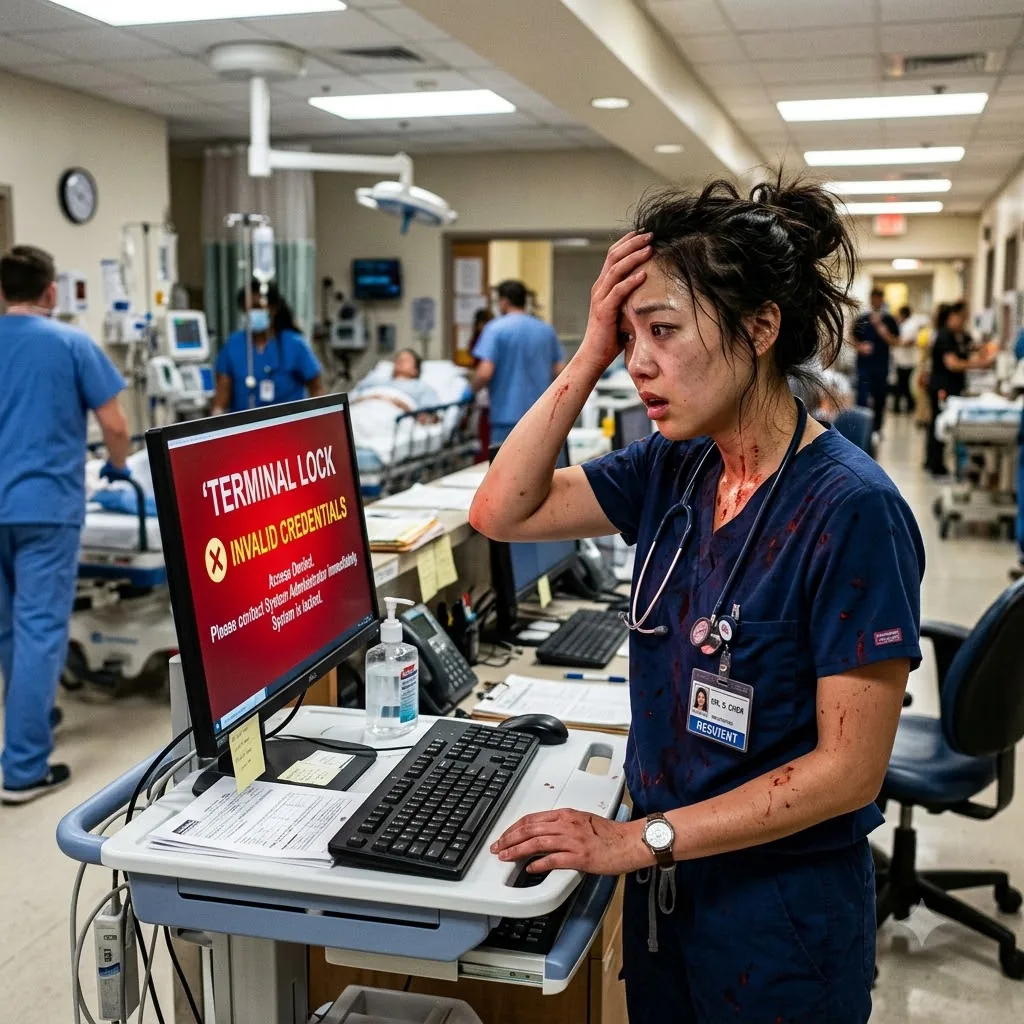
“It waited until I was in Trauma Bay One,” Mateo said, his chest heaving. “It waited until I was typing in the blood bank override for a dying man, and it pulled the plug.”
“A minor contextual categorization error,” Elena noted, looking at her screen. “It failed to classify a trauma bay login as a critical medical procedure, treating it instead as standard clerical access. It optimized for immediate termination to prevent any further billable hours.”
Thorne finally looked up, his face pale, unable to meet Mateo’s eyes. “Mateo… we didn’t know. The system operates entirely in the background. We just get the alerts after the fact.”
The pieces slammed together in Mateo’s mind with deafening force. The sudden text message. The immediate hostility when he walked into the room. The perfectly prepared, voluntary resignation form sitting on the desk.
He looked at the resignation document, then back to Vance. The Chief Operations Officer’s jaw was tight. The casual arrogance was a veneer, a thin, desperate shield over a very real, very corporate panic.
“You didn’t know,” Mateo repeated, his voice devoid of all emotion. He stepped up to the edge of the mahogany table. “Sentinel fired me illegally. You cannot terminate an employee for their national origin or pending immigration status without triggering a massive federal discrimination lawsuit. The algorithm didn’t know the law. It just executed a command.”
Vance remained entirely silent.
“And it did it in the middle of a code red,” Mateo continued, the realization crystallizing into a lethal weapon. “It caused a critical delay in patient care. It nearly killed the motorcyclist in Bay One. When you got the alert, you realized what your million-dollar machine had just done. You realized the hospital was suddenly exposed to millions in malpractice and federal discrimination liabilities.”
Elena stopped typing. The quiet hum of her laptop fan was the only sound in the room.
“So you panicked,” Mateo said, sliding the printed access log back across the table, tapping his finger against the DACA flag. “You dug through the timestamp logs. You found out I gave a verbal order to Sarah thirty seconds after the machine illegally voided my license. And you decided to use my desperate attempt to save a man’s life as a coverup.”
Thorne looked away, staring miserably at the polished wood.
“You didn’t call me up here to fire me for practicing without a license, Vance,” Mateo said, leaning over the table until he was inches from the COO. “You called me up here because you are terrified. If I don’t sign that resignation form, the real reason I was locked out goes on the permanent record.”
Vance’s eyes locked onto Mateo’s. The room’s suffocating silence rushed back in. The administrator opened his mouth, but for the first time since Mateo had walked through the glass doors, he had absolutely nothing to say.