Story code: ST-000858
Part 2: The Predictive Trap
The man holding the folder was Elias Vance, the hospital’s Chief Operations Officer. Vance did not step aside immediately. He looked down at Mateo’s scrubs, his eyes lingering on the drying rust-colored stains at the knees.
“Dr. Ruiz,” Vance said, his voice flat, devoid of the adrenaline that was still coursing through Mateo’s veins. “Step inside.”
Mateo crossed the threshold. The air conditioning in the executive suite was aggressive, biting into the damp cotton of his surgical top. The conference room was vast, dominated by a long mahogany table that reflected the recessed LED lighting above. At the far end sat Dr. Aris Thorne, the Chief Medical Officer, and a woman Mateo had never seen before. She wore a sharp charcoal blazer and had a sleek, silver laptop open in front of her.
Vance closed the heavy glass door. The ambient noise of the hospital-the distant pages, the rumble of carts-vanished entirely, replaced by a suffocating silence.
“Take a seat,” Vance instructed, moving to the head of the table and dropping the thick manila folder onto the polished wood.
Mateo remained standing. “I’d prefer to know why I was pulled from a trauma bay in the middle of a massive transfusion. My badge was deactivated. If Sarah hadn’t been standing next to me, that patient would have bled out on the table.”
Dr. Thorne finally looked up. He seemed tired, the deep lines around his mouth more pronounced than usual. “Mateo, please. Sit.”
Reluctantly, Mateo pulled out a leather chair and sat. He kept his hands resting on his thighs, acutely aware of the lingering smell of copper and iodine clinging to his skin.
“Your clinical outcome in Trauma Bay One is not in question,” the woman in the charcoal blazer said. She didn’t look up from her screen. “The patient was stabilized and is currently in OR 4. Survival probability is presently calculated at sixty-eight percent.”
“Calculated by who?” Mateo asked, narrowing his eyes. “Who are you?”
“Elena Rostova,” she replied, finally meeting his gaze. “Director of Predictive Analytics and Risk Management. And it wasn’t calculated by a ‘who’. It was calculated by the Sentinel system.”
Mateo looked at Thorne. “Sentinel? We don’t use a Sentinel system. We use the standard Epic EHR.”
“Sentinel is an overlay,” Vance interjected, tapping the manila folder. “A proprietary algorithmic risk-management protocol implemented by the board at midnight last night. It runs silently in the background of the electronic health record, analyzing data points in real time to prevent critical hospital liabilities.”
“It’s a digital safety net,” Thorne added, though his voice lacked conviction.
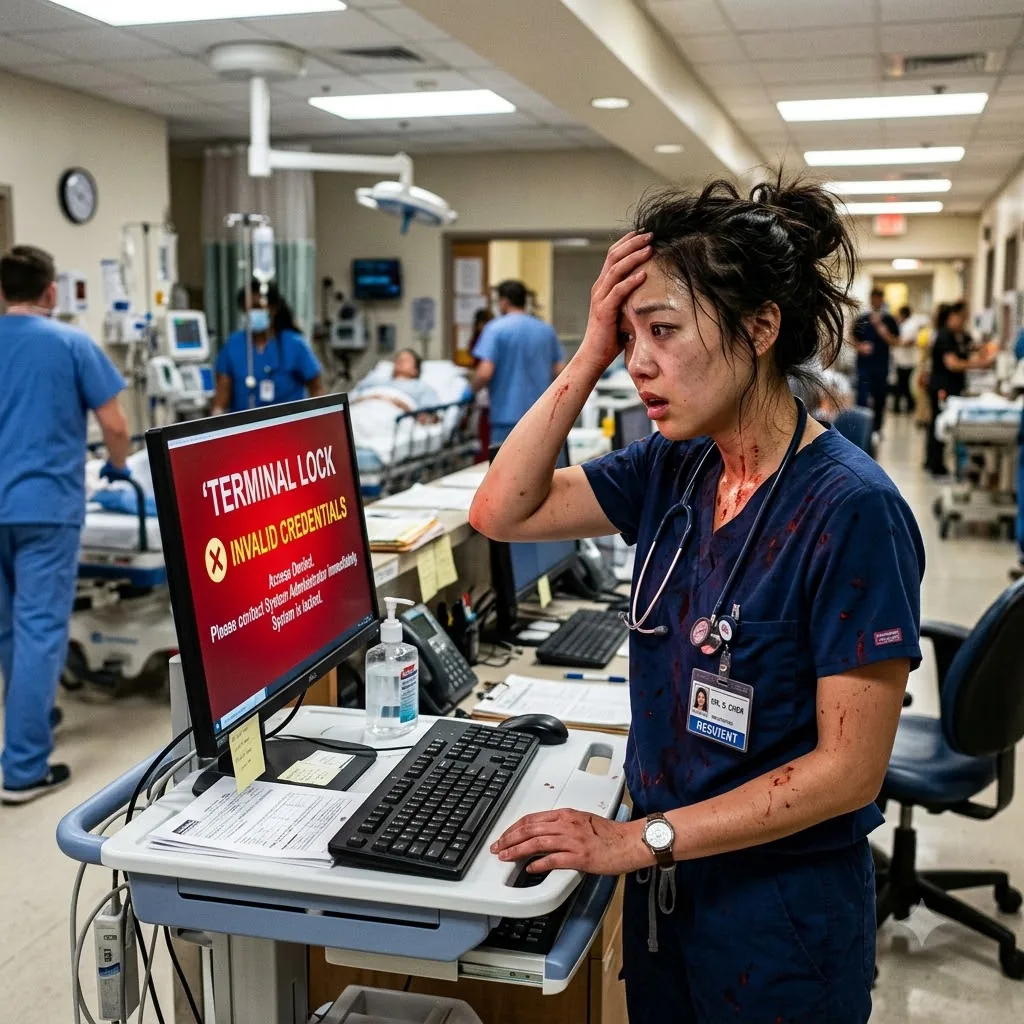
“A safety net?” Mateo leaned forward, his anger flaring. “It shut off my credentials in the middle of a code. It nearly killed a man.”
“It shut off your credentials,” Elena Rostova said smoothly, “because it determined with a ninety-nine point seven percent certainty that you were about to commit a catastrophic protocol violation.”
Mateo stared at her. The words took a moment to register. “About to? It disabled my badge based on something I hadn’t even done yet?”
Elena turned her laptop slightly so Mateo could see the screen. It was filled with cascading lines of data, complex graphs, and timestamps that meant nothing to him. “The algorithm analyzes your keystroke cadence, your historical override usage, your fatigue metrics based on hours logged, and the biometric stress indicators from your badge’s proximity sensors. Sentinel detected an erratic, high-risk pattern. It concluded you were entering a state of severe cognitive fatigue and were about to miscalculate the transfusion ratios. To protect the hospital from a multimillion-dollar malpractice liability, it preemptively revoked your access.”
“That is insane,” Mateo said, his voice deadly quiet. “I wasn’t fatigued. I was moving fast because the patient was crashing. I’ve run that exact massive transfusion protocol fifty times. I was perfectly in control.”
“The data says otherwise,” Vance said. “Sentinel’s predictive models are historically flawless in back-testing.”
“Then your algorithm is broken in the real world,” Mateo countered. He looked at Thorne, expecting his superior to back him up. “Dr. Thorne, you’ve watched me operate. You know my record. Tell them this is ridiculous.”
Thorne looked down at his folded hands. “Mateo… the system flagged you. Once Sentinel issues a Level One lockout, it triggers an automatic suspension of privileges. Administration has no choice but to enforce it.”
Mateo let out a harsh laugh. “Fine. Review the tape. Review the chart. You’ll see I did exactly what was required. Lift the suspension so I can get back to my shift.”
“It’s not that simple,” Vance said. He opened the manila folder and slid a single sheet of paper across the mahogany table. “Because Sentinel revoked your credentials at exactly 14:02 and twelve seconds, your medical license was technically suspended at that precise moment.”
Mateo felt a cold knot form in his stomach. He remembered the digital brick wall. The red screen.
“At 14:02 and forty seconds,” Vance continued, “you issued a verbal order to Nurse Sarah Jenkins to initiate the massive transfusion protocol. You directed the administration of uncrossmatched blood.”
“Because I was locked out!” Mateo yelled, finally slamming his hand onto the table. “I had to give a verbal order!”
“You gave a verbal order while under administrative suspension,” Elena corrected, her tone completely devoid of empathy. “You practiced medicine without active privileges. That is a strict liability violation of the state medical board’s charter. It is grounds for immediate termination and the permanent revocation of your medical license.”
The room seemed to shrink. Mateo looked at the three of them, realizing the sheer, inescapable weight of the trap. The algorithm had fired him for a mistake he hadn’t made, and in his desperation to save the patient’s life, he had given them the exact ammunition they needed to justify the firing after the fact.
“You set me up,” Mateo whispered. “The system locked me out knowing I would have to issue a verbal override to save the patient, thereby validating its own risk assessment.”
“The system does not possess malice, Dr. Ruiz,” Elena said. “It simply optimizes for liability reduction.”
Vance tapped the paper in front of Mateo. “This is a voluntary resignation form. If you sign it, we will classify your departure as a personal leave of absence. The hospital will not report the unauthorized verbal order to the state medical board. You keep your license, but you leave this hospital immediately.”
“And if I don’t sign?”
“Then we terminate you with cause at 8:00 AM tomorrow,” Vance said coldly. “And we forward the Sentinel logs to the board. Your career in medicine will be over.”
Mateo stared at the resignation form. Beneath it, the edge of another page was visible-a printed readout of his EHR access logs. As he looked closer, his eyes locked onto a single, strange anomaly in the printed code. It was a user ID string buried in the metadata, logging into his session a fraction of a second before the lockout. It wasn’t an automated Sentinel timestamp. It was a manual remote access string.
Someone hadn’t just trusted the algorithm. Someone had actively triggered it to target him.
“I’m not signing anything,” Mateo said, standing up. “I have until 8:00 AM.”