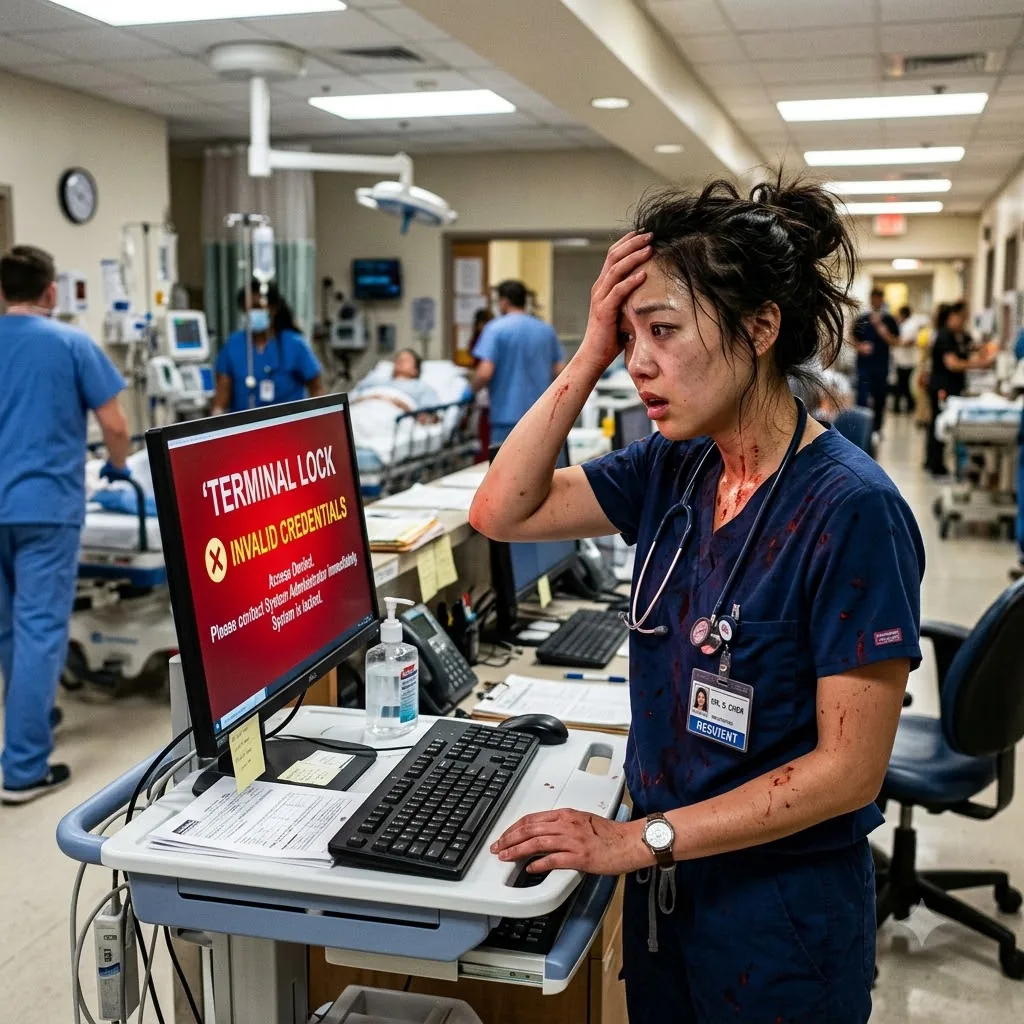
Story code: ST-000858
Part 4: The Cold Mathematics
Vance looked at Mateo, the silence stretching until it became a physical weight in the room. Then, slowly, the administrator reached out and adjusted his perfectly knotted tie. The panic Mateo had seen-or thought he had seen-receded, replaced by a cold, reptilian pragmatism.
“You are entirely correct, Dr. Ruiz,” Vance said, his voice dropping back to its flat corporate baseline. “If you refuse to sign, and you go to the press or file a federal lawsuit, it will be a monumental headache for this administration. Vanguard Health’s legal team will have to spend millions mitigating the public relations fallout. It will be ugly, and it will be drawn out.”
Vance leaned forward, resting his forearms on the mahogany. “But Vanguard has millions to spend. And they have years to litigate. Do you?”
Mateo didn’t move. “I don’t need millions. I have the access logs. I have the proof.”
“You have proof of a wrongful termination, yes,” Vance agreed, tapping the resignation form. “But the fact remains: you gave a medical order to a nurse after your credentials were voided. That is a strict liability violation. If you do not sign this resignation today, I will personally report that violation to the state medical board by noon. They will suspend your license pending a full investigation.”
“They’ll see why I did it,” Mateo said, though the absolute certainty in his voice began to fracture under the sudden pressure.
“Eventually, perhaps,” Vance said, his eyes entirely devoid of empathy. “In eighteen to twenty-four months. But let us examine that timeline, Mateo. Your DACA renewal is pending. If your medical license is suspended, your residency is terminated with cause. Without active employment or educational enrollment, your legal status in this country evaporates. You will be placed in removal proceedings before your lawsuit even reaches the discovery phase.”
The aggressive air conditioning of the executive suite bit through Mateo’s damp scrubs, chilling the sweat on his skin. He looked at Dr. Thorne. The Chief Medical Officer was staring fixedly at the grain of the wood table, offering nothing. He looked at Elena Rostova. She was already typing again, her silver laptop humming as she monitored the hospital’s operational metrics, entirely divorced from the human life she had just dismantled.
Mateo looked down at his own hands. The rust-colored stains of the motorcyclist’s blood were still flaking into the creases of his knuckles. He had given everything to this hospital. Hundred-hour weeks, missed holidays, sleepless nights sustained only by the desperate, burning desire to prove he belonged here. To prove he was undeniably necessary.
“Sign the voluntary resignation,” Vance said softly, recognizing the exact moment the fight died in the resident’s chest. “We code it as a personal leave of absence. No medical board report. You keep your license clean. You find a smaller, less prestigious program out of state that doesn’t use Vanguard’s proprietary algorithms. You survive.”
It wasn’t a choice. It was an execution disguised as a compromise. The machine had made an error, and the human administrators were utilizing the crushing weight of the federal immigration system to bury it.
Mateo picked up the heavy steel pen resting beside the manila folder. His hand, which had remained perfectly steady while packing gauze into a ruptured pelvis an hour ago, trembled as he pressed the ballpoint to the paper. He signed his name.
“Thank you, Dr. Ruiz,” Vance said, immediately pulling the paper away. “Your personal effects will be mailed to your address on file. Security has already disabled your physical access profile. You may escort yourself out.”
Mateo didn’t speak. He turned and walked out of the glass doors. He didn’t take the elevator down to the emergency department. He couldn’t face the chaotic energy, the nurses, or the trauma bays he was no longer allowed to touch. He took the staff stairwell, descending four flights in total silence, the rhythmic squeak of his rubber-soled shoes echoing off the concrete walls.
He pushed through the heavy fire doors and stepped out into the employee parking lot. The November air was freezing, a sharp, bitter wind sweeping across the expanse of gray asphalt. Mateo walked to his ten-year-old sedan, parked in the very last row, and stopped.
He didn’t unlock the door. He just sank down onto the concrete parking block in front of the bumper. The cold seeped instantly through his thin cotton scrubs. He reached up and unclipped the ID badge from his collar, staring at the plastic rectangle. The photo on it showed a younger, infinitely more hopeful version of himself, smiling against a blue backdrop. Now, it was just a dead piece of plastic, incapable of opening a single door.
Overhead, the rhythmic chopping of a medevac helicopter grew louder as it descended toward the hospital roof, bringing another shattered life to Trauma Bay One. The hospital would keep running. The Sentinel algorithm would continue scanning thousands of data points, silently pruning liabilities and optimizing profit margins with flawless, inhuman efficiency.
Mateo sat alone in the freezing wind, clutching his dead badge. He had done everything right. He had been faster, smarter, and more dedicated than anyone else in his cohort. He had saved a dying man. And as he sat shivering in the shadow of the towering hospital, he was left to confront the absolute, grim reality: human excellence, no matter how profound, was utterly defenseless against the cold mathematics of the machine.